
Look, I have a complicated relationship with Foxe's Book of Martyrs. I've assigned excerpts to my AP English students for years—it's foundational Protestant literature, historically significant, the kind of text that shaped English religious identity for centuries. But actually listening to the whole thing? That's a different beast entirely.
Here's my complaint: this is a book that demands emotional engagement, and the LibriVox production... doesn't quite deliver that. Which feels almost sacrilegious to say about accounts of people literally dying for their faith. But I'll get to the narration in a minute.
The Weight of What Foxe Built
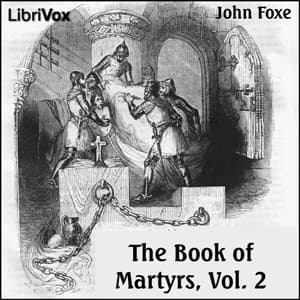
First, let's talk about what you're actually getting here. This is Volume 2 of an abridged version—and thank goodness for the abridging, because Foxe's original work was apparently twice as long as Gibbon's Decline and Fall. (My students complain about reading 20 pages of anything. Imagine dropping 2,300 folio pages on them.) What remains is still substantial: nine and a half hours of martyrdom accounts spanning from early Christians through the Marian persecutions.
And this is where I have to be honest with you. The content is brutal. I was grading sophomore essays on my kitchen counter, half-listening, when a particularly graphic burning-at-the-stake description made me put down my red pen. This isn't sanitized history. Foxe wanted readers to feel the horror, to understand what these Protestants endured. Mission accomplished, John. Mission very much accomplished.
But here's what I find genuinely fascinating as someone who teaches rhetoric: this book is propaganda. Effective, influential, historically important propaganda—but propaganda nonetheless. The Wikipedia summary included with the audiobook basically admits this, noting "willful falsification of evidence" in places. Foxe wasn't writing objective history. He was building a case for the Church of England's legitimacy. That same tension between religious conviction and institutional agenda shows up in God Is Not Great, though Hitchens approaches it from the opposite direction—arguing against faith rather than for it. Understanding that doesn't diminish the suffering of actual martyrs, but it does mean you should listen with critical ears.
The Voice(s) in My Head
LibriVox volunteers. God bless them, truly. They're doing the Lord's work—literally, in this case—making classic texts accessible for free. But volunteer narration is exactly what it sounds like: well-intentioned people with varying levels of skill reading into home microphones.
Some sections are quite good. Clear, measured, appropriate for historical content. Others are... monotone. And when you're describing someone's final moments before execution, monotone is a problem. The drama is already there in the text. Foxe wrote with passion. But flat delivery flattens everything.
I found myself wishing for what I tell my students about Shakespeare: the words need breath, need rhythm, need someone who understands that pause is punctuation. The best moments in this recording come when a volunteer actually leans into the material. The worst moments feel like someone reading a grocery list that happens to include immolation.
Production quality varies too—inevitable with multiple home recordings stitched together. Nothing that makes it unlistenable, but you'll notice the shifts.
Who This Is (and Isn't) For
Here's where I'm going to be direct. If you're studying Christian history, Protestant theology, or the English Reformation, this is essential primary source material. Period. The fact that you can get it free through LibriVox is remarkable. If you're looking for faith-affirming content about perseverance and conviction, it's here—though be prepared for the violence. These accounts don't shy away from suffering.
But if you want polished audiobook production? If you need a narrator who'll make nine hours fly by? Skip this one. I'd compare it to reading a photocopy of a historical document versus a modern edition with annotations and context. The content is the same; the experience is different.
My students would absolutely hate this. (I can hear them now: "Mr. Williams, why is this so long? Why is it so sad? Why does everyone die?") But that's partly why it matters. We've gotten too comfortable with history that doesn't hurt.
Mr. Williams's Final Grade
I listened at 1.0x because—and I'll die on this hill—Foxe chose those words. The rhythm of 16th-century prose deserves its natural pace. But I'll admit: I took breaks. This isn't a book you binge. It's a book you sit with, probably in small doses, probably with something to do with your hands.
For my tiny podcast audience of 47 (hi, Mom), I'd call this essential listening for the historically curious and the theologically engaged. For everyone else? Maybe start with excerpts. See if you can handle both the content and the delivery before committing to the full nine hours.
The martyrs' stories deserve to be heard. I just wish they had narrators who could fully honor what these people endured.