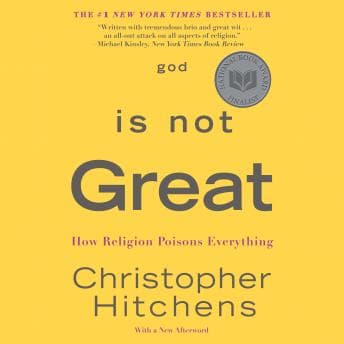

Look, I have a complicated relationship with Hitchens. As someone who studies why people believe what they believe - the psychology of conviction, the narratives we construct to make sense of existence - I find his work both fascinating and occasionally frustrating. But hearing him read his own polemic? That's a different experience entirely. It's like getting a lecture from that brilliant professor who terrifies half the class and inspires the other half.
Here's the thing about author-narrated books: they're either transcendent or terrible. There's no middle ground. And Hitchens lands somewhere interesting - not quite transcendent, but undeniably compelling in ways that matter.
The Voice Behind the Manifesto
Hitchens sounds exactly like you'd expect him to sound. That pleasantly modulated British accent, the conversational cadence of a man who's made these arguments a thousand times at dinner parties and debates. He knows where the humor lands. He knows when to pause for effect. This isn't a performance - it's a conversation he's having with you, and he assumes you're smart enough to keep up.
But - and this is important - sometimes he sounds tired. Rushed. Like he's reading at 10 PM after a long day of being Christopher Hitchens, which, let's be honest, probably was exhausting. There are moments where his voice drops and you're straining to catch the words. My therapist would have thoughts about this character - a man so certain of his intellectual superiority that he doesn't always ensure his audience can follow along.
I found myself rewinding more than I'd like. Not because the arguments were dense (they are, but manageable), but because his mumbling occasionally swallowed key phrases. It's frustrating when you're trying to follow a complex theological critique and suddenly you've missed the punchline.
The Psychology of Certainty
What makes this book compelling from my perspective isn't just the arguments against religion - it's watching a mind absolutely convinced of its position work through the evidence. Hitchens exhibits classic traits of what we'd call in my field "epistemic confidence" - the unwavering belief that one's framework for understanding reality is correct.
He documents religious texts with the precision of a prosecutor building a case. He traces the man-made origins of faith, the sexual repression baked into religious doctrine, the distortions of cosmological understanding. And he does it with wit. The research actually shows that people are more persuaded by arguments delivered with humor - and Hitchens understood this instinctively.
That same understanding of mortality and meaning runs through Being Mortal: Medicine and What Matters in the End, though from a completely different angle - one that finds purpose without needing to tear down what others believe.
But here's what I found myself asking: why does he really care so much? The passion here isn't academic detachment. It's personal. There's something almost evangelical about his atheism, which is psychologically fascinating. He's not just making an argument; he's on a mission. Hitchens understands human nature well enough to know that conviction sells - even when you're selling the absence of faith.
Where the Narration Shifts
The audiobook runs just under nine hours, and honestly? It's a lot. Not because the content is boring - Hitchens is too skilled a writer for that - but because the narration doesn't vary enough to sustain attention through dense theological analysis.
I listened during my morning jogs through Cambridge, and I noticed something: my engagement fluctuated wildly depending on the chapter. When he's telling stories - the anecdotes about religious hypocrisy, the historical examples of faith-based atrocities - he's magnetic. When he's doing close textual analysis of scripture? The monotone creeps in.
This is a case study in why some books work better in print. The intellectual rigor is there. The arguments are substantial. But the delivery doesn't always match the material's energy.
Would I Listen Again?
Probably not. And I don't mean that as harshly as it sounds.
Listen if you're a fan of intellectual non-fiction, already sympathetic to secular arguments, or a commuter who wants something that demands real thought. Hitchens' voice adds authenticity that no other narrator could replicate. You're getting the real thing, mumbles and all. Skip if you're easily frustrated by unclear narration, or if you need dynamic vocal energy to stay locked in with challenging material - grab the print version instead. The ideas deserve your full attention, and sometimes the audio delivery doesn't quite serve them.
Psychologically, this doesn't track as a perfect audiobook experience. But as a document of one of the 21st century's most provocative minds? It's worth the occasional rewind.