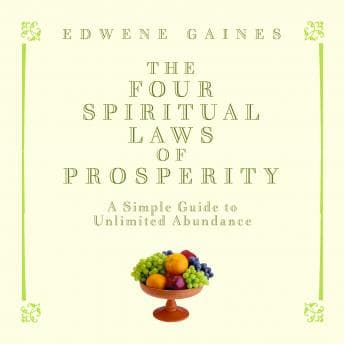

"Give away 10 percent of everything that comes to you, and watch what happens."
That's the core promise around the 45-minute mark, delivered in Edwene Gaines's warm Southern drawl like she's sharing sweet tea wisdom on a porch. And look, I'll be honest—I started this audiobook as a skeptic. I'm a systems engineer. I debug distributed systems for a living. The idea that "tithing" is going to fix my financial architecture felt about as logical as expecting prayer to fix a memory leak.
But here's the thing. I finished it. All 6 hours. And I'm still thinking about it three commutes later.
The ROI Question (Because I Had to Ask It)
So let me break down what you're actually getting here. Gaines lays out four laws: tithing, goal-setting, forgiveness, and finding your divine purpose. If you strip away the spiritual wrapper, it's basically a personal development framework with a faith-based runtime environment. The goal-setting section? Surprisingly tactical. She talks about writing goals in present tense, being specific about amounts and timelines, reviewing them daily. That's not woo-woo—that's literally what every productivity podcast tells you to do. Year of Yes has that same practical-advice-wrapped-in-personal-story vibe, though Shonda Rhimes skips the spiritual framework entirely.
The forgiveness piece hit different than I expected. Gaines argues that holding onto resentment is essentially a resource leak—you're burning cycles on anger that could be allocated elsewhere. She doesn't phrase it that way (obviously), but that's the mental model I built while listening. And honestly? There's something to it. I've definitely seen how grudges drain energy that could go toward, you know, actual work.
The divine purpose section is where it gets more abstract. If you're not spiritually inclined, this might feel like you're trying to parse documentation written in a language you don't speak. But even then, the underlying question—"What would you do if money weren't an issue?"—is worth sitting with.
Why Gaines Reading Her Own Story Works
Gaines narrating her own book is the right call. Full stop. There's this moment early on where she describes being so broke she couldn't afford groceries for her daughter, and her voice cracks just slightly. Not performatively—just authentically. You can't hire that. A professional narrator would've smoothed it over, made it polished. Gaines leaves the rough edges, and they're what make it land.
Her Southern accent is easy on the ears at 6 AM on a packed Caltrain (trust me, I tested this). She's got this grandmotherly energy mixed with the confidence of someone who's actually done the thing she's teaching. When she talks about going from poverty to running a retreat center, you believe her because she sounds like someone who's lived it, not someone reading about it.
The humor helps too. She's genuinely funny in spots—not stand-up comedian funny, but "wise aunt who knows she's being a little ridiculous" funny. It keeps what could be a preachy book from feeling like a lecture.
The Skeptic's Dilemma
Okay, cards on the table. The "I tithed and my income tripled in six months" story is... a lot. The engineer in me wants to see the control group. Correlation isn't causation, and survivorship bias is real. For every person who tithed and got rich, how many tithed and stayed broke? Gaines doesn't address this, and if you're the type who needs data (hi, that's me), it'll bug you.
But here's what I kept coming back to: even if the metaphysics don't hold up, the behavioral framework might. Tithing forces you to believe you have enough to give. Goal-setting forces clarity. Forgiveness frees up mental bandwidth. Finding purpose gives you direction. These aren't magic—they're just good cognitive hygiene wrapped in spiritual language.
Kevin (my boyfriend, also an engineer) would probably roll his eyes at this entire review. But he's also the one who got me into meditation apps, so he doesn't get to judge.
Who Should Queue This Up (And Who Should Skip)
Perfect for: commutes, morning walks, any time you need something that's more warm hug than intellectual workout. If you're going through a rough patch financially or just feeling stuck, this might be the permission slip you didn't know you needed.
Skip if: you need secular, evidence-based approaches or you're allergic to religious frameworks. This is Unity Christianity through and through—gentle and inclusive, but still faith-based. If that's not your stack, you'll be fighting the content the whole time.
I listened at 1.25x and it felt natural. Gaines speaks at a comfortable pace, but she's not slow.
Worth a Re-Listen?
Probably not cover to cover. But I bookmarked the goal-setting section and the forgiveness exercises. Those are the modules I'll revisit when I need a reset. The rest is scaffolding—useful for the first pass, optional after that. The mind-body connection stuff in Mindbody Prescription works the same way for me—I don't buy all the theory, but the exercises actually help.
Is this going to make you rich? Probably not through divine intervention. But it might make you think differently about what you're holding onto and what you're working toward. And honestly, for a 6-hour commute investment? That's not a bad ROI.