
"Invest with integrity."
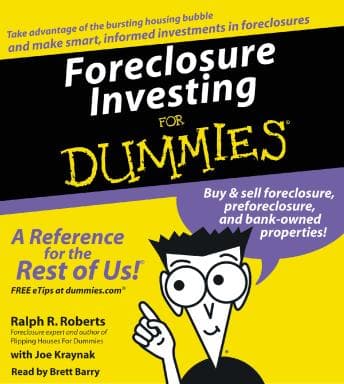
That phrase, tucked near the end of this under-three-hour audiobook, is the one that actually made me pause mid-stir. I was making chana masala — the kind that requires you to babysit the pressure cooker because you refuse to buy an Instant Pot like a normal person — and I found myself asking: why does a Dummies guide about foreclosure investing feel the need to include an ethical disclaimer?
Because the psychology of foreclosure investing is genuinely uncomfortable, that's why. And this book knows it.
The 80/20 Problem (Or: Why Caution Is the Actual Product)
Here's what tripped me up, and apparently trips up a lot of listeners: this audiobook reportedly spends about 80% of its runtime telling you why NOT to invest in foreclosures, and only 20% on the how-to mechanics. I can see why that frustrates people who came here wanting a step-by-step playbook. But as someone who studies why people make terrible decisions — professionally, not just as a hobby — I think the ratio might be the point.
The research actually shows that most people fail at high-risk investing not because they lack technical knowledge, but because they underestimate risk. They exhibit classic optimism bias. Eckhart Tolle gets at something adjacent in Power of Now — the idea that most of our bad decisions happen when we're living in a fantasy of future outcomes rather than the present reality in front of us. Roberts and Kraynak seem to understand this about their audience. The book walks you through property titles, mortgages, deeds, building an investment team, obtaining financing — it covers all of that. But it front-loads the caution. It's less "here's how to get rich" and more "here's how to not lose everything while attempting to get moderately less poor."
Psychologically, this actually tracks. If you're the kind of person who needs someone to pump you up before you invest, this isn't your book. If you're the kind of person who appreciates that someone told you to check for liens before you bid at auction — and explained what happens in YOUR specific state, since foreclosure rules vary wildly across all 50 — then this primer earns its keep.
Brett Barry Reads Like Your Competent Accountant (That's a Compliment)
One listener nailed it: Brett Barry "doesn't attempt to make the program more than it is." And honestly? For a book like this, that's exactly right. His voice is clean, pleasant, unshowy. He's not performing — he's presenting. There's no manufactured excitement when he's walking you through the difference between judicial and non-judicial foreclosure states. No dramatic pauses before the section on bank-owned properties.
This is a single-narrator, abridged audiobook clocking in at just under three hours. Barry treats it like what it is: a spoken reference guide. No sound effects, no music, no gimmicks. The plain language gets a plain delivery, and it works. My only note — and this is minor — is that at this length, with this density of practical information, you're essentially listening to a very organized lecture. Which is fine if you're prepping dinner or doing something with your hands. Less fine if you're trying to absorb specific state-by-state legal distinctions while jogging through Cambridge at 6 AM. (I tried. I retained maybe 40% of the financing section. My fault, not Barry's.)
The Abridgment Question Nobody's Asking
This is abridged. Under three hours. For a Dummies book that claims to cover foreclosure rules for all 50 states, build-your-team strategies, financing options, networking, property inspection, AND ethical investing — that's a LOT of ground for a very short runtime. I found myself wondering what got cut. The state-by-state specifics? The case examples? The deeper how-to mechanics that frustrated listeners say are missing?
I can't confirm what's absent since I haven't compared it to the full print edition, but the brevity explains some of the complaints. This isn't a comprehensive course. It's a primer. A "should I even be doing this?" gut check dressed up as practical guidance. And if you adjust your expectations accordingly, it's actually pretty useful for that.
Who This Is Actually For (And Who Should Keep Scrolling)
If you're a complete beginner who's been watching YouTube videos about foreclosure flipping and thinking "I should try that" — listen to this first. Seriously. It's the cold shower before you jump in the pool. The authors understand human nature well enough to know that most aspiring investors need to hear the risks before the rewards.
If you're already experienced in real estate investing and want advanced foreclosure strategies, skip it. You'll be bored by hour one.
And if you want a book that makes foreclosure investing sound exciting and easy? My therapist would have thoughts about that impulse, but also — this isn't that book.
My Clinical Assessment
This is a fascinating case study in how a practical guide can accidentally become a psychological intervention. The authors clearly wanted to help people invest wisely, but the subtext is really about impulse control, risk assessment, and — buried in there — treating distressed homeowners like human beings. At under three hours and in abridged form, it's a surface-level overview that's better at convincing you to be careful than teaching you to be skilled. But sometimes careful is the skill you actually need first.