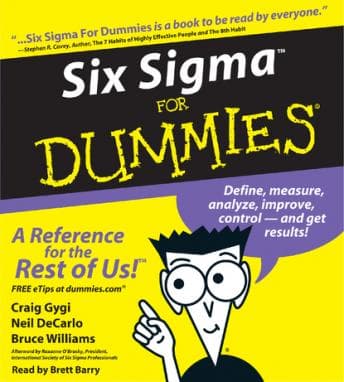

How many business books does it take before you realize most of them could've been a single well-structured README? Awaken the Giant Within was somewhere around audiobook thirty for me, and it did not help answer that question. Because I've been asking myself that question for about forty audiobooks now, and Six Sigma For Dummies lands right in the middle of that existential crisis.
I knocked this one out during a particularly brutal Monday commute plus a Tuesday morning where the Caltrain was delayed twenty minutes outside Millbrae. Under four hours total, which at 1.75x (my standard speed for business books that smell like they could've been blog posts) means I was done before Wednesday.
The DMAIC of This Audiobook: Define What You're Getting Into
Look, here's the thing about Six Sigma. Half the engineers I work with throw the term around in sprint retros like it's a magic spell, and maybe 10% of them could actually explain what a sigma level means statistically. This book exists for that other 90%.
The structure is pretty much what you'd expect from a For Dummies title - it walks you through Six Sigma's core methodology (DMAIC: Define, Measure, Analyze, Improve, Control) in plain English, explains the belt system hierarchy without making it sound like a karate dojo cosplay, and gives you just enough statistical context to be dangerous at your next all-hands. The authors - Bruce Williams from Pegasystems and Neil DeCarlo - clearly know their stuff, and they do a decent job of not drowning beginners in jargon. One thing I actually appreciated: terms get defined before they're used, which sounds basic but is shockingly rare in business audiobooks. You won't be Googling "what's a CTQ" while trying not to drop your coffee on a stranger's laptop.
But here's my honest take: at 3 hours and 50 minutes, this is essentially a primer. It gives you vocabulary and frameworks. It does NOT give you the muscle memory to actually implement Six Sigma. It's like reading the Kubernetes docs overview page - you'll understand the architecture, but you're not deploying anything to production tomorrow.
Brett Barry Does What He Needs To Do (And Nothing More)
Brett Barry's narration is... competent. Clear diction, comfortable pacing, no weird pronunciation fumbles on technical terms. He reads this like a well-prepared conference presenter who's done his homework but isn't going to blow your mind with charisma. For a business reference book, that's honestly fine. You don't need Ray Porter energy here - you need someone who won't put you to sleep while explaining process variation metrics at 6:47 AM.
That said, there's zero dynamic range. Every section sounds pretty much the same. When the book transitions from explaining the history of Six Sigma at Motorola to walking through statistical process control tools, the energy stays flat. For a sub-4-hour listen, it's not a dealbreaker. But it does mean your attention has to do all the heavy lifting.
Could've Been a Blog Post? Almost. But Not Quite.
I go back and forth on this one. My instinct says yes - the core concepts here could fit in a solid 3,000-word Medium article. But the audiobook format does something a blog post can't: it forces linear progression. You can't skim ahead to the "cool tools" section and skip the statistical foundations that make those tools make sense. For someone genuinely new to Six Sigma, that forced pacing is actually valuable.
The ROI on this audiobook is highest if you're: (a) about to join a company that runs Six Sigma processes and you need to not sound clueless in your first week, or (b) you're a small business owner curious whether this methodology is worth implementing. If you're already Green Belt certified or above, this will feel like reading the first three chapters of a textbook you already passed the exam on.
What it's NOT: a deep dive into the math. If you want actual statistical rigor - control charts, capability indices, hypothesis testing frameworks - you need a real textbook, not a Dummies guide. This is the "I want to understand what my quality team is talking about" version.
Who Gets Value, Who Doesn't
Perfect for: Absolute beginners, managers who need Six Sigma literacy fast, anyone prepping for a job at a company that drinks the Six Sigma Kool-Aid. Train-friendly - you can zone out for a few minutes and still track the thread.
Skip if: You have any real Six Sigma experience, you want implementation-level detail, or you're the type (like me, honestly) who'd rather just read the Wikipedia article and a few case studies.
The Commit Message
Solid primer, nothing more. It does exactly what it promises - makes Six Sigma accessible to people who've never touched it - and doesn't waste much of your time doing it. But it's a 101 lecture, not a workshop. At under four hours, the time investment is low enough that I don't regret it, but I also wouldn't spend a full Audible credit on this when it's probably available through your library's Libby app. Borrow it, absorb the framework, move on to something with more depth when you're ready.