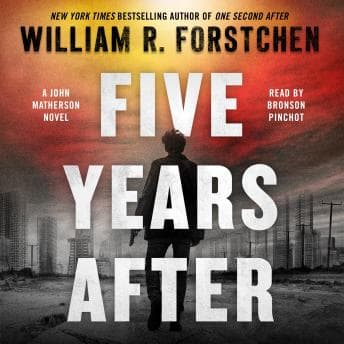

So Kevin and I were doing one of our rare Sunday meal prep sessions - the kind where we pretend we're going to eat healthy all week and then order DoorDash by Tuesday - and I needed something to fill the silence between us arguing about whether quinoa actually tastes like anything. I'd been putting off this one because honestly, I bounced off The Final Day pretty hard, but One Second After was genuinely formative for me. That first book is basically a systems failure postmortem written as fiction, and as someone who spends her career thinking about cascading failures in distributed systems, it hit different. So I gave Forstchen one more shot.
TL;DR: Worth your commute if you're already invested in the series. Otherwise, probably not the on-ramp.
The First Six Hours Are a Status Meeting That Could've Been an Email
Look, I get it. Five years post-EMP, you need to re-establish the geopolitical landscape. John Matherson has been trying to live quietly, the Republic of New America is fracturing into regional powers, the president might've been poisoned - there's a lot of table-setting. But the pacing for roughly the first two-thirds of this book is... rough. It feels like when you're in a sprint planning meeting and someone keeps relitigating decisions from three sprints ago instead of moving forward.
Forstchen clearly wants to explore what governance looks like when you're duct-taping a country back together, and conceptually that's interesting. But in practice, it's a lot of John having conversations about supply chains and political alliances that don't quite land with the urgency the plot needs. The new military threat hiding in the wreckage of the old world? Cool concept. The execution is more "committee discussion" than "thriller." I found myself zoning out during my Monday 6AM Caltrain ride, which is my litmus test - if I can't track the plot while half-conscious surrounded by other caffeine-deprived engineers, the pacing has a problem.
Then the last three hours hit, and suddenly the book remembers it's supposed to be a thriller. The threat of another EMP attack on both the US and China creates actual stakes, and John finally has to make decisions under pressure instead of just talking about making decisions. It's the kind of back-loaded payoff that makes you wonder why the first six hours couldn't have been tighter.
Bronson Pinchot and the "Johnnnnnn" Problem
Okay, so Bronson Pinchot is an objectively talented narrator. The man has Audies, Earphones Awards, Narrator of the Year - his résumé is stacked. And there are stretches here where he's genuinely good, where he finds the weariness in John that five years of post-apocalyptic nation-building would absolutely produce.
But. BUT.
The way he says "John" will live rent-free in your head. It's this drawn-out, almost Jack Nicholson-esque "Johnnnnnn" that happens constantly because - surprise - people say the protagonist's name a lot. Every time another character addressed him, I'd wince a little. It's like a tiny paper cut that wouldn't be a big deal once, but after nine hours, you've got dozens of them.
The bigger issue is the antagonist. The dialogue for the main villain already reads a bit cartoonish on the page (or at least, that's my strong suspicion), and Pinchot's delivery leans into it rather than grounding it. The result is a bad guy who feels more like a B-movie heavy than a credible threat. I genuinely can't tell if this is a writing problem or a narration problem or some unfortunate synergy of both. It's like debugging a race condition - you know something's wrong but isolating the root cause is tricky.
Who Gets Value from This Deploy
Perfect for: train, housework. Skip for: deep work, or if you haven't read the first three books.
If you've been with John Matherson since One Second After and you want to see where the world goes, this scratches the itch. It's a weaker entry than the original - honestly, most post-apocalyptic series peak at book one when the collapse is fresh and terrifying - but it's better than The Final Day. Though I'll say, even a weaker entry in a series with genuine stakes beats starting something like Wicked Will Rise, which I found had the opposite problem - action without weight. The ROI on this audiobook is middling: nine hours isn't a huge commitment, and the final act delivers enough to keep me from feeling like I wasted my time.
If you're new to the series, start with One Second After. That book is basically a distributed systems failure analysis wrapped in survival fiction, and it's genuinely excellent. This one assumes you care about John, about Black Mountain, about the fragile political structures they've built. Without that context, the slow burn of the first two-thirds will just feel like... slow.
At 1.5x this took me about four commutes. I'd actually recommend bumping to 1.5x minimum - the pacing needs the help, and Pinchot's delivery is clear enough to handle the speed increase without losing anything.
Not a Rollback, But Definitely a Patch, Not a Feature Release
Forstchen still understands infrastructure collapse better than almost any thriller writer working today. The man did his homework on EMP effects and he respects the logistics of rebuilding. But Five Years After feels like a book that needed one more editing pass to tighten the middle and give the villain actual dimension. The bones are there. The execution is uneven. I don't regret the listen, but I wouldn't burn a credit on it when Libby exists.