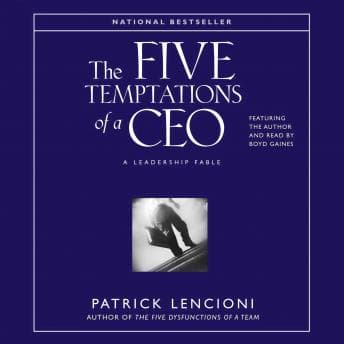

Leadership books have a problem. They either drown you in abstract theory or patronize you with oversimplified platitudes. Patrick Lencioni does something different here—he writes what amounts to a psychological case study disguised as a subway encounter.
I finished this during a late-night cooking session. Paneer tikka masala, if you're curious. The kind of elaborate dish I make when I need to think. And this book gave me plenty to chew on—metaphorically and literally.
The Protagonist as Patient
Andrew O'Brien is a fascinating case study in executive dysfunction. Not the ADHD kind. The "I'm failing and I don't know why" kind. He's young, he's ambitious, and he's about to lose his job as CEO. The research actually shows that new executives fail at alarming rates—something like 40% within their first 18 months. The performance anxiety underneath that failure rate reminds me of the pressure athletes face in Faster, Higher, Stronger—different arena, same psychological weight of measurable outcomes. Andrew is living that statistic.
What makes this character compelling is his defensiveness. When he encounters this mysterious old man on what appears to be a deserted subway (the metaphor isn't subtle, but stay with me), Andrew doesn't want wisdom. He wants validation. He wants someone to tell him the board is wrong, that his strategy is sound, that he just needs more time.
The old man—who may or may not be a ghost, a dream, or Lencioni's narrative device for delivering tough love—doesn't give him that. Instead, he systematically dismantles Andrew's excuses. It's basically a therapy session with a confrontational stranger. My therapist would have thoughts about this character.
Five Defense Mechanisms in Executive Clothing
The framework itself is deceptively simple. Choosing status over results. Choosing popularity over accountability. Choosing certainty over clarity. Choosing harmony over productive conflict. Choosing invulnerability over trust.
I found myself asking: why does Andrew really resist each of these? Lencioni—to his credit—shows the psychological roots. Status feels safer than results because results can be measured and found wanting. Popularity protects against the loneliness of leadership. Certainty delays the moment when you might be proven wrong.
Psychologically, this tracks. These aren't just "temptations"—they're defense mechanisms. Every CEO who chooses harmony over productive conflict is avoiding the anxiety of confrontation. Every leader who hoards information to appear invulnerable is managing their own fear of inadequacy.
Andrew exhibits classic avoidant patterns. He'd rather not know he's failing than face the data. He'd rather be liked than respected. The combative exchange with the old man forces him to see these patterns for what they are.
The Consultant Behind the Curtain
Lencioni narrates this himself, which creates an interesting dynamic. He's not a professional voice actor—he's a management consultant reading his own fable. The delivery is clear, competent, unpretentious. No dramatic flourishes. No attempts to "do voices" for Andrew versus the old man.
This actually works for the material. The straightforward reading matches the straightforward message. The summary at the end—where Lencioni drops the fable format and just explains the five temptations directly—is genuinely helpful. It's like getting the therapy session AND the clinical notes.
At 90 minutes, this is basically a long podcast episode. I appreciated that. Business books are often padded to justify their price point. This one says what it needs to say and stops.
Your Prescription (Or Not)
If you're a new leader feeling overwhelmed—this is for you. If you're managing people for the first time and wondering why it's harder than you expected—this is for you. If you've been leading for decades and think you've figured it out—maybe especially for you. The temptations don't go away with experience. They just get better camouflaged.
Skip this if you want tactical advice. There's no "five steps to running better meetings" here. It's about the internal work of leadership, not the external mechanics. Also skip if you need your business books to feel Important and Serious. The fable format might feel too simple. The subway setting might feel gimmicky. But sometimes the simple frame holds the complex truth.
Session Notes
I keep thinking about Andrew's defensiveness. How quickly he pivots to justification when challenged. How familiar that pattern feels—not just in leaders, but in all of us when we're confronted with our own avoidance.
Lencioni understands human nature. The five temptations aren't leadership problems. They're human problems that become catastrophic at the leadership level. Top 1% explores similar patterns—how individual habits scale into exceptional performance, though it focuses more on the mechanics than the psychology. The CEO who chooses popularity over accountability is the same person who avoided hard conversations their whole life. They just have more people depending on them now.
Ninety minutes. Five temptations. Zero places to hide from your own patterns. That's a decent return on investment.