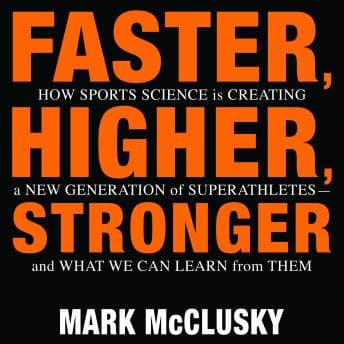

What separates an Olympic gold medalist from the person who finishes fourth? Is it genetics? Training? Some mysterious combination of both that we can't quite quantify?
I found myself turning this question over during my morning jogs through Cambridge while listening to Mark McClusky's Faster, Higher, Stronger. And honestly, as someone who spends her days analyzing why humans do what they do, I was fascinated by how McClusky approaches the psychology of elite performance. This isn't just sports science—it's a case study in human optimization.
The Science Behind the Superhuman
McClusky, who comes from a background at Sports Illustrated and Wired, does something clever here. He takes what could be dry, technical material—VO2 max, lactate thresholds, genetic markers—and wraps it in stories that actually make you care. The research shows that narrative is how humans process information best, and he clearly understands this.
What struck me most was his treatment of the 10,000 hours rule. If you've been in any self-improvement space, you've heard this thrown around like gospel. McClusky doesn't just debunk it; he adds nuance. The truth is messier than Malcolm Gladwell made it sound. Breaking the Habit of Being Yourself wrestles with similar questions about whether we can actually rewire our patterns through deliberate practice. (My therapist would have thoughts about our collective need for simple formulas to explain complex achievement.)
The sections on talent identification were particularly interesting from a psychological perspective. How do you spot potential greatness in a twelve-year-old? What markers do scouts look for that the rest of us miss? McClusky interviews coaches and scientists working at the cutting edge of this, and some of their methods are genuinely surprising.
Where McClusky Narrates McClusky
Here's the thing about author-narrated audiobooks: they're a gamble. Sometimes you get someone who knows their material but can't perform it. Sometimes you get the opposite. McClusky lands somewhere good—not exceptional, but good.
His delivery is clear and professional. He sounds like what he is: a journalist who's spent years explaining complex topics to general audiences. The science never feels overwhelming, and he knows when to slow down for the technical bits. But I'll be honest—there's not a lot of vocal range here. It's informative rather than dynamic. Perfect for a commute when you want to learn something. Less ideal if you need dramatic energy to stay engaged.
I listened at 1.25x and found that actually helped the pacing. His natural rhythm is measured, almost deliberate, and speeding it up slightly gave it more momentum without losing clarity.
The Gap Between Promise and Delivery
Okay, so here's where I have to be honest. The subtitle promises we'll learn "what we can learn from them"—the superathletes and their scientific support teams. And while McClusky delivers on the first part beautifully, the application to regular humans like us feels... thin.
This is more biographical and anecdotal than it is a practical guide. If you're looking for a book that will tell you exactly how to optimize your own training, you might feel a bit shortchanged. The protagonist here—if we're thinking in narrative terms—is really the science itself, not the reader's transformation. Falling Upward takes the opposite approach—it's less interested in the mechanics and more focused on what transformation actually feels like from the inside.
That said, I don't think this is necessarily a flaw. It depends on what you're looking for. As a piece of well-researched journalism about the intersection of sports and science, it's excellent. As a how-to manual, it's not trying to be that. Just know which one you're getting.
Who Should Listen (And Who Should Skip)
The ideal listener here is someone who finds the why behind elite performance genuinely fascinating. Someone who wants to understand the machinery, not just the results. If you're the type who watches the Olympics and wonders about the training protocols and genetic advantages and psychological conditioning that got those athletes there—this is your book.
Skip it if you're looking for motivation or a step-by-step program. McClusky is a journalist, not a coach, and the book reflects that.
I found myself thinking about it long after I finished. Not in a "I need to change my life" way, but in a "huh, that's how that works" way. Which, for a nonfiction audiobook consumed during runs, is pretty much exactly what I wanted.
The human mind has patterns. So does the human body. McClusky maps those patterns with the clarity of someone who's done the research and knows how to tell a story. That's worth about eight and a half hours of your time.