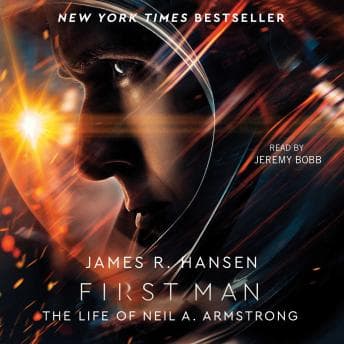

Okay so I have a complaint. Sixteen and a half hours I spent with Neil Armstrong and I still feel like the man wouldn't let me in. And that's not a flaw of the book - that IS the book. That's who Armstrong was. A man so private, so buttoned-up, so midwestern-stoic that even his authorized biographer had to work fifty hours of interviews just to get him to crack the emotional door open a sliver. And somehow that restraint made me cry harder than half the romance novels on my shelf.
I was deep into a freelance rebrand project - one of those nightmare clients who wants "clean but edgy, minimal but bold" - and I put this on expecting background brain fuel. Frida was asleep on my keyboard (as she does), Diego was judging me from the bookshelf (as HE does), and within two hours I had completely stopped working. Just sitting there with my stylus hovering over my tablet, listening to Jeremy Bobb describe a young Neil Armstrong building model airplanes in his bedroom in Wapakoneta, Ohio.
The Quietest Man Who Ever Did the Loudest Thing
Here's what wrecked me about this book: Armstrong wasn't a showman. He wasn't Buzz Aldrin working the press circuit. He was an engineer who happened to be the first human to walk on another world and then came home and basically said "well, that was interesting" and went back to teaching. Hansen does this incredible thing where he builds Armstrong's entire life - the combat missions over Korea at twenty-one, the X-15 flights that were basically riding a missile with wings, the Gemini VIII docking that nearly killed him - and through all of it, Armstrong is this calm, analytical presence. The man's heart rate during the lunar landing was 150 BPM and his voice sounded like he was ordering a sandwich.
But then Hansen gets to the parts Armstrong didn't want to talk about. His daughter Karen, who died of a brain tumor at two years old. And the way Hansen handles it - piecing together what Armstrong wouldn't say from family members, from the gaps in conversation, from the things left unsaid - I had to pause the audiobook and just sit with my cats for a minute. Because I know that silence. My abuela had it too. That generation that carried grief like a stone in their pocket, never showing it, never naming it. Abuela would have understood Neil Armstrong perfectly, and that thought hit me like a truck at 2 AM on a Tuesday. Sarah Smarsh writes about that same swallowed grief with devastating precision in Heartland — different world than Armstrong's Ohio, but the same silence around the things that cost the most.
Jeremy Bobb and the Art of the Steady Voice
Bobb's narration is interesting. He's not flashy - no dramatic vocal shifts, no theatrical pauses designed to make you gasp. His delivery is measured and clear, almost documentary-style, which honestly fits Armstrong's personality like a glove. You're not getting Julia Whelan warmth here (I miss her, always), but you ARE getting a narrator who understood the assignment: this is a book about a reserved man, and the narration respects that reserve.
Now. The Gemini thing. Bobb pronounces it "Gem-ih-nye" instead of "Gem-ih-nee," which is the correct NASA pronunciation. And look, it's a small thing, but when the word comes up roughly every four minutes for several chapters during the Gemini VIII section, it starts to itch. Like a tag on the back of your shirt. You notice it, you try to ignore it, you notice it again. It didn't ruin anything for me, but if you're a space nerd with strong opinions about pronunciation, fair warning.
At 16.5 hours, this is a commitment. There are stretches - especially the deep-dive technical passages about flight mechanics and aeronautical engineering - where I felt my attention drift. Hansen is a historian first, and sometimes the book reads like a very well-written textbook. The first five hours especially require patience. But when it clicks, when you get past the engineering specs and into the human cost of being Neil Armstrong - the marriage strain, the distance from his sons, the way fame became a cage - it's devastating in the quietest possible way. I felt something close to that same slow-burn devastation in Ashley's War, which also earns every emotional gut-punch through accumulation rather than drama.
This Book Felt Like Finding Your Abuelo's Old Letters in a Drawer
The thing that stays with me is the loneliness. Not the cosmic loneliness of orbiting the moon while your crewmates walk on it (though that too), but the everyday loneliness of being a man who couldn't express what he felt. Armstrong loved flying more than almost anything, and Hansen makes you understand that flying was where Armstrong felt free - above the noise, above the expectations, above the need to perform emotion for other people. And when the flying stopped, what was left?
My heart. MY HEART.
I cried twice. Once during the section about Karen (obviously), and once near the end, when Hansen describes Armstrong in his later years - this quiet man on his Ohio farm, still looking up. If you want plot twists and drama, go watch the Ryan Gosling movie. If you want to sit with a human being for sixteen hours and slowly understand what it costs to carry the weight of being "first" at anything - listen to this.
Who should grab this: Anyone who loves biography that earns its emotional moments through patience, not manipulation. Space history fans. People who understand that the quietest person in the room is often feeling the most. Skip it if you need constant momentum or if mispronunciations are a dealbreaker for you.
Abuela would have loved this one. She always respected the quiet ones.








![Steve Jobs [unabridged audiobook] audiobook cover](/_next/image?url=https%3A%2F%2Fcovers.audiobooks.com%2Fimages%2Fcovers%2Ffull%2F9788499923406.jpg&w=1920&q=75)