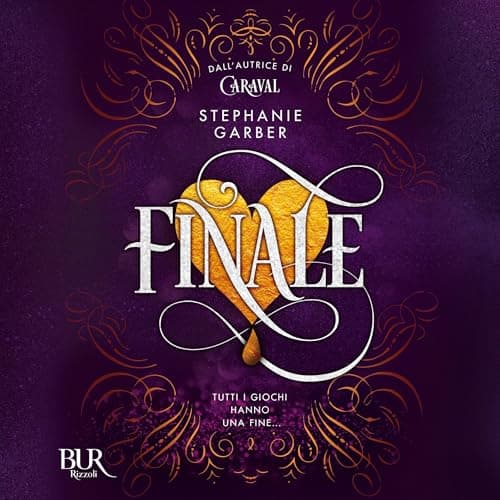

Look, I need to rant about something for a second. I was three hours deep into Finale, headphones in, supposedly debugging a procedural terrain generator for my thesis, when Tella makes yet another choice that had me literally saying "NO" out loud in the grad lab at 1 AM. Like, girl, you have been through TWO books of Caraval's reality-bending nonsense and you're still trusting the hot mysterious guy whose whole brand is deception? My D&D group would have rolled Insight checks forty chapters ago.
But here's the thing — I kept listening. Thirteen hours and twenty-one minutes, and I kept listening.
The Game Board Got Bigger, But the Rules Got Messier
So Finale picks up with the Fates unleashed into the world, Legend on the throne, and both Donatella and Scarlett dealing with the fallout of everything Caraval broke open. The stakes are legitimately higher this time — we're not inside a game anymore, and Garber wants you to feel that shift. The Fates as antagonists are genuinely creepy in concept. Ancient immortal beings with specific, weird powers running loose? That's a campaign setting I'd steal for my table in a heartbeat. Speaking of magic systems that actually make you feel the weight of immortal power, Mark of the Fool 10 does something fascinating with its progression mechanics that scratched a completely different itch — more structured, more costly, but that same sense of ancient forces operating on rules humans barely understand.
But Garber's world-building operates differently than, say, Sanderson's. There's no hard magic system here. The rules of what the Fates can do, what Legend's powers actually are, what Scarlett's dress-that-changes-with-her-emotions actually means in practical terms — it's all vibes. Beautiful, theatrical, glittering vibes. Scarlett's dress is actually one of my favorite details in the whole trilogy. The way it shifts color based on her emotional state — rose gold for hope, black for fear — it's the kind of visual storytelling that works surprisingly well in audio because your brain keeps painting it. But if you need your magic systems to have clear constraints and costs? This is going to frustrate you.
The dual POV between Tella and Scarlett gives the book more range than the previous entries. Tella's chapters are all reckless romantic energy — she's caught between Legend and the Fallen Star (a.k.a. Gavriel, her actual father, which... yeah, that's a whole thing). Scarlett's chapters ground everything with more emotional weight. That listener who said Scarlett's courage sneaks up on her — the courage she didn't even know she had — nailed it. Scarlett's arc from terrified girl to someone who'll attempt the impossible for the people she loves is genuinely the backbone of this trilogy.
Francesca Pittatore and the Italian Audio Question
Okay, I need to be upfront here: this is the Italian language edition narrated by Francesca Pittatore, and my research on her specific performance is thin. I don't have the kind of granular narrator notes I'd want — no detailed breakdowns of her character differentiation or pacing choices. What I can tell you is that it's a single-narrator production, which for a book juggling this many characters (Tella, Scarlett, Legend, Jacks, the Fallen Star, Dante, Julian) is ambitious. Italian as a language honestly suits Garber's prose style — there's a musicality to the writing that probably lands differently than in English. The emotional peaks, the dramatic reveals, the romantic tension — Italian was practically built for this.
But I can't tell you if Pittatore nails distinct voices for Legend versus Jacks, or whether she captures the menace of the Fallen Star. That's a gap in my intel, and I'd rather be honest about it than fake specifics I don't have.
The Romance Problem (It's Also the Romance Appeal)
Here's where I'm torn. The love triangle — or love quadrangle, or whatever shape this thing is — drives a LOT of the plot. And I mean a lot. Tella's decision-making is almost entirely filtered through who she's choosing to trust romantically, and sometimes that means the Fate-of-the-world stakes take a backseat to "but which boy?" If you're here for the romance, this is satisfying. The progression is satisfying — Garber knows how to escalate tension between characters, and the final reveals about Legend's identity and his choice at the end genuinely land.
But if you're like me, sitting there wanting to know more about how the Fates' prison worked, or what the Fallen Star's endgame actually looks like tactically, or how the Empire's political structure functions now that immortals are walking around... you'll be a little hungry. I listened to this instead of writing my thesis, and part of me wishes Garber had spent the same energy on her lore that she spends on her love scenes.
That said — and I mean this — the final act delivers. When all the threads pull together and characters start making sacrifices that actually cost them something, Garber earns the emotional payoff she's been building across three books. The ending isn't just a bow on the trilogy; it's a door into Once Upon a Broken Heart, which is clever structural design. That same trick of threading one story into a larger world reminded me of how La vie invisible d'Addie LaRue handles its mythology — immortality, deals with mysterious beings, a protagonist whose choices echo across time — though that one leans into its melancholy in ways Garber deliberately avoids.
Who Should Listen (And Who Should Skip)
Pick this up if you loved Caraval and Legendary and want the payoff. If you've listened to those two, you're not stopping here — and you shouldn't. But if you're coming in cold, absolutely do not start with this book. The emotional weight depends entirely on having lived through the first two.
Skip it if you need your fantasy worlds to run on logic rather than atmosphere. This is Garber-level world-building — lush, emotional, dream-logic. Not Sanderson-level. Both are valid. They're just different games.
Roll Credits on Caraval
Finale is the ending this trilogy needed — messy where it should be messy, romantic where it should be romantic, and genuinely surprising in its final reveals. It's not flawless. The magic stays stubbornly soft, the romance occasionally hijacks the plot, and thirteen hours is a lot of time to spend with characters who keep making questionable decisions. But Garber built something that feels like stepping into a living, breathing carnival that doesn't want to let you go. And honestly? I didn't want to leave either. Now if you'll excuse me, my advisor just emailed me about my thesis draft. Again.