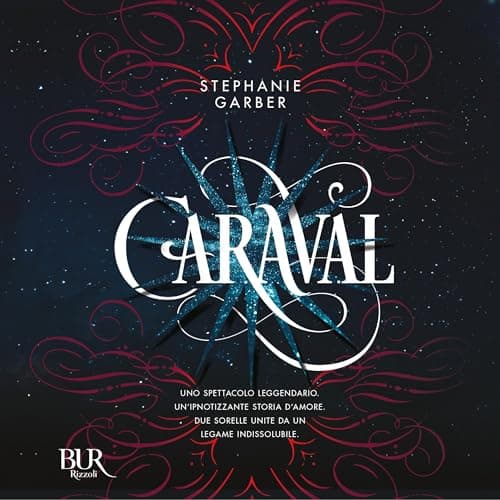

Everybody told me Caraval was this lush, dreamy fantasy confection - the kind of book that makes you feel like you're wandering through a carnival at midnight. I finished it at 2 AM sitting on my apartment floor in Capitol Hill, hearing aids out, reading along with the Italian audio and captions synced on my tablet, and honestly? The experience was stranger and more disorienting than I expected, in ways both good and frustrating.
Let me be upfront: this is the Italian-language audiobook narrated by Francesca Pittatore, translated by Maria Concetta Scotto di Santillo. So I'm reviewing a specific localized experience that most English-language listeners won't encounter. And that distinction matters.
The Game Inside the Game Inside the Audio
Garber's whole conceit - a magical performance where the audience becomes part of the show, where nothing is real but everything matters - is genuinely clever for audio. The structure lends itself to a listening experience where you're constantly questioning what's a trick and what's actual stakes. Rossella (Scarlett in the original) is dragged into Caraval after her sister Tella gets snatched by the enigmatic Legend, and she has five nights to find her. The ticking clock works. The layered unreality works. But here's the thing that kept nagging me: Garber writes emotion through color. Scarlett literally perceives feelings as colors - her fear is a shade of green, her desire is crimson - and in audio, you lose some of that synesthetic punch. It becomes Pittatore telling you about colors rather than the visual imagination doing the heavy lifting on the page.
Pittatore handles this reasonably well. Her voice has a warm, slightly breathless quality that fits Rossella's constant state of anxious determination. She differentiates between Rossella and Tella with subtle shifts - Tella gets a brighter, more reckless energy, while Rossella stays wound tight and careful. Julian, the mysterious sailor, comes through with a lower register and a hint of flirtation that doesn't tip into parody. But - and this is where my accessibility brain kicks in - the Italian translation sometimes loses the rhythmic punch of Garber's shorter English sentences. Italian syntax naturally runs longer, and Pittatore doesn't always compensate with pacing changes. There are moments, especially in the middle third around the third and fourth nights of the game, where urgency should be climbing but the delivery stays at a steady mid-tempo. Clarity over speed - always - but I needed more dynamic range.
When Illusion Becomes the Whole Point
Here's what I'll give Caraval: it commits to its own unreliability in a way that actually made me lean in harder. As a hard-of-hearing listener, I'm already working overtime to parse what's real in every conversation - tone, intent, sarcasm, sincerity. Garber builds that exact cognitive load into the plot itself. Is Legend dangerous or performing? Is Julian lying or protecting? Is the blood real? The book kept me in that state of active interpretation that I live in every day, and that hit different. Not because it was particularly deep, but because the structure mirrored my actual listening experience.
The father character - cruel, controlling, the reason Rossella and Tella are trapped on their island - is painted in broad, almost fairy-tale villain strokes. Pittatore gives him a flat, cold delivery that works for the archetype but doesn't give him much dimension. Fine. He's not really the point. The point is the sisters' bond, and when Rossella finally confronts what she's willing to sacrifice for Tella, Pittatore lands that emotional beat. There's a moment near the climax where Rossella's voice cracks with genuine desperation, and even through my hearing aids at reduced volume, the shift comes through without relying on sound alone - I could feel the performance change physically, in the pacing, in the breath.
But let's be real: the romance subplot with Julian is cotton candy. Sweet, dissolves fast, leaves you wanting something more substantial. And the twist at the end - I won't spoil it, but if you've read any amount of YA fantasy, you'll see it coming by about hour seven.
Who Gets a Ticket (And Who Stays on the Island)
If you want a sensory, atmospheric fantasy that prioritizes mood over plot mechanics, and you're comfortable with Italian-language narration, this is a solid listen. You get a narrator who genuinely performs rather than just reads, even if she doesn't always push the dynamic range where it needs to go. You get a story that's basically a puzzle box wrapped in velvet - pretty, engaging, but not particularly hard to solve.
Skip if you need tight worldbuilding logic or if dream-vs-reality ambiguity frustrates rather than intrigues you. Also skip if you're looking for caption sync - I couldn't find a perfectly synced Italian text companion, so I was doing some manual alignment, which is... not accessibility done right. My experience with Neuschnee had me wrestling with similar sync frustrations in a German-language production—different language, same fundamental problem of localized audio that treats caption alignment as an afterthought.
My Hearing Aids and I Will Come Back for the Sequel
Caraval is a performance piece more than a literary one, and that's not an insult. Pittatore understands the assignment even when the translation occasionally fights the pacing. At 11 and a half hours, it doesn't overstay its welcome. I wanted more from the narrator in the middle stretch and more from the romance throughout, but the core sister dynamic and the carnival-as-metaphor structure kept me engaged through that 2 AM finish. Not a revelation, but a genuinely enjoyable night at the show.