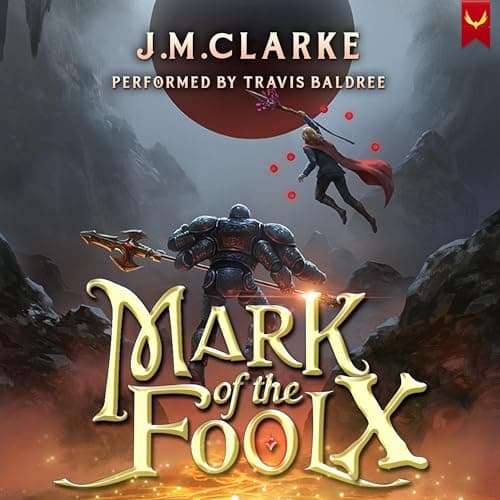

"Alex plans to destroy the hell out of it." That line from the book description had me grinning like an idiot on my morning run, because after nine books of watching a baker's son work around a mark that literally sabotaged him every time he tried to fight, hearing Alex finally unleash everything felt like the payoff I'd been waiting hundreds of hours for.
I burned through most of Mark of the Fool 10 across a long weekend — headphones on during a Saturday hike, then parked on the couch for the back half with the lights dimmed. This is a 23-hour finale that demands your attention, especially during the war-prep middle act where Alex is marshaling allies, layering contingencies, and thinking through magical logistics like a general running a campaign. If you try to half-listen to this while doing dishes, you'll miss the connective tissue that makes the final confrontation land. I learned that the hard way around hour eight when I had to rewind fifteen minutes because I'd zoned out during what turned out to be a critical strategy session.
The Ravener at full strength is genuinely terrifying as a final antagonist — unchained after millennia, it feels like the weight of every previous cycle bearing down on Thameland at once. And Clarke earns the confrontation because Alex's path from cursed Fool to archwizard was built on study, failure, friendship, and lateral thinking rather than power dumps. When he finally goes all-out against the thing, you feel the accumulated weight of ten books behind every spell.
That said, the climactic battles themselves land a tier below the worldbuilding and character work that got us here. Some of the final fight choreography felt predictable — you can see certain beats coming chapters out, and the narrative thins where it should be thickest. Clarke's real strength has always been systems, relationships, and the slow accumulation of knowledge and power, not surprise twists in combat. The resolution of Uldar's legacy and the breaking of the generational cycle carries more emotional punch than the pyrotechnics, which tells you where this series' heart actually lives.
The middle stretch — hours eight through fourteen roughly — is where the series' divisive quality shows up strongest. Alex organizing resources, calling in favors, preparing contingencies. If you're the kind of listener who found earlier books' logistics sections tedious, this won't convert you. But for me, as someone who genuinely enjoys watching a strategist lay groundwork before a fight, those chapters scratched an itch. The pleasure is in the preparation, in seeing how every tool Alex picked up across the series gets its moment.
Travis Baldree has been voicing these characters for ten books now, and you can hear the intimacy. His Alex in book ten sounds noticeably different from book one — not just older, but carrying weight, authority, earned confidence. Baldree brings that same nuanced character evolution to his work in Retribution: An EMP Survival Story, where he does something similar with a protagonist who hardens over the course of a brutal survival arc. The cast is enormous by this point and he keeps the vocal differentiation sharp. Where he occasionally trips up is with the sound effects — there are magical crackles and combat swooshes that sometimes yank you out of the prose instead of pulling you deeper in. It happened maybe four or five times across the full runtime for me. Minor, but worth noting if that kind of thing bothers you.
What I respected most about this finale is that Clarke doesn't end at the kill shot. Too many progression fantasy series treat the final boss as the final page. Mark of the Fool 10 gives you real breathing room with these characters after the dust settles — the aftermath, the grief, the quiet conversations. The slice-of-life warmth that made earlier books distinctive gets somewhat overshadowed by the apocalyptic main plot, but it returns in the closing hours, and it matters.
Buy this if you're already invested in Alex and you enjoy long war-prep chapters, payoff for progression systems, and finales that spend time on aftermath rather than just spectacle. The emotional closure here is genuine — one listener nailed it: "Sad to see it end, but happy to have experienced it."
Skip it if you wanted a twisty, unpredictable final battle, if the series' slower organizational sections already tested your patience in earlier books, or if sound effects pulling focus during action scenes is a dealbreaker for you. And obviously, don't start here — this is a book ten that assumes you know every character, system, and plot thread.
Quest Complete
The D&D-campaign energy that defined this series from the start carries through to the end. It feels like the final session of a years-long tabletop game — imperfect in spots, a little sprawling, but shot through with enough heart and earned spectacle to honor the journey. Roll credits. Pour one out for a hell of a run.