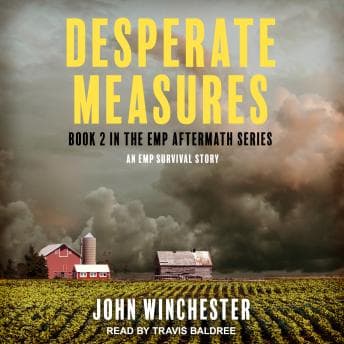

What happens when the guy who narrated Cradle — literal LitRPG royalty — shows up to read a post-apocalyptic EMP survival book about scrounging for food in West Virginia? That's the question I didn't know I needed answered until I was three hours deep into this thing while reorganizing my board game shelf at 1 AM on a Tuesday.
Let me set expectations: this is not Sanderson-level world-building. This is not a 40-hour epic. Desperate Measures is a tight five-hour survival story that knows exactly what it is — a guy, his family, an EMP that fried everything electronic, and a brutal winter bearing down on a rural homestead with no supplies. It's the kind of scenario my D&D group would absolutely TPK in session one because someone would try to diplomacy-check a hostile raider party instead of just hiding.
Travis Baldree in the Wilderness (Without His Stat Blocks)
Here's the thing about Travis Baldree: the man is a phenomenal narrator when he's got distinct fantasy characters to sink his teeth into. Lindon, Eithan, Yerin — he makes those characters live and breathe. But drop him into a gritty survival story where every other character is a grizzled rural dude or a stressed-out family member? His range gets... compressed. The male voices work fine — Jack Miller sounds appropriately worn and determined, and Wyatt's got that stubborn homesteader energy. But the women? Every female character sounds like she's doing a Dana Carvey Church Lady impression, and I am not exaggerating. It's the same slightly pinched, slightly nasal register for basically every woman in the book. When Jack's wife is arguing about rationing and the neighbor lady is arguing about territory rights, you genuinely cannot tell who's speaking without context clues.
It's not a dealbreaker for a five-hour listen, but if you're coming here because you love Baldree's work on Cradle or Legends & Lattes, temper those expectations. This feels like early-career Baldree, or at least Baldree-on-autopilot. Passable. Professional. Not electric.
The Food Cache Standoff Is Where It Gets Interesting
The actual story follows a pretty standard EMP-apocalypse template for the first half — society collapses, family flees Baltimore, they reach the rural homestead, winter's coming, supplies are thin. If you've read any of the genre (and I've consumed more post-apoc fiction than my thesis advisor would be comfortable knowing about), you know the beats. Exit Strategy runs through those same familiar beats but manages to subvert enough of them that I found myself actually surprised a couple times — which, at this point in my post-apoc consumption, is genuinely rare. John Winchester clearly knows his survival stuff — the man's an outdoorsman and prepper, and it shows in the practical details about food storage, water purification, and winter preparation. The info-dumps about wilderness survival are actually the strongest parts. If you don't like info-dumps, this isn't for you (but you're wrong).
Where the book earns its keep is the second half, when Jack stumbles onto a food cache large enough to sustain his family through winter — and another group claims it. The tension here is real. It's not zombies or supervillains, it's just desperate people making desperate choices, and the escalation feels organic rather than forced. The conflict spirals in a way that reminded me of those D&D sessions where one bad Persuasion roll turns a simple negotiation into a full combat encounter nobody was prepared for.
The pacing could be tighter in spots — there are stretches in the first two hours that drag, especially the journey from Baltimore to West Virginia, which hits every expected plot beat without much surprise. But at under five hours, the whole thing moves quick enough that I never seriously considered bailing.
Who Rolls Initiative on This One
This is for the prepper-fiction crowd who want something they can knock out in an afternoon. If you're into EMP/SHTF scenarios, rural survival, and resource-conflict stories, you'll find a competent if predictable entry in the genre. The progression is satisfying — watching the family go from refugees to tentatively established to fighting for their survival against human threats rather than just environmental ones gives it a decent arc.
Skip it if you need strong female characters with distinct voices (both on the page and in the audio). Skip it if you're looking for genre-defying post-apocalyptic fiction. This is comfort food for survivalist fiction fans — formulaic but filling. Ritualist scratches a similar itch on the LitRPG side — competent, hits the genre marks, nobody's writing a dissertation about it.
I read this instead of writing my thesis. Was it worth it? For five hours, sure. I wouldn't burn a full-price Audible credit on it, but if it shows up on a sale or you've got a streaming subscription, it's solid background listening for when you're doing something with your hands — sorting minis, painting terrain, alphabetizing your Cosmere collection for the third time this month. You know. Normal stuff.
The Rations Are Decent, Not Gourmet
Baldree at 70% is still better than a lot of narrators at 100%, and the story delivers exactly what the tin promises. Nothing more, nothing less. My D&D group would love the survival logistics. My thesis? Still unwritten.