
When's the last time you sat still for four hours and just... breathed?
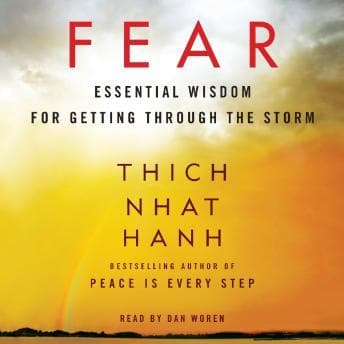
Because that's basically what Thich Nhat Hanh is asking you to do with Fear, and honestly? As someone who optimizes every waking minute — listening at 1.75x, debugging Kubernetes manifests while meal-prepping — the idea of slowing down felt almost offensive. But I didn't pick this up during my commute. I picked it up at 2AM on a Tuesday after a particularly brutal on-call rotation where my heart rate hadn't dropped below 90 in three days. Kevin was asleep. I was staring at the ceiling doing that thing where you replay every decision you made during the incident, convinced you missed something catastrophic. So I put this on.
The Anti-Optimization Book for Optimization Addicts
Here's the thing about Thich Nhat Hanh's writing: it's deceptively simple. Like, almost frustratingly so if you're used to books that front-load a thesis and then spend 300 pages defending it. Fear doesn't work that way. It operates more like a series of gentle nudges — short chapters, each one circling back to the same core ideas about acknowledging fear rather than running from it, sitting with discomfort instead of immediately reaching for a fix.
And look, I know what you're thinking. "Sarah, this sounds like it could've been a blog post." I thought so too, for about the first 45 minutes. But the repetition is the point. Hanh talks about fear as something we inherited — from our parents, from our ancestors, from our own inner child who's still carrying wounds we thought we'd processed. He uses this concept of "original fear" (the fear of a newborn separated from its mother) and threads it through every chapter until it stops being a concept and starts being something you recognize in your own chest at 2AM when you can't sleep.
The part that got me — and this is specific — is when he describes the practice of "Beginning Anew," where you literally sit with another person and acknowledge how you've hurt them without defending yourself. No root cause analysis. No blameless postmortem. Just: I see that I caused you pain, and I'm sorry. As someone whose entire professional life revolves around finding the root cause and fixing the system, the idea of just... acknowledging the failure without immediately jumping to remediation? That hit different.
Dan Woren Does What the Material Demands
Dan Woren's narration is calm and measured and — I'm going to be honest — not particularly dynamic. But that's exactly right for this book. You don't want someone doing vocal gymnastics with Buddhist meditation teachings. Woren reads like a steady heartbeat. His pacing is unhurried, his tone warm but not syrupy. He doesn't try to make Hanh sound mystical or otherworldly. He sounds like a patient person reading to you in a quiet room.
The downside? If you're trying to listen to this at 6AM on the Caltrain surrounded by commuter zombies, you will fall asleep. Not because it's boring — because it's genuinely calming. This is not a commute book. This is a 10PM-in-bed-with-the-lights-off book. I tried it on the train once and woke up at San Jose. Kevin had to come get me. Dan Woren's range as a narrator really shows when you compare this to Three Signs of a Miserable Job—his delivery there is crisp, almost sarcastic, which is perfect for a corporate fable about finding purpose at work.
Where the Signal Gets Noisy
At 4 hours 19 minutes, it's short, and that works in its favor. But I'll say this: if you've read The Heart of the Buddha's Teaching or Peace Is Every Step or basically any other Thich Nhat Hanh book, you'll find significant overlap. I noticed the same thing when I reviewed Peace Is Every Step—but I think Fear sharpens the focus on anxiety in a way that hits closer to my 2AM dread. The breathing exercises, the walking meditations, the emphasis on mindful awareness — it's all here, just filtered through the specific lens of fear and anxiety. If this is your first Hanh book, the ROI on this audiobook is actually pretty high. If it's your fifth, you might feel like you're re-reading familiar documentation with slightly different variable names.
Also — and this is a me problem — some of the guided meditation passages feel like they're designed for reading, not listening. Hanh will say something like "breathing in, I calm my body; breathing out, I smile" and you're supposed to actually do it. Hard to practice mindful breathing when you're standing in the Safeway checkout line with headphones on. Context matters with this one.
Perfect For: the 2AM Anxiety Spiral. Skip For: Your Morning Commute.
This book isn't going to fix your distributed system. It's not going to optimize your sprint velocity. But if you're the kind of person who lies awake debugging your own emotional architecture and wondering why the same fears keep resurfacing despite all the "fixes" you've applied — Hanh's gentle, repetitive insistence that you just need to hold the fear like you'd hold a crying child is... weirdly effective. Like a warmth that sneaks up on you.
I've started doing his breathing thing before I look at my pager alerts in the morning. Kevin says I'm 14% less insufferable. I'll take it.