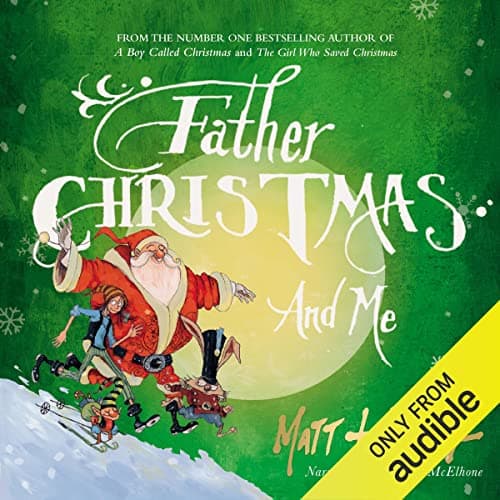

What happens when Christmas itself is under siege — not from Scrooge or the Grinch, but from the Easter Bunny and his army of rabbits? That's the kind of wonderfully absurd premise Matt Haig builds his third Christmas-universe book around, and it works far better than it has any right to.
I came to Father Christmas and Me after spending time with Haig's earlier entries in the series, and what struck me almost immediately was how this one finds its own gear. It's lighter in some ways — there's a playful irreverence to the whole setup that keeps things from feeling like a retread. But there's genuine emotional weight beneath the silliness, particularly in Amelia's struggle to find her place in Elfhelm as the only human child. Anyone who's ever felt like they didn't quite fit in will recognize that particular ache, even when it's wrapped in tinsel and elf songs.
Natascha McElhone's narration is where the audiobook format truly earns its keep. Her voice has this quality — warm but never saccharine — that matches the tone Haig is going for. She reads like the most gifted aunt you've ever had, the one who could make a bedtime story feel like a secret adventure between just the two of you. The holiday feel permeates every chapter, but McElhone never oversells it. She trusts the material, and the material rewards that trust. Characters each get their own subtle vocal shade without veering into cartoonish territory, which is a tricky balance with a cast that includes elves, trolls, and a vengeful lagomorph.
The story itself moves at a brisk, purposeful clip across its roughly five-hour runtime. Haig structures the conflict well — the Easter Bunny's jealousy is played for laughs but carries enough menace to generate real stakes for young listeners. There are moments of genuine suspense mixed with the humor, and Haig doesn't talk down to his audience. He treats kids as capable of handling complicated emotions: jealousy, belonging, the fear of losing something precious. The Christmas-in-July elf school sequences are particularly fun, offering this gentle satire of school life that adults will appreciate even as kids giggle at the absurdity of singing carols in the summer heat.
One thing I noticed while listening during an evening walk — this is the kind of audiobook that rewards your full attention. Not because it's dense or complicated, but because the charm is in the details. The small jokes, the quiet emotional beats, the way McElhone inflects a particular line to land a punchline or tug at your heart. Playing it as background noise while doing dishes would mean missing half the magic.
At under five hours, it's perfectly sized for what it is. No padding, no filler chapters that exist just to bulk up the page count. It tells its story and gets out, which is honestly refreshing. The short runtime does mean it won't carry you through a long road trip on its own, but it's ideal for a few evenings of family listening during the holiday season — or frankly, any time you need a shot of warmth and whimsy.
The book's weakness, if you can call it that, is its simplicity. Readers who've grown up on more complex middle-grade fantasy — say, the layered world-building of Nevermoor or the philosophical puzzles of The Phantom Tollbooth — might find the plot a touch straightforward. I ran into a similar ceiling with Trackers Series Box Set, which keeps things moving briskly but never quite digs into its characters the way you want it to. The Easter Bunny villain, while amusing, doesn't have the depth of a truly memorable antagonist. But I'd argue that simplicity is partly the point. This isn't trying to be an epic. It's trying to be a hug in book form, and on that count, it succeeds.
What surprised me most was how well Haig handles the adopted-family dynamic. Amelia's relationship with Father Christmas and Mary Christmas feels lived-in and real despite the fantastical setting. There's a scene where Amelia grapples with what it means to truly belong somewhere, and McElhone reads it with such understated tenderness that I actually stopped walking for a moment. That's the mark of good narration meeting good writing — when it catches you off guard with feeling.
Who Should Listen (And Who Should Skip)
Families looking to build a holiday listening tradition should put this on the shortlist. It pairs beautifully with A Boy Called Christmas and The Girl Who Saved Christmas — you could listen to all three across December and have yourself a proper seasonal ritual. If your kids crave twisty, complex plots, this might feel too breezy for them — but for listeners ages five to ten (and the adults sharing the couch with them), McElhone's performance elevates the experience well beyond what reading the print version alone offers. Her voice becomes inseparable from the world Haig has created.