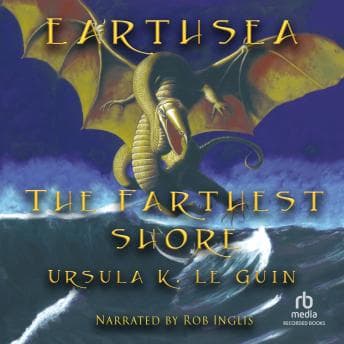

Look, I have a bone to pick with Ursula K. Le Guin. She wrote these Earthsea books in the 1970s and somehow made every epic fantasy that came after feel like it was playing catch-up. I'm supposed to be working on my thesis about procedural generation, and instead I'm lying on my apartment floor surrounded by board game boxes, staring at the ceiling while Rob Inglis tells me about the magic draining out of the world. My advisor would be so disappointed. (Dr. Patel, if you're reading this, I was definitely working on Chapter 3.)
The Farthest Shore hit me different than I expected. This isn't the young, impulsive Ged from A Wizard of Earthsea. This is Archmage Ged, older, wiser, and carrying the weight of a world that's slowly forgetting how to dream. And that premise—magic itself dying, wizards losing their spells like old men losing their memories—that's the kind of existential dread I didn't know I needed at 2 AM on a Tuesday.
When Your Magic System Starts Breaking
Here's what makes Le Guin a genius: she built this entire world on the concept of True Names, where knowing something's real name gives you power over it. Three books in, she asks: what happens when people start forgetting the names? The magic system isn't just window dressing—it's load-bearing for the entire narrative. My D&D group would absolutely lose their minds over this. It's like if someone started erasing the Player's Handbook mid-campaign. That same sense of a world unraveling at its foundations shows up in Watership Down, where an entire society has to reckon with its own mortality.
The journey Ged and young Prince Arren take across Earthsea is slower than the previous books. This isn't Sanderson-level action sequences every chapter. It's contemplative. Philosophical. They sail past islands where wizards have become charlatans, where the springs of magic have literally run dry. There's this creeping sense of wrongness that builds and builds. If you don't like slow burns, this might test your patience. But the payoff—sailing to the shores of death itself—earns every quiet hour before it.
Rob Inglis Walked So Other Fantasy Narrators Could Run
I've listened to a lot of fantasy audiobooks. A LOT. (Again, thesis avoidance is a powerful motivator.) And Rob Inglis doing Earthsea is something special. He's got this quality where he doesn't try to do theatrical voice acting—instead, he reads like a master storyteller by a fire. His Ged has this weathered authority, and his Arren carries the uncertainty of youth without being annoying about it.
There are some minor audio quirks—occasional breaths between passages, the kind of tape sounds that remind you this was recorded before everything was digitally scrubbed clean. Honestly? I kind of liked it. Gave it texture. Made it feel like someone was actually reading to me rather than a sterile studio production.
The pacing works for long sessions. I knocked out about four hours while pretending to organize my bookshelf (the books are still not organized), and it never dragged. Inglis knows when to let Le Guin's prose breathe and when to push forward.
This Book Will Make You Think About Death (In a Good Way?)
Le Guin does something here that I've rarely seen in fantasy: she treats death as a real thing, not just a dramatic plot device. The climax takes Ged and Arren to a place where the dead walk, where the boundary between living and dying has been breached by someone who refused to accept mortality. It's heavy stuff. But it's also weirdly comforting? Like sitting with a difficult truth until it becomes less scary.
Compared to the first two Earthsea books, this one feels more mature. Less adventure, more meditation. If Wizard of Earthsea was about learning who you are, and Tombs of Atuan was about breaking free from who you were told to be, Farthest Shore is about accepting that everything ends—and finding meaning anyway. Crown wrestles with similar questions about legacy and what we leave behind, though it takes a very different narrative path to get there.
Who Should Sail These Waters (And Who Should Stay Ashore)
If you want non-stop action and complex magic battles, this isn't it. Skip to something with more explosions. But if you want fantasy that treats you like an adult, that trusts you to sit with silence and uncertainty, that builds its world through suggestion rather than info-dumps? This is the good stuff.
Perfect for: late-night listening when you can't sleep, long drives through boring stretches of highway, anyone who's ever wondered why modern fantasy feels hollow sometimes. Less perfect for: workout motivation, background noise while gaming, anyone who needs constant plot momentum.
At eight hours, it's a comfortable commitment. Not the 40-hour epic that requires a spreadsheet to track, but substantial enough to really sink into. I finished it and immediately wanted to start the fourth book. My thesis can wait another week.
Roll for Wisdom Save
The Farthest Shore is Le Guin at her most philosophical, and Rob Inglis delivers it with the respect it deserves. It's not flashy. It won't give you quotable one-liners for your Discord server. But it might make you think about mortality, meaning, and why we tell stories at all. And sometimes that's exactly what you need instead of another chapter on procedural dungeon generation algorithms.