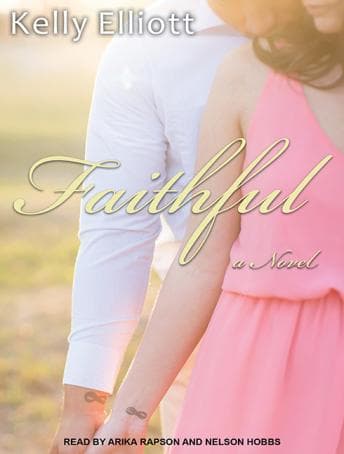

So here's the thing - I'd seen people online absolutely dragging the female narration in this book, and I almost didn't hit play. Almost. I was three hours into a branding project at 2 AM, Diego curled up on my keyboard like he pays rent, and I needed something with enough emotional weight to keep me awake but familiar enough in structure that I wouldn't lose the thread while adjusting kerning. Kelly Elliott's Faithful seemed like the right call.
And honestly? It was. Mostly.
The Grief That Opens Like a Door You Can't Close
Look, I'm biased. A story that starts with a girl losing both parents in a car accident and then building walls so high she can barely breathe behind them - that's going to get me. Heather Lambert's refusal to let anyone in isn't played as quirky or mysterious. It's played as survival. And Arika Rapson captures something specific in those early chapters - this tight, controlled quality in Heather's internal voice, like she's narrating her own life from a safe distance because getting close to her own feelings might break her. There's a guardedness in the delivery that felt real to me.
But then Josh Hayes shows up with all his persistent, patient energy, and Nelson Hobbs gives him this steady warmth that contrasts Heather's tension perfectly. He doesn't oversell Josh's devotion - it's just there, consistent, like a low hum underneath everything. The months of rejection, of Heather pushing him away while clearly wanting to pull him closer? That slow unraveling worked for me. This book felt like watching someone peel tape off a wound very, very carefully. That same slow, careful dismantling of a person's defenses is something I felt in French Gardener too — grief dressed up in quiet routines until something cracks it open.
And then - the car accident. Again. The same nightmare, recycled. Heather having to face the exact thing she's been terrified of since page one. I was sitting at my desk with my headphones on and I literally put my stylus down and just... sat there. Because the cruelty of that plot device isn't cheap - it's the whole point. This woman built her entire emotional architecture around never being blindsided by loss again, and the universe said try again.
About That Narration Debate
Okay, let's talk about the elephant. Arika Rapson's voice. I've read the reviews calling it nasal, annoying, a dealbreaker. And I get it - there IS a quality to her delivery that sits in a higher register, especially when she's voicing younger Heather or some of the secondary female characters. If you're sensitive to vocal tone, I can see it grating over twelve-plus hours.
But here's where I land: her portrayal of Heather's growth from this locked-down, grief-frozen girl into someone brave enough to fight for love? That arc comes through. You can hear the difference between early Heather and late Heather. The voice softens, opens up. That matters to me more than tonal perfection.
Nelson Hobbs is the steadier performer here. Solid, warm, uncomplicated in the best way. He doesn't try to do too much with Josh, which is smart because Josh is written as a good man, not a complicated one.
The real issue isn't either narrator individually - it's the POV switching. This book has a LOT of character perspectives, and the transitions between them can get genuinely confusing in audio. There were moments where I had to rewind because I'd lost track of whose head I was in. For a book that runs nearly thirteen hours, that's a problem. It dilutes the emotional focus. I wanted to live in Heather and Josh's story, and sometimes I felt like I was being shuffled into rooms I didn't ask to enter.
Victoria and the Art of the Telenovela Villain
I have to talk about Victoria, the ex-girlfriend-turned-nurse who swoops in when Josh loses his memory. Because Abuela would have LOVED this woman. Not liked her - loved to hate her. This is straight-up telenovela energy. The scheming ex taking advantage of amnesia? Abuela would've been yelling at the speaker, clutching her rosary, calling Victoria every name in the book. I could hear her voice in my head during those scenes, and I had to smile through the ache of missing her.
Is it dramatic? Wildly. Is it original? Not remotely. But does it work as emotional stakes? Yeah. It does. Paranoid leans into that same heightened, almost theatrical tension — the kind where you know intellectually it's overwrought and you're completely at its mercy anyway. Because the real question was never whether Victoria would win - it was whether Heather would let fear win. Whether she'd walk away from Josh because staying meant risking the exact devastation she'd already survived once.
My heart. MY HEART.
Who Should Press Play (And Who Should Keep Scrolling)
If you need tight plotting and zero melodrama, this isn't your book. If multiple POVs in audio make you twitchy, proceed with caution. And if narrator voice is a make-or-break thing for you, sample before you commit - Rapson is genuinely polarizing.
But if you're someone who reads romance for the emotional excavation - for that moment when a character finally stops running and turns around - this delivers. It's not subtle. It's not trying to be. It's a rainy Sunday book with a side of ugly-crying, and sometimes that's exactly what the thirteen-hour design session needs.
The Last Pixel
I finished Faithful as the sun came up over my apartment, both cats asleep, coffee cold, project forgotten. Did I cry? Twice. Not my record, but respectable. The amnesia plot is soapy and the narration won't work for everyone, but Heather's journey from grief to trust hit me somewhere real. Sometimes the books that aren't perfect are the ones that stick.