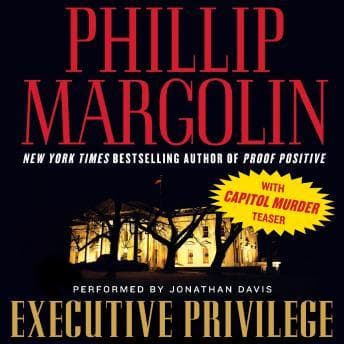

Everyone tells you Margolin is "the next Grisham," and I'll be honest - I went in skeptical. I've taught legal thrillers as a guilty pleasure unit in my AP English class, and most of them read like screenplays with delusions of grandeur. But here's the thing about Executive Privilege: it's smarter than it needs to be, and Phillip Margolin's background as a criminal defense attorney who handled thirty actual murder cases gives the procedural bones of this thing a weight that pure fiction writers can't fake.
I was not grading papers when I listened to this one. I was up at midnight, Denise already asleep, walking laps around the kitchen because I couldn't sit still. That should tell you something.
A Former Defense Attorney Writing Murder Is Basically Cheating
Margolin structures this like a chess game with two pawns who don't know they're on the same board. You've got Dana Cutler, a private detective hired for what looks like a routine surveillance job - follow a college student, report back. Simple. And then you've got Brad Miller, a junior associate in Oregon grinding through a death row appeal for a convicted serial killer named Clarence Little. These two storylines feel completely unrelated for a good chunk of the book. Margolin lets you sit in that confusion, trusting you to hold the threads.
And then Charlotte Walsh turns up dead after a secret meeting with the President of the United States, and suddenly Dana Cutler's boring surveillance gig becomes a survival situation. The shift is sharp. What I appreciate is that Margolin doesn't rush the convergence. He lets the Oregon legal work and the D.C. intrigue build independently until they crash together with genuine force.
Now - do you have to suspend your disbelief toward the end? Yeah, a little. The conspiracy stretches in ways that feel more Hollywood than courtroom. Some listeners have complained about keeping the characters straight, and I get that. Margolin populates this thing with lawyers, politicians, staffers, and operatives, and not all of them are distinct enough to justify their page time. This reminds me of what Hemingway said about cutting - everything you leave in should earn its place. A few of these secondary players could've hit the editing floor and the book would've been tighter for it. Jane Austen understood this too - every character in Pride and Prejudice pulls narrative weight, which is partly why that book still holds up in my classroom two centuries later.
But the core mechanism works. The idea that a sitting president might be connected to murders stretching back to his days as governor - that's genuinely unsettling. Margolin earned that Spotted Owl Award for Best Northwest Mystery, and the Oregon sections in particular have a grounded, procedural authenticity that the D.C. chapters sometimes lack.
Jonathan Davis Knows When to Get Out of the Prose's Way
Here's where I'll give credit where it's earned. Jonathan Davis doesn't try to be a full cast. He's one guy doing one job well - and that job is keeping you oriented in a story with a lot of moving parts. His female voices are distinguishable without being cartoonish, which is harder than people think. When he shifts from Dana Cutler's scenes to Brad Miller's, there's a tonal change in his delivery that helps your brain switch tracks. Practical? Absolutely. Flashy? No. And for a book with this many characters in this many locations, practical is exactly what you need.
The narrator understands that pause is punctuation. Davis uses silence in the suspense sequences - particularly around the Walsh murder aftermath - in a way that tightens the tension without melodrama. He's not performing the thriller; he's reading it with conviction. There's a difference. At 1.0x speed (yes, I'm that guy, my students have told me), his pacing felt right. The prose deserves to be heard at its natural rhythm, even when it's genre fiction. Especially when it's genre fiction, actually.
That said, with the character count in this book, there were moments where I had to rewind and figure out who was talking. That's partly Margolin's construction and partly the limits of single-narrator audio when you've got a dozen speaking roles.
Who Gets the Assignment
If you loved The Firm and wished it had more body count and less billing disputes, this is your book. If you're the kind of listener who needs literary prose to stay engaged, this won't convert you - Margolin writes clean, functional sentences that serve the plot. He's not trying to be Faulkner. (My students would hate Faulkner too, so maybe that's fine.)
This is a strong pick for road trips or any extended listening session where you can maintain focus. Don't try this as background audio while cooking - you'll miss a plot thread and spend twenty minutes confused. Ask me how I know.
The teaser for Capitol Murder at the end is a nice touch if you're already hooked on the Washington Trilogy. If you're not, it's easy enough to stop.
Worth Pausing the Faculty Meeting For
Executive Privilege isn't reinventing the legal thriller. It's just doing the thing well - with the credibility of a writer who's actually stood in courtrooms defending people accused of murder. The dual-protagonist structure gives it more texture than your standard "one hero against the machine" setup, and Davis's narration keeps the gears turning smoothly. It wobbles at the end when the conspiracy demands more faith than evidence, but by that point, you're invested enough to forgive it.
My students would hate this. I love it. Well - I really liked it. Let's not get carried away.