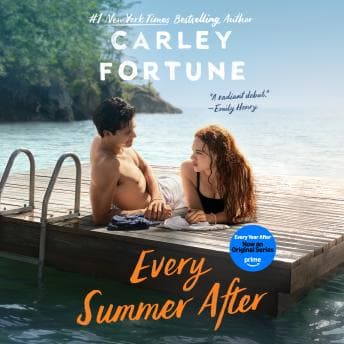

How much forgiveness can you reasonably fit into one weekend, especially when twelve years of silence come with it? I was folding clean scrubs out of the dryer on my afternoon off, one earbud in, when that question started bothering me about Every Summer After. Carlos had taken the kids out, and I’d expected a little borrowed lake weather while I worked. Instead, I got Percy Fraser returning to Barry’s Bay for Sam Florek’s mother’s funeral. Not exactly a carefree afternoon on the water.
My first impression was that Carley Fortune knew precisely how to make first love feel like a place you could visit. My second was less comfortable: wanting to go back isn’t the same as being ready to repair what happened there. That tension kept me listening, even when the romance asked me to be more forgiving than I felt.
Six summers earn their space
Percy and Sam’s relationship develops across six summers, while the present-day reunion unfolds over a single weekend. That imbalance matters. We get time to understand the friendship before being asked to care about its wreckage, and the return visits to their younger selves give the adult awkwardness something concrete to stand on.
The detail I kept coming back to was their reading: Sam with medical textbooks, Percy with the horror stories she’s writing. Two kids sharing space without needing to share every interest. My unit's break room runs on the same principle—somebody's got a pharmacology pocket guide out, somebody's halfway through Life, the Universe and Everything, and both of them still end up at the same lunch table. That’s more persuasive to me than pages of declarations about being destined for each other. Working in his family’s restaurant gives their attachment another ordinary setting—because apparently even a lakeside romance needs somebody to show up for a shift.
And yes, Sam’s textbooks caught my nurse brain’s attention. But this isn’t a medical novel, and I’m not handing out clinical-accuracy points because a character studies medicine. What interested me was the contrast between his direction and her imagination. Those choices help establish who they are before regret starts doing most of the talking.
The lake setting does considerable emotional work, too. Percy hasn’t simply avoided an ex. She’s stayed away from a whole version of her life. Returning for a funeral means she can’t separate the place she misses from the family’s grief. I appreciated that complication. Loss doesn’t wait until everyone has sorted out their romantic history (an inconvenient scheduling policy, but a consistent one).
Bridel lets Percy grow up in your ear
AJ Bridel’s strongest contribution is the age progression. Young Percy and adult Percy remain recognizably the same person, but the delivery changes enough that the alternating timelines don’t feel like one adult voice remembering everything at the same emotional temperature.
That matters more here than a flashy collection of character voices would. The audiobook depends on hearing the distance between what Percy felt then and what she can admit now. Bridel gives the younger material an openness that makes the adult restraint register. She doesn’t need to announce the difference. She does the same understated work in Meet Me at the Lake, the other Carley Fortune novel Bridel narrates—same author, same voice, and the restraint holds there too.
Her warmth also keeps Percy approachable when her choices might otherwise make me want to set down the laundry basket and have a fairly direct conversation with her. I can stay interested in a character without approving of her. Bridel helps maintain that distinction.
Looking at listener feedback afterward, I wasn’t surprised that the changing age of Percy’s voice kept getting singled out. What surprised me was how central it had been to my own enjoyment: I’d initially credited the summer structure, but the performance was doing a substantial part of that organizing work. At nine hours and thirty-eight minutes, this is a manageable single-narrator listen, with clean production and no distracting audio problems noted in the research.
You get the lake, but forgiveness costs extra
Here’s my reservation: Fortune earns the attachment more convincingly than she earns every part of the reconciliation. The central rupture carries a lot of weight, and the resolution leans toward the romantic belief that enduring love can cover a considerable repair bill. I wanted more room for the adult consequences—not just the ache of having lost each other.
I don’t need fictional people to make sensible choices. Please. I work with people. But when a book spends six summers building a bond, I notice how little calendar space the present gives its repair.
So, choose this if you want childhood friendship becoming love, a return-home romance complicated by grief, and a narrator who makes the years audible. Accept that nostalgia gets more breathing room than accountability. Skip it if compressed forgiveness reliably irritates you, or if you need the adult relationship to receive as much development as the teenage one.
For me, Every Summer After earns a credit, with that reservation attached. Bridel made Percy’s return worth hearing; Fortune made those summers worth missing. I just wanted the weekend to do a little more work before everybody went home.