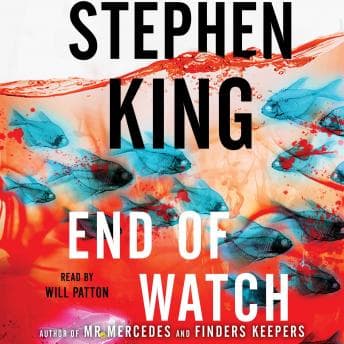

Okay, so here's the thing about Stephen King and me. I grew up in a house where his books were basically considered gateway drugs to demonic possession. Naturally, the second I moved out, I devoured everything the man ever wrote. And yeah, I've said publicly—on my podcast, multiple times—that Shirley Jackson's work hits harder for me than King's. I stand by that.
But Will Patton narrating Stephen King? That's a different conversation entirely.
I finished End of Watch at 1:47 AM. In the dark. Shirley (my cat, not Jackson) was asleep on my chest, completely unbothered by the fact that I was holding my breath during the final act. She's seen me scared before. She's unimpressed.
Let me back up. This is the third book in the Bill Hodges trilogy, and if you haven't listened to Mr. Mercedes and Finders Keepers first—stop. Go back. Do not pass go. The emotional payoff here requires that foundation. Brady Hartsfield, the Mercedes Killer, has been lying in a hospital bed for years, supposedly vegetative. Except he's not. He's awake. He's aware. And he's been developing abilities that push this trilogy from crime thriller into full-on supernatural territory.
I know some King fans were thrown by that shift. The first two books are grounded procedurals, basically. And then End of Watch goes full psychic horror. Personally? I was here for it. King has always blurred those lines—his crime fiction has never been entirely free of the uncanny—and watching Brady evolve from pathetic human monster to something genuinely otherworldly felt earned. He pulls similar moves in Outsider, also narrated by Patton, where the procedural slowly cracks open into nightmare. Creepy as hell, but earned.
Will Patton Becomes These People
The narrator commits. That's rare.
Patton has been with this trilogy from the start, and by End of Watch, he's not just reading these characters—he IS them. Bill Hodges sounds tired. Worn down. A man who knows he's running out of time in more ways than one. Holly Gibney—and this is where Patton really shows off—has this nervous, slightly too-fast cadence that captures her anxiety without ever tipping into caricature. He respects her. You can hear it.
And Brady. God, Brady.
Patton drops into this low, slow register for Brady's internal monologue that made me genuinely uncomfortable. Not horror-movie-villain uncomfortable. More like... you're-in-the-room-with-someone-wrong uncomfortable. The kind of dread that settles in your stomach. Patton gets that horror isn't about gore—it's about dread. He's not performing scary. He's performing emptiness. Malice without heat. Way more effective.
The Slow Burn Before the Sprint
The pacing here is interesting. The first third moves deliberately—King is setting up his pieces, reintroducing players, establishing the new rules of Brady's abilities. Some listeners might find it slow. I didn't, but I was also folding laundry during that section, so I had something to do with my hands. (Yes, I listen to horror while doing chores. Yes, my neighbors have seen me freeze mid-sock-fold looking terrified. We don't discuss it.)
Once the plot kicks into gear, though? Breathless. Patton's delivery matches the escalation perfectly—his voice gets tighter, faster, more urgent as the stakes climb. There's a sequence involving a concert venue that had me pausing the audiobook just to collect myself. Not because it was gory. Because King and Patton together build this sense of inevitability, of something terrible approaching that you can't stop. Classic horror mechanics executed beautifully.
Look, I'll be honest—this isn't my favorite King novel. The supernatural elements, while I appreciated them, don't quite gel with the procedural tone of the earlier books. It's a tonal shift that works better in audio than I suspect it does on the page, largely because Patton sells it so completely. He bridges that gap with sheer commitment. Patton also brought me around on Raven Boys—his range is genuinely wild.
The ending? Satisfying. Emotional in ways I wasn't expecting. Bill Hodges has become one of King's most human protagonists, and Patton's performance in the final chapters carries real weight. I may have gotten a little misty. Shirley remained unmoved.
Who's This For (And Who Should Run)
My podcast listeners are going to love this. It's the kind of audiobook that rewards investment—if you've been with the trilogy, the payoff is substantial. If you're jumping in cold, you'll be lost and you'll deserve it.
Who should skip? If you need your crime fiction to stay grounded, this will frustrate you. King goes weird here. Embrace it or don't.
But if you want nearly thirteen hours of Will Patton absolutely nailing a descent into psychic horror? If you want to feel genuinely unsettled by a villain who barely moves? If you want proof that audiobook narrators are actors and the good ones create magic?
I listened in the dark. Mistake? Maybe. Worth it? Absolutely.