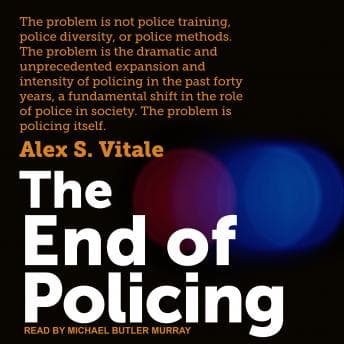

Around hour three, Vitale drops this line about how police in schools don't actually reduce violence—they just funnel kids into the criminal justice system. I was chopping onions for dal at the time, and I had to set down my knife. Not because I was crying (okay, partly the onions), but because the research actually shows exactly what he's describing. I've read the studies on school-to-prison pipeline effects on adolescent identity formation. And here was someone connecting those dots for a general audience in a way that felt almost... clinical. Too Much and Never Enough does something similar—translating clinical psychology into accessible narrative without losing analytical rigor. In the best sense.
This is a fascinating case study in how to write an abolition argument that reads like a policy brief.
The Sociologist's Scalpel
Vitale isn't an activist screaming into the void. He's a sociologist who's done his homework, and you can tell. Each chapter operates like a discrete case study—policing of sex work, policing of mental health crises, policing of homelessness, policing in schools. What makes this compelling is that he doesn't just argue "cops bad." He traces the genealogy of each expansion of police authority back to its origins, showing how these interventions were designed not for public safety but for social control.
The chapter on the origins of modern policing—slave patrols in the South, strike-breaking forces in the North—is material I'd encountered in academic contexts. But Vitale synthesizes it with contemporary data in ways that made me rethink some of my own assumptions. (My therapist would have thoughts about how I approach systemic critique like it's a personality assessment. She'd probably be right.)
Psychologically, what's interesting is how Vitale handles the reader's resistance. I saw a similar strategic anticipation of skepticism in Game, where the author had to navigate reader doubts about pickup artistry while making broader points about social dynamics. He anticipates the "but what about violent crime?" objection and addresses it directly, citing harm reduction models and restorative justice programs with actual outcome data. It's persuasive because it's not ideological—it's empirical.
Michael Butler Murray Knows When to Step Back
Here's the thing about narrating political nonfiction: you can either turn it into a sermon or you can trust the material. Murray trusts the material. His delivery is clear, measured, almost professorial—which works for a book that's essentially making an academic argument for mass consumption. No dramatic pauses when Vitale describes police violence. No quiver in the voice during the historical sections. Just steady, competent reading that lets the research speak.
Is it electrifying? No. But that's actually appropriate here. This isn't a memoir. It's not asking for emotional performance. Murray's restraint means you're processing the arguments, not the narrator's interpretation of them. At 8 hours and change, it's a substantial listen, but the pacing never drags because each chapter functions as its own contained analysis.
Where the Argument Gets Slippery
I found myself asking: why does Vitale spend so much time on alternatives without addressing implementation barriers more thoroughly? He cites successful programs in Portugal, in various US cities, in community-based crisis response. But the political economy of dismantling police departments—the unions, the municipal budgets, the cultural attachment to carceral solutions—gets thinner treatment.
The protagonist of this book (and yes, I'm calling the argument the protagonist, this is how I think) exhibits classic reformist-to-abolitionist evolution, but it occasionally skips steps. If you're already sympathetic to decarceration, you'll nod along. If you're genuinely skeptical, you might want more on the "how" and less on the "why."
That said—and I mean this—the research is solid. Vitale cites his sources clearly enough that you can follow up. This is a book that wants you to check its work.
Who This Is For (And Who It Isn't)
If you work in criminal justice, social work, mental health, or education—this is required listening. Not because you'll agree with everything, but because you need to know these arguments exist and are being made seriously.
If you're looking for an emotional narrative about policing, this isn't it. Vitale doesn't profile individual victims or tell personal stories. It's policy analysis, not true crime. Some listeners will find that cold. I found it refreshing—there's enough trauma porn in the discourse. Sometimes you just need the data.
Skip this if you fundamentally believe police reform is sufficient. Vitale explicitly rejects incrementalism. That's either clarifying or infuriating depending on where you sit.
The Research File I Didn't Expect to Open
I started this during a week when I was supposed to be finishing revisions on a paper about narrative identity in incarcerated populations. (I wasn't procrastinating. I was... adjacent researching.) What struck me was how Vitale's framework—policing as social control rather than public safety—maps onto what I see in my own work about how people construct self-narratives within carceral systems.
The system doesn't just punish behavior. It creates identities. "Criminal." "Delinquent." "Threat." Vitale doesn't use psychological language, but the implication is there: we've built institutions that manufacture the problems they claim to solve.
That's not a comfortable thought to sit with while your dal is burning. But it's the kind of thought worth having.