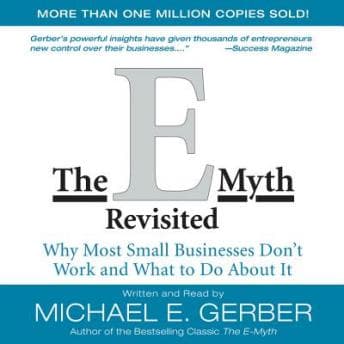

Okay so here's the thing - this book has been on my "I should really listen to this" list for like two years. Every startup founder I know has mentioned it at some point, usually with that slightly evangelical tone that makes me suspicious. But I finally caved during a particularly brutal week of on-call, and honestly? I get it now.
Quick Verdict: Worth your commute. This is basically a systems engineering mindset applied to running a business, and as someone who debugs distributed systems for a living, that framing clicked immediately.
The Entrepreneurial Seizure (And Why Your Skills Are Lying to You)
The core premise is deceptively simple: most small business owners are technicians who had an "entrepreneurial seizure" - they were good at making pies or fixing cars or writing code, so they thought "I should start a business doing this!" And then they discover that running a business and doing the work are completely different skill sets. Gerber argues you need to think like a franchisor from day one, building systems that could theoretically run without you.
Gerber Behind the Mic
Author-narrated business books are always a gamble. Sometimes you get genuine passion and insight. Sometimes you get someone who clearly should've hired a professional. This lands somewhere in the middle, leaning positive. He's clearly invested in the material (duh, it's his life's work), and that passion comes through. The pacing though? Oof. I bumped it to 1.5x almost immediately, and even then it felt a little leisurely. Some listeners apparently go 1.3x or 1.4x, but if you're a fellow speed listener, don't be shy about cranking it up.
The production quality is clean - no weird audio artifacts or background noise. Gerber's voice is pleasant enough, conversational without being too casual. He does this thing where he'll pause for emphasis that works better in a live presentation than an audiobook, but at 1.5x speed those pauses shrink to something reasonable.
The Sarah Framework (For Better and Worse)
The book uses this narrative framework where Gerber is coaching a small business owner named Sarah through transforming her struggling pie shop. And I have... mixed feelings about this. On one hand, it grounds abstract concepts in something concrete. When he talks about the difference between working ON your business versus IN your business, seeing Sarah realize she's been the bottleneck in her own operation makes it stick. On the other hand, sometimes the Sarah interludes feel like they're padding what could've been a tighter book. (Yes, I know, "could've been a blog post" is my default criticism for business books, but I'm trying to be fair here.)
The Mental Models That Actually Stuck
What landed for me: the technician/manager/entrepreneur framework. The idea that every business owner needs to balance three personalities - the technician who does the work, the manager who craves order, and the entrepreneur who dreams big - is genuinely useful. I've been thinking about it in terms of my own career, honestly. Like, when I'm heads-down debugging a gnarly race condition, that's technician mode. When I'm writing runbooks and documentation, manager mode. And when I'm pitching new architecture to leadership? Entrepreneur. It's a mental model that generalizes way beyond small business.
The franchise prototype concept is the other big takeaway. Basically: document everything, systematize everything, make your business run like a McDonald's even if you're never going to franchise. The ROI on this audiobook is highest if you're actually running or planning to run a small business, but honestly, the systems thinking translates. I've already started applying some of these ideas to how I organize my side projects.
Perfect for: train, gym, chores. Skip for: deep work (it's not that dense, but you want to actually absorb the frameworks).
I finished this in about 4 commutes (accounting for speed adjustment), and by the end I had a genuinely different perspective on what it means to build something sustainable. Is it life-changing? I mean, I'm not quitting my FAANG job to open a pie shop. But it reframed how I think about systems, processes, and the trap of being indispensable.
Queue It or Skip It?
Who should listen: anyone running a small business, thinking about starting one, or honestly just interested in systems thinking applied to organizations. The concepts are evergreen even though some of the specific examples feel a bit dated. If you want the wealth-building mindset without the business operations focus, Millionaire Next Door takes a completely different angle on financial systems.
Who should skip: if you're looking for tactical startup advice (fundraising, growth hacking, whatever), this isn't it. It's more philosophical, more foundational. Also if slow narration drives you absolutely nuts and you refuse to speed-adjust, maybe grab the print version instead.
Pushing to Main
Kevin's been making noise about maybe starting a side business, and I've already told him he needs to listen to this first. Whether that's genuine recommendation or just me wanting him to understand why I keep muttering about "working ON the business, not IN it" - honestly, probably both.