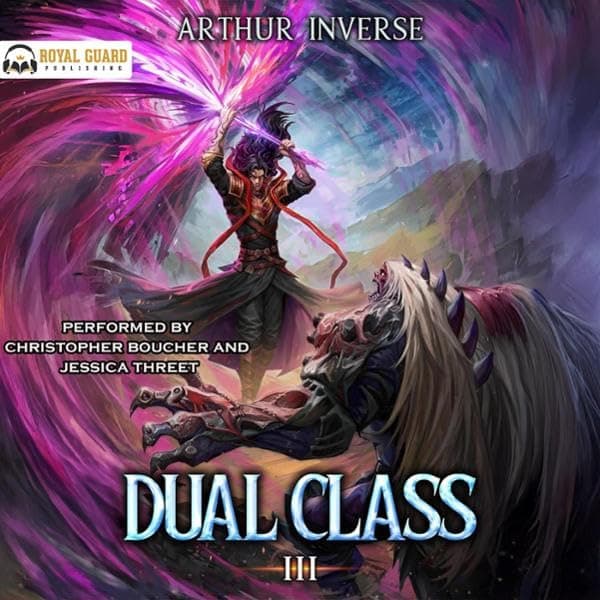

What happens when an overpowered protagonist's biggest enemy isn't the monsters—it's his own ego? That's the question I kept wrestling with across 27 hours of Dual Class 3, and whether that tension works for you will determine everything about your experience with this book.
Arthur Inverse's third installment picks up after the tutorial arc, dropping Drake into a System-transformed Earth where Primordials are watching him like a reality TV contestant they can't decide whether to sponsor or squash. The setup is strong: the shift from contained tutorial to open-world survival raises the stakes meaningfully, and the LitRPG progression mechanics continue to scratch that leveling itch. Drake's dual-class build remains one of the more interesting power systems in the genre, and watching him puzzle out new ability synergies kept me engaged through long stretches of my commute.
But let's talk about Drake himself, because he's the axis on which this whole series spins. His pride and arrogance aren't character flaws the narrative interrogates—they're features the story celebrates, repeatedly and loudly. If you're into that anime-protagonist energy where the MC talks trash, powers up, and bulldozes through consequences, you'll eat this up. If you're not, prepare for frustration. By the midpoint, I'd lost count of how many times Drake's stubbornness was framed as badass rather than reckless. The book leans hard into the weeby personality type, and while that's clearly intentional, the repetition dulls the edge. A character flaw that never costs the protagonist anything meaningful isn't really a flaw—it's just a personality quirk wearing a leather jacket. Rand al'Thor in Path of Daggers walks that same razor's edge—arrogance coded as destiny—except Jordan actually makes him bleed for it, and that difference stuck with me long after I finished.
The action sequences hit hard when they land. Inverse writes combat with a kinetic, system-integrated style that gives fights mechanical weight beyond just "sword goes whoosh." The Primordial threat adds genuine menace to the world-building, and there are moments where the political maneuvering between ancient powers creates real tension. The problem is pacing: between the big set pieces, the humor sometimes feels forced, leaning on volume rather than wit. There's a difference between a character being funny and a character being loud, and Drake occasionally mistakes one for the other.
Now, the narration—and this is where opinions fracture like a crit-hit damage table. Christopher Boucher and Jessica Threet deliver a dual narration that, at its best, rivals the top tier in LitRPG audio. Their character differentiation is excellent, with distinct voices that make group conversations easy to follow. Threet brings genuine warmth and edge to her characters, and Boucher captures Drake's brash energy convincingly. When the two are in sync, trading off perspectives, the production feels polished and professional.
Here's the catch: the dynamic range is aggressive. And I mean AGGRESSIVE. Some passages feel like the narrators are whispering conspiratorially, then suddenly Drake is screaming at full volume like someone cranked the gain to eleven. During my morning drive, I found myself lunging for the volume knob more than once. If you're a headphone listener, be warned—the jumps between quiet dialogue and full-throated battle cries can be genuinely startling. Boucher commits fully to Drake's melodramatic moments, which means when Drake is being loud and proud (which is often), your eardrums are along for the ride whether they want to be or not.
The narration simultaneously elevates and complicates the source material here. The screaming that some listeners find immersion-breaking is the same committed performance others praise as best-in-class. It comes down to your tolerance for theatrical delivery and whether you experience Drake's personality as infectious or exhausting.
At 27-plus hours, this is a substantial listen, and the length works both for and against the book. The progression is satisfying—you genuinely feel Drake growing in power—but the character beats can feel circular. The book could trim 15-20% without losing narrative momentum, particularly in the mid-section where Drake's internal monologue revisits the same emotional territory.
What keeps me coming back to this series despite my complaints is the core loop: the dual-class system is clever, the power scaling feels earned (mostly), and when Inverse lets the world-building breathe beyond Drake's perspective, there's a genuinely interesting post-apocalyptic setting here. The Primordial dynamics add a layer of cosmic intrigue that gives the story more narrative ambition than your average LitRPG.
Who Should Listen (And Who Should Skip): If you've made it through books one and two and you're still on board with Drake's energy, this delivers exactly what you want—more levels, bigger fights, higher stakes. If Drake's personality wore you down in earlier installments, nothing here will change your mind. Skip it and save your eardrums. Newcomers: start at book one or you'll be lost.
Dual Class 3 is a confident third entry that doubles down on everything that made the series popular, for better and for worse. It doesn't reinvent itself or address the criticisms from earlier books. It knows its audience, serves them well, and doesn't apologize for it.