
Denise and I have this ritual on Sunday mornings — lakefront walk, coffee in hand, whatever I've got queued up on the earbuds. She listens to true crime. I listen to literature. We hold hands and exist in completely separate fictional universes. It works for us.
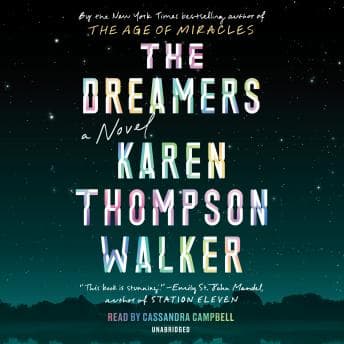
I started The Dreamers on one of those walks, and I want to say something happened — that the lake looked different, that the light shifted, that I stopped walking and made Denise stop too. But honestly? The opening was quieter than that. A college girl falls asleep in her dorm room in a small California hill town. Doesn't wake up. Then another girl. Then another. And Walker just... lets that sit there. No explosion. No immediate hysteria. Just the slow, creeping wrongness of it.
That restraint is the whole book, actually. And whether you find it hypnotic or frustrating will determine everything about your experience.
When the Prose IS the Plot
Let me be direct about what this novel is not: it is not a thriller. It is not a puzzle box with a satisfying answer about what the sleeping sickness actually is or means. The blurb says the sleepers are having "heightened dreams — but of what?" and Walker's answer is, essentially, that's not the point. My students would hate this. I love it.
What Walker is doing — and she did something similar in The Age of Miracles, though this one is less thematically tight — is using a speculative premise the way Camus used plague. The illness is a pressure system. It forces the characters into the essential questions: what do we protect, what do we abandon, who are we when the ordinary scaffolding collapses? A young couple hovers over their newborn as the town unravels around them. Two sisters orbit their survivalist father, who has been preparing for exactly this kind of disaster his whole life and is somehow still unprepared for what it actually feels like. Mei, the roommate who first discovers the sleeping girl, gets pulled into the chaos with an eccentric classmate who reads like someone Walker loved writing.
None of these storylines fully converge. That's a deliberate choice. The novel is structured like a fever — episodic, associative, occasionally disorienting. Some readers want the threads to pull tight at the end. They won't. If you loved Station Eleven, this is its quieter, more interior spiritual successor — less about the architecture of collapse, more about the texture of being inside it. Three Day Road lives in that same interior space — less interested in the machinery of catastrophe than in what it does to the people caught inside it, and it's stayed with me the way this one is starting to.
Cassandra Campbell Understands What "Pause" Does
The narrator understands that pause is punctuation. Campbell's approach to Walker's prose — which is genuinely beautiful in the way that slows you down, the way you re-read a sentence not because you missed something but because you want to stay in it — is to honor the rhythm rather than push through it. She keeps her voice in a fairly neutral, elegant register throughout. Character differentiation is there, but subtle. The male voices get a slight grounding, the female voices a slight lift, but nobody sounds dramatically different from anybody else.
For a different kind of book, that would be a problem. Here, it's almost right. The effect is that the whole novel feels like it's being told from a slight remove — like someone recounting a dream they half-remember. Which, given the subject matter, is either brilliant or a happy accident. I'm choosing to believe it's intentional. The one place I wished Campbell had pushed harder was in the survivalist father scenes, where a little more edge in his voice would've made the tension between his preparedness and his helplessness land with more weight. As it is, he sounds like everyone else, and he shouldn't.
But her emotional delivery in the quieter domestic scenes — particularly anything involving the newborn — is genuinely affecting. She finds the fear in the mundane, which is exactly what the book asks of her.
Who This Walk Is For
If you need narrative momentum, skip this one. The pacing complaints are real — this is a novel that moves the way fog moves, which is to say: you don't notice it happening and then suddenly you can't see the road. That's either your thing or it isn't.
If you're someone who teaches or reads Marilynne Robinson and thinks yes, but what if there were also a mysterious illness — this is your book. If you've been looking for something that takes the quiet catastrophe of ordinary life seriously without wrapping it in easy resolution — this is your book. Worth pausing the faculty meeting for. Worth the full Sunday lakefront walk.
At 10.5 hours, it's a reasonable commitment for what it delivers. I finished it in three walks and one late-night grading session where I absolutely should have been focused on my juniors' Gatsby essays. Fitzgerald would understand. He had his own feelings about dreams that don't quite deliver on their promise.