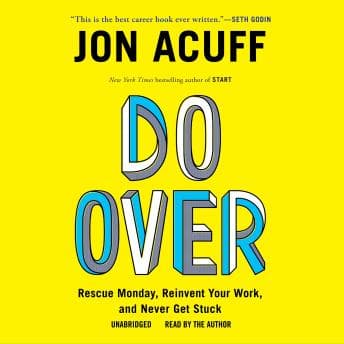

How much time have you actually spent thinking about your career versus just... surviving it?
I was chopping onions for a chana masala at 9 PM on a Tuesday when Jon Acuff hit me with that question, basically. And I stood there, knife in hand, tears running down my face (from the onions, but also maybe from the existential reckoning), thinking about how I spent four years on a PhD and approximately zero hours strategically planning what comes after the dissertation defense. Acuff's point landed harder than I expected from a self-help book with a pun in the title.
The Career Savings Account Is Actually a Decent Framework
Here's what I'll give Acuff credit for: the central metaphor works. He builds his whole career advice structure around what he calls a "Career Savings Account" - four investments you make: skills, relationships, character, and hustle. It's not revolutionary psychology (I found myself mapping it loosely onto existing motivation frameworks), but it's organized in a way that makes the abstract concrete. Which is, frankly, what most self-help books fail at.
What makes this different from the usual "follow your passion" noise is that Acuff acknowledges the mortgage problem. You have a family. You have bills. You can't just quit your job Monday morning because a book told you to chase your dreams. The same tension between practical constraints and personal reinvention shows up in Art of Money Getting, though Barnum's version is considerably less concerned with your feelings about it. The research actually shows that most successful career pivots happen gradually, and Acuff seems to intuitively understand this even if he doesn't cite the literature. He's building a case for incremental change, not dramatic reinvention, and psychologically, that tracks.
The stories he shares - people who got laid off, who came back from extended leave, who just woke up one day realizing they were enduring fifty weeks to enjoy two - these function as mini case studies. Some are genuinely useful. Others feel a bit like motivational conference filler, the kind where everyone claps but nobody remembers the specifics by Thursday.
Acuff Reading Acuff: The Charm and the Limitation
So Jon Acuff narrates his own book, and this is both the strength and the ceiling of the audiobook experience. His delivery is warm, funny, conversational - he sounds like the guy at the party who's actually interesting to talk to, which is rare for business authors. There's a looseness to his reading that makes six hours and forty-eight minutes feel lighter than it should.
But - and this is where my inner researcher gets twitchy - the humor sometimes becomes the point rather than supporting the point. He'll set up a genuinely smart insight about career stagnation and then pivot to a joke that deflects from the discomfort of sitting with the idea. My therapist would have thoughts about this character trait. It's a classic avoidance pattern dressed up as self-deprecation, and while it makes him likeable, it occasionally undercuts the depth.
One listener I came across put it perfectly: they loved Acuff but this book "just didn't do it" for them. I found myself asking: why does that happen with an author people clearly adore? I think it's because the audio format exposes the thinness of certain sections. In print, you can skim past a weaker anecdote. In audio, you're committed. You're standing in your kitchen, stirring, waiting for the insight to land, and sometimes it just... doesn't arrive with enough weight.
Who This Actually Helps (And Who It Won't)
The protagonist of this book - and yes, in self-help, there IS a protagonist, it's the imagined reader - exhibits classic mid-career paralysis. They're not miserable enough to quit, not satisfied enough to stop Googling "career change at 35." If that's you, this book is a solid entry point. It won't replace actual career counseling or a hard look at your finances, but it'll give you a vocabulary for what you're feeling and a framework for small moves.
If you're an academic or someone who wants data-driven career advice, you'll find this lightweight. Acuff is a storyteller and a motivator, not a researcher. The evidence base is anecdotal. Which is fine - not every book needs to be a meta-analysis - but know what you're getting.
Also, several listeners noted they'd prefer this in print for reference, and I get that. This is the kind of book where you want to underline things and come back to specific sections. Audio makes that harder. It's a good listen for a first pass, but you might want the physical copy if you're serious about implementing the Career Savings Account framework.
My Clinical Note
Do Over is a fascinating case study in accessible self-help that mostly earns its optimism. Acuff understands something fundamental about human motivation: people don't change because they're told to, they change because someone makes the alternative feel possible rather than terrifying. He does that well. Not perfectly - the humor occasionally shields him from going deeper, and some sections feel more like a keynote speech than a book - but well enough that I finished it, thought about my own career choices, and only mildly burned my chana masala in the process.
Worth your time if you're stuck. Not a revelation, but a genuinely useful nudge from someone who's funny enough to keep you listening.