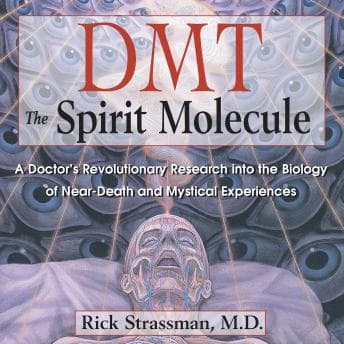

"The feeling was like being shot out of a cannon into another dimension."
That's roughly how one of Strassman's volunteers describes their DMT trip, and honestly? That sentence basically summarizes my entire 15-hour experience with this audiobook. I started listening during a particularly brutal on-call week—couldn't sleep after a 3AM pager alert, figured I'd learn something. Four nights later, I'm lying in bed at 2AM questioning the nature of consciousness while my boyfriend snores peacefully beside me. Thanks, Dr. Strassman.
When Your Brain Manufactures Its Own Rocket Fuel
Bottom Line: This is basically a clinical trial report but for interdimensional travel. Strassman ran FDA-approved DMT studies at UNM from 1990-1995, injecting sixty volunteers with what he calls "the spirit molecule," and this book is his detailed account of what happened. The kicker? DMT isn't just some exotic plant compound—your brain makes it. Your pineal gland. The chemistry here is wild; The Disappearing Spoon has that same "wait, WHAT?" energy when it gets into how elements mess with biology. That tiny pine-cone-shaped thing Descartes called the "seat of the soul." The science actually holds up, at least the neurochemistry parts.
What makes this genuinely fascinating is Strassman's position. He's a clinical psychiatrist, not some guy who ate too many mushrooms at Burning Man. He got government funding. He had IRB approval. He took vitals and blood samples while people reported meeting machine elves and receiving telepathic downloads from alien entities. The cognitive dissonance of reading clinical notes about mystical experiences is... something.
The Alien Abduction Connection (Yes, Really)
Okay, so here's where it gets weird. And I mean *weird* weird, not just "oh that's unusual" weird. A significant number of Strassman's volunteers—completely independent of each other—reported encounters with intelligent nonhuman beings. Not vague "presences" but specific entities. Some described classic grey aliens. Others met insectoid creatures. A few encountered what they could only describe as angels.
Strassman's hypothesis? Those alien abduction experiences people report—the ones with the paralysis, the bright lights, the beings performing examinations—might be triggered by spontaneous DMT releases in the brain. It's a wild theory, but he presents it with the careful hedging of someone who knows he's walking a tightrope between legitimate research and career suicide. I appreciate that he doesn't oversell it. He's basically saying "here's the data, here's one possible interpretation, make of it what you will."
Where the Signal Gets Noisy
Now, the ROI on this audiobook is complicated. At nearly 15 hours, there's significant padding. The first few hours cover Strassman's journey to getting the study approved—important context, but it drags. There are sections where he analyzes individual trip reports that start to feel repetitive by hour 8. (Person takes DMT. Person leaves body. Person meets entities. Person returns confused but transformed. Repeat.)
Drew Graham's narration is... fine? He's competent, clear, doesn't stumble over the pharmacological terminology. But he reads it like what it is: a medical researcher's account of clinical trials. There's not much he can do to inject drama into dosage protocols and blood pressure readings. The book needed someone who could differentiate between the clinical framework sections and the genuinely transcendent volunteer accounts, and Graham kind of reads everything at the same emotional register.
I also have to flag something that bugged me as someone who works with data: Strassman occasionally makes leaps from observation to conclusion that feel... ambitious. The pineal gland theory is fascinating but largely speculative. He admits this, but then keeps building on it anyway. It's like watching someone construct an elaborate system architecture on top of an unproven assumption. (Yes, I just compared metaphysical speculation to technical debt. I contain multitudes.)
Who This Is For (And Who Should Bail)
This is absolutely not a commute book. I tried. The train from SF to Mountain View is not the place to contemplate whether consciousness survives bodily death. You need focus. You need to be able to rewind when Strassman starts explaining tryptamine biosynthesis pathways.
Listen if: You're interested in consciousness research, psychedelic therapy, or the intersection of neuroscience and spirituality. If you've ever wondered why near-death experiences share common elements across cultures, this offers one genuinely interesting hypothesis. Also recommended for the morbidly curious who want to know what happens when you inject people with the most powerful psychedelic known to science under clinical conditions.
Skip if: You want hard conclusions—you'll be frustrated. If you're looking for a practical guide to anything, this ain't it. And if detailed trip reports start to blur together for you (they did for me around hour 10), you might want the physical book where you can skim.
End of Stack Trace
I finished this audiobook with more questions than answers, which I think is actually the point. That open-ended exploration of psychological territory reminded me of Emotional First Aid—different subject matter, but the same approach of mapping uncharted mental experiences with clinical precision. Strassman isn't claiming to have solved consciousness. He's documenting a strange corner of human experience that mainstream science has mostly ignored, and he's doing it with the rigor of someone who knows his career depends on being taken seriously.
Is it slow in places? Yes. Does the narration lack dynamism? Also yes. But the core content—the idea that your brain produces a compound capable of generating experiences indistinguishable from contact with otherworldly intelligences—that's worth the time investment. Even if you end up skeptical of Strassman's conclusions, you'll come away thinking differently about the relationship between brain chemistry and subjective experience.
I listened at 1.25x, which helped with the pacing without losing the technical content. Would I recommend it? For the right listener, absolutely. Just maybe not at 6AM on a packed Caltrain.