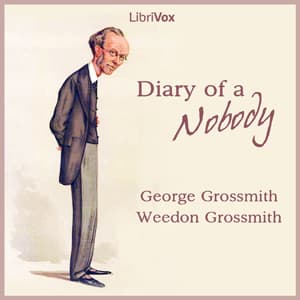

Charles Pooter is the most boring man in Victorian England, and I mean that as the highest compliment the Grossmith brothers ever received.
I finished this one during a Saturday morning walk along the lakefront with Denise, and she kept asking why I was laughing out loud at what I'd described as "a Victorian diary about nothing." Because that's exactly what it is. A man records the absolute minutiae of his suburban life — the paint on his bath, the rudeness of tradesmen, the horrifying moment his son announces he's going by "Lupin" now — and somehow, across 130 years, it's still funny. Not in a clever, look-how-witty-I-am way. Funny because Pooter is so earnest, so utterly convinced that his small indignities matter, that you can't help but recognize yourself in him.
The Original Blog, Before Blogs Ruined Everything
Let's talk about what the Grossmith brothers are really doing here, because it's sneakier than it looks. This started as a serial in Punch magazine in 1892, and it's essentially a satirical blog written a century before the internet existed. Pooter documents everything — every dinner party slight, every social faux pas, every bit of unsolicited advice from his insufferable friends Cummings and Gowing — with the unshakable belief that posterity will care. The joke, of course, is that posterity does care, just not for the reasons Pooter imagines.
The bath painting scene is a perfect example. Pooter decides to paint his bathtub red, it goes predictably wrong, and the way he records the disaster with wounded dignity rather than self-awareness is what makes it land. He's not trying to be funny. He's trying to be Important. That gap between intention and reality is where all the humor lives. My students would hate this. I love it. I reviewed Lost Rider a while back and that one has a similar thing going on — a character so stubbornly committed to his own version of himself that the gap between self-image and reality does most of the heavy lifting.
And then there's his son Willie — sorry, Lupin — who represents everything Pooter fears about modernity. The kid changes his name on a whim, runs with a flashier crowd, and treats his father's conventions like furniture to be rearranged. It's a generational conflict I watch play out in my classroom every single day, just with less Victorian propriety and more phones.
Martin Clifton Understands That the Joke Is Keeping a Straight Face
Here's the thing about narrating comedy this dry — you have to resist every instinct to wink at the audience. Martin Clifton gets this completely. His reading is deadpan in exactly the right way. Warm voice, pleasant pacing, and absolutely zero mugging. He reads Pooter's most absurd observations with the same matter-of-fact sincerity Pooter would use himself, and that restraint is the performance.
The narrator understands that pause is punctuation. When Pooter records some minor social humiliation and then moves on to the next diary entry as if nothing happened, Clifton lets the silence do the work. He doesn't italicize the punchlines with his voice. He trusts you to find them. That's a harder skill than most people realize — the comedy of understatement requires a narrator willing to disappear into the character's obliviousness.
I don't have strong complaints about the narration. It's polished, it's clear, the audio is clean. If I'm being picky — and at 1.0x speed I notice everything — there's not a ton of vocal differentiation between characters. Cummings and Gowing could use a bit more distinction. But honestly, for a book that's essentially one man's internal monologue dressed up as a diary, a single consistent voice works. This is Pooter's world. Everyone else is just visiting.
Who This Is For (And Who'll Give Up by Hour Two)
If you loved Wodehouse, this is its spiritual predecessor — the DNA of English comic writing about well-meaning people making small messes of their small lives. If you appreciate Jane Austen's social satire but want something that takes a quarter of the time, this four-and-a-half-hour listen is the move.
But if you need plot — real, forward-moving plot with stakes and consequences — you're going to be frustrated. Nothing much happens. That's the point. This is a book about the comedy of the mundane, and either that registers with you or it doesn't. I'd also say this rewards focused listening more than background play. The humor is quiet enough that you'll miss it while doing dishes.
Worth Pausing the Faculty Meeting For
This is why we still read the classics. Not because they're Important with a capital I, but because a comedian writing in 1892 about a man who thinks too highly of himself and too little of the world around him still hits in 2024. The prose deserves to be savored, Clifton's narration matches the material's temperament perfectly, and at just over four hours, it doesn't overstay its welcome.
Pooter would be delighted to know people are still listening to his diary. He'd also be mortified to learn they're laughing at him. That's the whole beautiful, ridiculous joke.