
"The orators of our day are as tepid as the schools that formed them."
That line hit different at 5:47 AM on a Tuesday, wedged between two sleeping strangers on the Caltrain, coffee not yet kicked in. Tacitus — or possibly Quintilian, because even scholars can't agree on who wrote this — basically roasting the entire Roman education system for producing mediocre speakers. And I'm sitting there thinking: this is a 2,000-year-old subtweet about how standards have fallen. Some things really don't change.
A 75 A.D. Postmortem on Why Everyone Sucks Now
TL;DR: Worth your commute if you're into rhetoric, Roman history, or just enjoy listening to intellectuals dunk on each other in a structured debate format. Not if you want anything resembling a narrative arc.
So here's the setup: it's the year 75, Vespasian is emperor, and a group of Roman intellectuals sit around debating why oratory has gone downhill. That's it. That's the plot. Think of it as basically a Hacker News thread about "why we can't hire good engineers anymore" but set in ancient Rome and written with infinitely more grace.
The structure is a Socratic-style dialogue — different speakers take turns making arguments about whether poetry or oratory is the higher art, whether modern education is failing students, and whether the political system itself has killed the need for great public speaking. That last point actually lands hard. One speaker argues that the decline of the Republic and rise of autocracy removed the stakes from rhetoric — when political outcomes are predetermined, why bother being eloquent? It's a systems-level diagnosis disguised as a literary debate.
At three hours, it's lean. No bloat. Could not have been a blog post, actually, because the back-and-forth format is the whole point. Each speaker builds on or dismantles the previous argument, and you can feel the intellectual tension ratcheting up. The section where Maternus defends his choice of poetry over law — arguing that poets commune with the sacred while orators wade through corruption — that's genuinely affecting stuff, even in translation.
Leni and the LibriVox Question
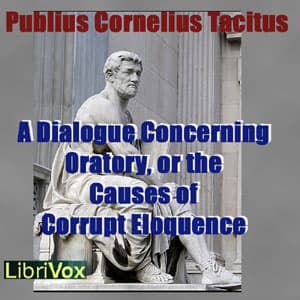
Let me be straight: this is a LibriVox recording. Free audiobook, volunteer narrator, no production budget. You know what you're getting. Leni reads clearly and at a steady pace, which for a dialogue-heavy classical text is honestly the main thing you need. There's no background music, no sound effects, no post-production wizardry. Just a person reading Tacitus into a microphone.
The limitation is that with a single narrator handling what's essentially a multi-person debate, the speakers can blur together. There are moments where I lost track of who was arguing what — was that Aper defending modern oratory or Messalla critiquing it? In a full-cast production this would be trivial to follow. Here, you need to pay slightly more attention than I could manage pre-coffee. I found myself rewinding maybe three or four times across the full listen.
Leni's pacing is measured, almost academic, which fits the material. But at 1x it dragged for me. I bumped to 1.5x and it felt like a brisk intellectual conversation rather than a lecture. At 1.75x some of the Latin names started getting slippery, so 1.5x was the sweet spot.
Who This Is Actually For (And Who Should Bail)
Perfect for: anyone who's ever fallen down a Wikipedia rabbit hole on Roman history, anyone in communications or rhetoric, anyone who likes primary sources over secondary commentary. Also weirdly relevant if you work in tech and have opinions about declining craft standards — swap "oratory" for "software engineering" and half of these arguments still track.
Skip for: anyone wanting a story, anyone who needs character development, anyone who finds classical translations dry. If you bounced off Marcus Aurelius's Meditations in audio format, this will not convert you.
The ROI on this audiobook is... complicated. It's free, so the cost is just your time — three hours. The ROI framing is something I've been thinking about a lot lately after reading Debt-Free Spending Plan — that book made me weirdly rigorous about how I budget not just money but hours, and it's changed how I evaluate whether any three-hour listen actually earns its slot. For what it is, a window into how educated Romans thought about education, rhetoric, politics, and cultural decline, it's dense with ideas. I pulled out at least four concepts I've been chewing on all week, including the argument that systemic stability actually kills innovation in communication. (Someone pitch that as a startup book: "Why Empires Make Bad Speakers.")
But the audio experience specifically? It's serviceable, not great. The translation itself reads a bit stiff in places — this is an older public domain rendering, and you can feel the Victorian-era translator trying to be Faithful To The Latin at the expense of natural English rhythm.
Commit to Main or Cherry-Pick
I finished this in two commutes. It didn't blow my mind the way a great sci-fi series does, but it gave me something different — a genuinely old perspective on a genuinely permanent problem. The fact that people in 75 A.D. were already complaining about declining standards and blaming the education system is either depressing or comforting, depending on your mood.
For a free LibriVox listen, it over-delivers on substance. For an Audible credit? Don't. Stream it, borrow it, treat it as a curiosity. But if you have any interest in rhetoric or Roman intellectual life, the three hours are well spent.