
When does a hero stop being charming and start being insufferable?
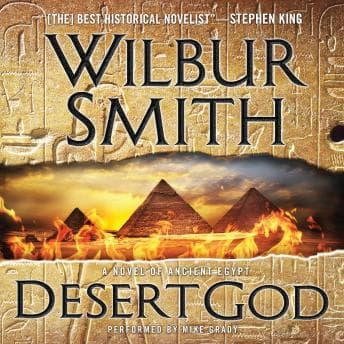
I've been thinking about this ever since I finished Wilbur Smith's Desert God, fifteen hours I spent mostly on the lakefront with Denise during those unseasonably warm November evenings. She kept asking why I was making faces at nothing. The answer was Taita — Smith's brilliant, beautiful, impossibly capable protagonist who narrates his own legend with the subtlety of a man writing his own Wikipedia page.
The Smartest Man in Every Room He Enters (And He Knows It)
Let me be clear: Wilbur Smith can write. The man builds ancient Egypt the way a master carpenter builds a house — you can feel the grain of the wood, smell the sawdust. The descriptions of the Nile landscape genuinely stopped me mid-stride more than once. There's a sequence involving the eruption of Mount Cronus and the rescue of princesses Tehuti and Bekatha that's pure cinematic spectacle, the kind of set piece that makes you understand why Smith has sold over 140 million books.
But Taita. Oh, Taita.
He's a eunuch slave who also happens to be the greatest strategist, healer, charioteer, spy, diplomat, and humble-bragger in the ancient world. The first-person narration means we're trapped inside his self-congratulatory inner monologue for every single one of those fifteen hours. It's like being stuck at a dinner party with someone who tells you how modest they are — five times. This reminds me of what Hemingway said about the importance of leaving things out. Smith leaves nothing out. Taita's genius is announced, demonstrated, celebrated, and then announced again, just in case you missed it.
My students would hate this. I... didn't hate it exactly. But I was exhausted by it.
Mike Grady and the Difficult Art of Narrating a Braggart
Mike Grady is an Earphones Award winner, and you can hear why — the man has genuine skill. His pacing through the battle sequences against the Hyksos carries real momentum, and when Smith's prose goes landscape-painting mode, Grady settles into this warm, almost reverent tone that works. He understands that pause is punctuation, and he uses it well during the quieter strategic scenes.
But here's the problem: how do you narrate a character who is constantly impressed with himself without the performance itself sounding corny? Grady doesn't quite solve this. When Taita is marveling at his own cleverness — which happens roughly every twenty minutes — there's a theatrical quality to the delivery that tips over into unintentional comedy. It's not Grady's fault, really. The text gives him nowhere to hide. You can't underplay "I am the greatest warrior-poet-spy in Egypt" when the next paragraph has the character proving it again.
I kept wishing Grady had gone dryer with the self-praise passages — a hint of irony, a slight detachment, anything to suggest Taita might be an unreliable narrator. But Smith clearly doesn't intend unreliability. He means every word of Taita's glory. And Grady delivers it straight.
The Journey That Covers More Ground Than Your Average Road Trip
The epic journey itself — up the Nile, through Arabia, into Babylon, across the Mediterranean to Crete — is genuinely ambitious in scope. Smith writes action like a man who's held a sword (or at least studied people who have). That same meticulous attention to tactical detail made Great Train Robbery such a satisfying listen — the heist mechanics feel just as researched. The strategic planning against the Hyksos has real tactical weight. And when the novel slows down to breathe in Babylon, there's a magical quality to the world-building that earns the fifteen-hour commitment.
But. And this is the "but" that kept nagging me during a particularly long faculty meeting where I was definitely not listening to this instead of the curriculum review. (Sorry, Martinez.) The novel is overstuffed. It rushes through moments that deserve lingering and lingers on moments that deserve rushing. The pacing lurches between breathless action sequences and stretches where you're just... waiting for Taita to finish admiring himself so the plot can resume.
If you loved Smith's earlier Egyptian novels — River God especially — this is recognizably the same universe, the same ambition. But it's also a little tired. The formula shows. The prose deserves to be savored in places, but in others it's on autopilot.
Who Gets the Permission Slip
Historical fiction fans who want scale, spectacle, and a fully immersive ancient world — you'll find plenty to love here. If you've read the Taita series before, you already know whether you can tolerate the protagonist. If this is your first — maybe start with River God instead, where the formula was still fresh.
Skip it if self-congratulatory narrators make your teeth itch. At fifteen hours, that's a lot of itching.
The Grade I'd Write in the Margin
Smith can still build a world that swallows you whole. The Egypt here is vivid, dangerous, and real. But the novel needs an editor with a red pen and the courage to use it — something I tell my sophomores every single day while they roll their eyes at me. Worth pausing the faculty meeting for, but just barely.