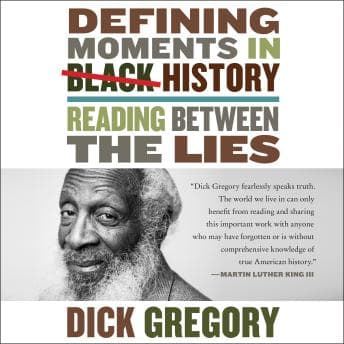

How many history books have you read where the author personally marched alongside the people he's writing about?
That question kept rattling around my head while I listened to Dick Gregory's Defining Moments in Black History during a late-night security audit at a client's warehouse complex. Just me, Ranger in the truck, a thermos of black coffee, and Gregory's voice - well, James Shippy channeling Gregory's voice - cutting through the quiet like a drill sergeant who happens to be hilarious.
A Comedian Who Was There When It Mattered
Let me cut to the chase. This isn't your standard history audiobook. Gregory doesn't approach Black American history like an academic. He approaches it like a man who ate at the same table as Medgar Evers, who stood next to Dr. King, who put his body on the line at Selma. That first-person proximity to history gives certain passages a weight that no footnoted textbook can touch. When he talks about personal relationships with civil rights leaders spanning sixty-plus years, you're not getting secondhand analysis. You're getting battlefield testimony.
And that's where my ears perked up. I know what it's like to have been there - to have a version of events burned into your memory that doesn't always match the official record. Battle Scars wrestles with that same gap between lived experience and the tidy version that gets written down afterward - worth a read if that tension resonates with you the way it does with me. Gregory's subtitle - "Reading Between the Lies" - tells you exactly what he's doing. He's challenging the sanitized version. Sometimes brilliantly. Sometimes... well, I'll get to that.
The book covers roughly 100 moments, from the Middle Passage all the way to Black Lives Matter, and it moves fast for a 7.5-hour listen. You get cultural touchstones like Sidney Poitier's Oscar for Lilies of the Field sitting alongside Billie Holiday's Strange Fruit, the Great Migration, the Harlem Renaissance, and - I kid you not - a section on the Jheri Curl and the cultural significance of bacon and pork in Black American life. That range is either going to charm you or give you whiplash. For me, it was mostly the former.
Where the Intel Gets Shaky
Here's where it gets complicated. Gregory's "infectious paranoia" - and the publisher's own description uses that phrase, which should tell you something - means some of his takes land hard and others fly right past the target. His voice is unapologetically his own, and that's the book's greatest strength and its most significant liability.
Some listeners who know the biographies he discusses have pushed back, saying certain perspectives don't ring true or accurate. I noticed moments where Gregory's lens seemed less like analysis and more like personal grudge work. There's a difference between challenging the historical record with evidence and just... having a hot take. A few of these essays blur that line.
I've briefed enough intelligence reports to know when someone's convictions are running ahead of their facts. Gregory does this occasionally. Not enough to sink the book, but enough that I'd recommend keeping your critical thinking engaged rather than absorbing everything as gospel. This is one man's perspective on history - a man who was present for much of it, which counts for a lot - but still one man.
Shippy Behind the Mic
James Shippy's narration is solid. He captures Gregory's acerbic wit without overplaying it, which is the right call. Gregory's humor works best when it sneaks up on you - a deadpan observation about race that makes you laugh and then immediately feel uncomfortable for laughing. Shippy understands that rhythm. He doesn't try to turn this into a comedy special. He plays it straight and lets Gregory's words do the work.
No audio issues. No weird pacing problems. Single narrator handling essay-format material is about as clean a production setup as you can get, and this one executes without hiccups. I ran it at my standard 1.25x and it felt natural - Gregory's conversational style actually benefits from a slightly quicker pace.
Who Should Saddle Up (And Who Should Stand Down)
If you want a conventional, play-it-safe survey of African American history, this isn't it. Go find a textbook. If you want to hear a man who spent fifty years in the fight share his unfiltered, sometimes uncomfortable, occasionally off-base, but always passionate take on the moments that shaped Black America - this is worth your time.
Military folks and anyone who's lived through history rather than just studied it will appreciate Gregory's first-person authority, even when you disagree with his conclusions. People who need their history neat and tidy will probably bail by hour two.
Worth your time? Here's the debrief: it's an imperfect but important listen. The essays where Gregory draws on personal experience are genuinely powerful. The ones where he's working from opinion rather than proximity are weaker but still interesting. The NAACP Image Award it won was deserved - not because every word is unassailable, but because Gregory's voice is one that needed to be preserved.
Ranger slept through most of it, but he perked up during the sections on the civil rights movement. Smart dog. Those were the best parts.









![Steve Jobs [unabridged audiobook] audiobook cover](/_next/image?url=https%3A%2F%2Fcovers.audiobooks.com%2Fimages%2Fcovers%2Ffull%2F9788499923406.jpg&w=1920&q=75)