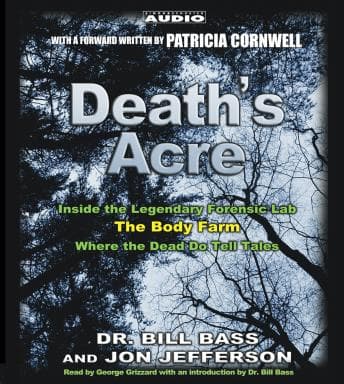

Look, I need to talk about the cognitive dissonance of listening to a man describe insect colonization patterns on human remains while his narrator sounds like he's reading you a bedtime story. George Grizzard's voice is warm. Like, grandfather-telling-you-about-his-fishing-trip warm. And the thing he's telling you about is how Dr. Bill Bass left bodies out in the Tennessee sun to figure out how long it takes for soft tissue to liquefy. Some listeners found that disconnect jarring. I found it fascinating - because that's exactly how Bass himself apparently operates. The man built his career on treating death like a puzzle to be solved over coffee, and the narration mirrors that unsettling calm perfectly.
I was cooking aloo gobi at 10 PM on a Tuesday - one of those nights where the kitchen becomes a meditation space and I needed something to keep my brain from spiraling into committee feedback on my latest paper. Death's Acre was... not what I expected to pair with cumin and turmeric, but here we are.
The Narcissist or the Genius (Sometimes Both)
Here's what I found myself asking: why does Bass frame every chapter around himself rather than the dead? Because this isn't really a forensic science textbook dressed up as true crime. It's a memoir. A "look what I built" memoir from a man who genuinely revolutionized how we determine time since death - but who also clearly enjoys being the smartest person in every room he describes. One listener nailed it: "This guy's a little too full of himself." And yeah, I get it. There's a pattern here that any personality psychologist would recognize - the pioneer who conflates his identity so thoroughly with his work that every story becomes an origin myth.
But here's the thing. The cases are good. The Lindbergh kidnapping revisit - Bass going back fifty years after the fact to examine evidence with modern forensic anthropology techniques - is a genuinely interesting case study in how science evolves past its own limitations. The headless corpse chapter where the identity of the victim shocked investigators? That one had me turning down the stove burner because I'd stopped stirring entirely. And the entomology case - the "telltale bugs" that put a grandfather on death row - is the kind of detail that makes you understand why this man's work matters, ego or not.
The protagonist exhibits classic founder syndrome. He can't separate the Body Farm's achievements from his personal narrative, and honestly, maybe he shouldn't have to. He built the thing. On a hillside. With actual human bodies. That takes a specific kind of psychological constitution that I find endlessly interesting to analyze.
Grizzard's Folksy Gravitas Problem
George Grizzard narrates this solo, and at six hours and thirteen minutes, it's a tight listen. His strength is that he makes Bass sound approachable - the kind of professor you'd actually want to take a class from, not the kind who makes you regret your major. The gravitas is there when it needs to be, particularly during the more harrowing case descriptions.
But that folksy quality some listeners flagged? I noticed it too. There are moments where the subject matter demands a harder edge - descriptions of decomposition stages, crime scene details that are genuinely grim - and Grizzard's delivery stays at the same comfortable register. It's like watching a nature documentary narrator describe a predator kill with the same intonation they used for the sunset establishing shot. Psychologically, this doesn't track with how we process disturbing information. We expect vocal cues to match content severity. When they don't, some part of your brain flags it as "off."
That said, the counterargument is real: Bass himself treats this material matter-of-factly. The narration might be the most honest representation of how a forensic anthropologist actually talks about their work. Not with drama. With the quiet confidence of someone who's seen it all.
Who Gets the Most Out of This
If you want a CSI-level deep dive into forensic methodology, you'll be disappointed. The research actually shows that readers expecting heavy technical detail consistently rate this lower - it's more "how I got here" than "here's the science." But if you're interested in the psychology of someone who chose to spend their career among the decomposing dead and somehow remained cheerful about it? This is a fascinating case study in that exact thing.
Skip it if: you want pure forensic science, can't handle descriptions of decomposition (they're frequent and matter-of-fact), or get irritated by self-congratulatory memoir framing.
Listen if: you're curious about the person behind the science, you enjoy true crime that's more procedural than sensational, or you want something short enough to finish in a weekend.
My Therapist Would Have Thoughts About Dr. Bass
The man who founded the Body Farm is, psychologically speaking, one of the more interesting subjects in his own book. He built a career on understanding death's timeline and he tells it like it's the most natural thing in the world. Maybe it is. Maybe that's what makes the book work despite its flaws - Bass's absolute refusal to be haunted by his own work. Whether that's healthy or a defense mechanism worthy of its own case study, I'll leave to better clinicians than me.
Worth your time. Not perfect. But genuinely unlike anything else in the true crime space. Visions in Death scratches a similar itch if you want your procedural with a side of psychological character study - though it wraps the forensic obsession in fiction rather than memoir.