
"The Miracles of the Church seem to me to rest not so much upon faces or voices or healing power coming suddenly near to us from afar off, but upon our perceptions being made finer, so that for a moment our eyes can see and our ears can hear what is there about us always."
That line stopped me mid-stride on the lakefront. Denise had to pull me back from a cyclist. I stood there with my earbuds in, Lake Michigan doing its gray November thing, and Willa Cather — through David Ackroyd's measured, unhurried voice — had just described exactly what this strange, quiet book does to you if you let it.
The Novel That Refuses to Be a Novel
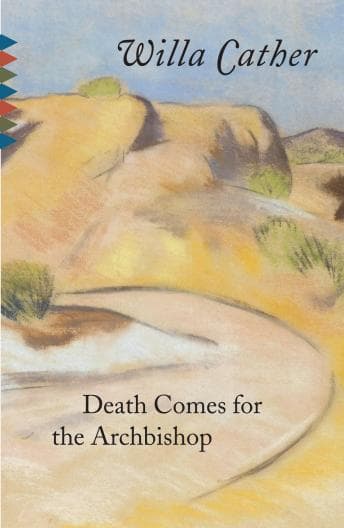
Let me be honest about something: if you come to Death Comes for the Archbishop expecting plot, you will be disappointed. My students would bail by chapter three. There's no rising action in any conventional sense. No climax. Cather herself called it a "narrative" rather than a novel, and she wasn't being coy — she meant it. What you get instead is something closer to a series of frescoes. Father Latour arrives in New Mexico in 1851. He builds a cathedral. He grows old. He dies. That's it.
And it's one of the most beautiful things I've ever listened to.
Cather writes the desert the way Monet painted water — not the thing itself but the light on the thing, the air around it. The red sandstone hills outside Santa Fe. The smell of piñon smoke. The way a mesa appears "as if it had walked there from New Jersey and sat down." (That's not the exact quote, but it's close, and it made me laugh out loud near Montrose Harbor.) She gives you the American Southwest as a kind of open-air cathedral, which is of course the whole point — Latour is trying to build a stone church in a place where God already built one out of rock and sky.
If you loved My Ántonia, this is its spiritual successor, though darker and more solitary. Where Ántonia celebrated the communal life of the prairie, Archbishop is about one man's quiet reckoning with vastness. The loneliness here is almost geological. Hotel on the Corner of Bitter and Sweet sits at a completely different latitude — Seattle, WWII, the internment camps — but it carries that same quality of solitude inside community, one person holding an entire world's grief quietly.
Ackroyd and the Problem of French Priests in English
David Ackroyd narrates at a pace that matches Cather's prose — deliberate, contemplative, with the kind of pauses that let sentences breathe. The narrator understands that pause is punctuation. He gets the tone right: this is a book about faith and landscape, not a thriller, and Ackroyd never tries to juice the energy where Cather didn't intend any.
But here's the thing I can't ignore. Father Latour is French. His beloved companion Father Vaillant is French. They speak to each other in French-accented English throughout the book, and Ackroyd's French pronunciation is — how do I put this charitably — the French of a man who took two semesters in college and remembers the word "bonjour." The names land flat. "Vaillant" comes out anglicized in a way that made me wince more than once. For a book so deeply concerned with the collision of cultures — French, Spanish, Pueblo, American — the flattening of that French identity through pronunciation feels like a missed opportunity.
Is it a dealbreaker? No. Ackroyd's strength is in the descriptive passages, where his voice settles into that sandy, sun-bleached register that suits the landscape sections perfectly. But every time Latour and Vaillant have an intimate conversation, I found myself wishing for a narrator who could give those exchanges the warmth of their mother tongue.
Who This Is Actually For
This is not background listening. This is not your workout audiobook. This is the audiobook you put on at 11 PM when the stack of sophomore essays has defeated you and you need to remember why language matters. It's for people who can sit with silence, who don't need a murder every thirty pages, who understand that a description of how light falls on adobe walls can be as dramatic as any plot twist.
If you need constant motion, skip this. If you think audiobooks under eight hours can't be substantial — well, at 7 hours and 42 minutes, Cather will prove you wrong. She packs more genuine feeling into a single paragraph about a priest eating soup with his old friend than most authors manage in entire trilogies.
Let's talk about what Cather is really saying here: this is a book about how we make meaning in hostile places. About the difference between imposing your will on a landscape and learning to listen to it. Latour doesn't conquer New Mexico. He's absorbed by it. And the prose deserves to be savored — at 1.0x, please, for the love of everything.
The Grade I'd Write in the Margin
Seven hours with Willa Cather in the desert. The narration is good — not great, hobbled by that French problem — but the source material is so extraordinary that it almost doesn't matter. Almost. I'd love to hear what a narrator like Juliet Stevenson or Simon Vance could do with this text. But Ackroyd serves the book honestly, and sometimes honest is enough.
Worth pausing the faculty meeting for. Definitely worth pausing the budget presentation for. (Sorry again, Principal Martinez.)