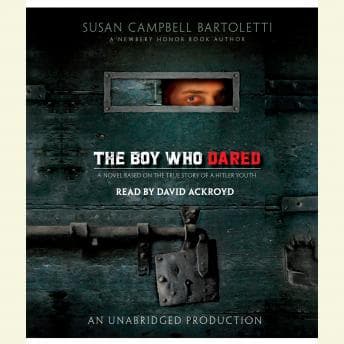

Look, I need to have a small complaint first: nobody warned me this was going to wreck me in a school parking lot. I'm sitting there at 2:45 PM waiting for Emma's dismissal, sunglasses on, tissues from the glove compartment, looking like I just watched the end of a Nicholas Sparks movie. Except this isn't fiction-fiction. This is a real kid. Helmuth Hübener was seventeen years old. Seventeen.
Made me cry at school pickup. Worth it though.
A Book About a Teenager That Made Me Feel Like a Coward
Here's what got me. My biggest act of rebellion this week was buying the expensive oat milk without a coupon. Meanwhile, Helmuth — a kid younger than some of my babysitters — is secretly listening to BBC broadcasts in Nazi Germany and distributing leaflets that could get him killed. And did get him killed. Bartoletti doesn't let you forget that. The book opens with Helmuth in prison, counting down his final hours, and then flashes back to show you exactly how a bright, enthusiastic boy who loved his Hitler Youth uniform slowly woke up to the horror around him.
What makes this work — what makes it more than just a history lesson with a pulse — is how Bartoletti captures the specific, mundane ways fascism creeps into a family. Helmuth's half-brother Hugo coming home in his stormtrooper uniform, proud and shining. His grandparents whispering about things they can't say out loud anymore. His friend Karl getting quieter and quieter as Jewish neighbors disappear. It's not one dramatic moment of awakening. It's a slow erosion of everything Helmuth thought was true, told through the tiny details of a kid's daily life. That felt painfully real to me as a parent — the idea that the world could shift under your children's feet and they'd just... adapt. Because kids do.
At 4 hours and 12 minutes, this is short enough that I finished it in about three days of nap times and drop-off drives. I finished this during nap time. High praise. And the brevity works here — Bartoletti doesn't pad the story. Every scene earns its place.
David Ackroyd Made a Smart Choice With His Voice
So here's the thing about the narration. Ackroyd reads with an American accent for the most part, but shifts into a German accent during dialogue. At first I thought — okay, is this going to feel weird? Like when someone does a bad accent at a dinner party? But it actually works. The German inflections during conversations between Helmuth and his family create this immediate sense of place without being cartoonish. And when Helmuth is alone with his thoughts, the American-accented narration feels more intimate, almost like you're hearing his inner voice translated for you. It's a subtle thing but it helped me track when we were in Helmuth's head versus when he was performing for the people around him — which, when you think about it, is basically the entire tension of the book.
Ackroyd's pacing during the final chapters is where he really earns his paycheck. He doesn't rush it. He doesn't melodramatize it. He just... lets the weight of it sit there. Which is why I was a mess in my minivan.
This Is the Book I'll Give Emma in a Few Years
I keep thinking about this as a mom. Sophie's two — she won't remember any of this era we're living through. But Emma's seven. She's starting to ask questions about the world that I can't always answer neatly. And Lucas is five and already parroting things he hears from older kids at school. Bartoletti wrote this for young adults, and it reads at that level — clear prose, not overly graphic, focused on moral choices rather than gore. But there are content warnings I'd flag: violence, some abusive situations, and the emotional weight of knowing a teenager was executed by the state.
This isn't my usual comfort read. Not even close. There's no satisfying happy ending here. There's a satisfying meaningful ending, which is different and harder. But sometimes — between the rom-coms and the cozy mysteries and the books where everyone gets a puppy at the end — sometimes you need a story that asks you what you'd actually do. What you'd risk. What you'd teach your kids to risk. I had a similar reckoning reading Anna Karenina — different century, completely different stakes, but that same uncomfortable mirror held up to your choices and your compromises.
Survived 47 pauses and still made sense. The flashback structure is clean enough that even when Sophie woke up screaming about her blanket being "wrong" and I had to pause for twenty minutes, I picked right back up without confusion.
Who This Is For (and Who Should Brace Themselves)
If you have kids roughly 10 and up and you want to start conversations about courage and conformity and why history matters — this is your book. If you're a parent who listens during stolen moments and needs something short but substantial, this fits perfectly. If you need a happy ending to function, skip this one. I mean it. This will gut you. But in the way that good, true stories should.
My book club will love this (if I ever have time for book club again). It's the kind of book that makes you want to talk to another adult about it immediately, which is unfortunate when your primary conversational partners are under the age of eight.