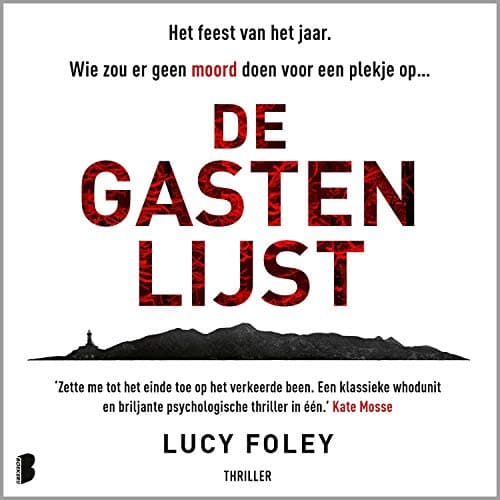

What happens when you trap thirteen people with grudges on a storm-lashed island and add champagne? Nothing good, obviously — but the question of exactly how bad things get is what makes Lucy Foley's De gastenlijst such an effective page-turner, or in this case, an earworm you can't shake during a ten-hour listen.
I went into this one with a healthy dose of skepticism. The marketing leans hard on Agatha Christie comparisons, and every other isolated-location thriller gets the same treatment. But Foley earns most of the hype by doing something deceptively simple: she builds her mystery like a puzzle box you actually want to solve, then has the discipline not to cheat when she opens it.
The setup is pure classic whodunit. Jules and Will are getting married on a gorgeous but remote island off the Irish coast. The venue is atmospheric and slightly decaying, the guest list is curated to within an inch of its life, and — naturally — a storm rolls in and cuts everyone off from the mainland. Before the celebrations are over, someone is dead. The story cycles through multiple perspectives: the bride, the best man, the plus-one, the bridesmaid, the wedding planner. Each chapter strips back another layer of resentment, jealousy, and buried history. The trick isn't just figuring out who killed — it's working out who died.
Foley's strongest suit here is atmosphere. The island drips with menace well before any violence breaks out. Fog rolling across the bog, the crumbling reception hall, forced smiles cracking under the weight of old grudges. She builds dread the way a skilled horror director uses silence — you feel the tension in your spine even when nothing is technically happening yet. And the pacing is disciplined. Alternating between the lead-up and the aftermath of the crime keeps you toggling between two timelines, which creates a kind of double suspense that never lets you settle.
Karin Douma narrates the Dutch version solo, and she handles the multi-perspective structure with quiet competence. Each viewpoint gets its own energy: Jules's tight-lipped perfectionism, Hannah's anxious inner monologue, Johnno's looser, rougher presence. You won't mistake this for a full-cast production — the vocal distinctions are more about tone and rhythm than radically different voices — but you always know whose head you're in. Douma's pacing matches the book's building tension well; she doesn't rush the atmospheric passages or overplay the emotional beats. It's the kind of narration that stays out of the story's way while still giving it shape.
Now, where I pull back from the enthusiastic praise: the characters. Foley gives each suspect a secret and a backstory, but several of them feel more like chess pieces than people. Will, the golden-boy groom with a sinister undertow, borders on schematic. The usher group — meant to represent a certain breed of entitled male friendship — blurs into a collective despite the narrative's efforts to differentiate them. If you're coming to this for rich psychological portraits and complex inner lives, you'll find the cast functional rather than fascinating. Christie's suspects, for all their archetype status, often had sharper edges and more personality beyond their plot function.
The whodunit payoff, though, is genuinely satisfying. The reveal caught me off guard, which doesn't happen as often as I'd like with this kind of thriller. Foley scatters her clues fairly across the different perspectives, and when the pieces click into place, the solution feels earned rather than pulled from nowhere. If you've read Foley's De jachtpartij (The Hunting Party), this is the tighter, more confident book — better pacing, a more evocative setting, and a mystery that doesn't spin its wheels the way its predecessor sometimes did.
I covered The Hunting Party separately, and the contrast between the two books is genuinely instructive — same DNA, noticeably different execution.
Readers familiar with Ruth Ware — particularly In een donker, donker bos — will recognize the territory. Ware tends to give her protagonists more interior life, more psychological texture beneath the plot machinery. Foley trades some of that depth for efficiency and speed, which means De gastenlijst moves faster but doesn't land its emotional punches quite as hard. If that trade-off sounds fine to you, you'll fly through this.
I listened across a rainy weekend — part of it during a long drive, the last stretch before bed — and the storm-on-an-island atmosphere paired perfectly with both. The rotating perspectives create natural mini-cliffhangers every twenty minutes, which makes it easy to binge but also gives you clean stopping points if you need them. The Dutch translation flows smoothly in audio, and Douma's delivery never had me wishing for the English original.
Who Should Listen (And Who Should Skip)
If you love locked-room mysteries with a modern edge and don't mind characters who serve the plot more than they breathe on their own, this is a sharp, well-paced ten hours. Skip it if you need deep psychological interiority from your cast — Foley's people are clever constructions, not quite living ones.
The reason to spend a credit on this specific audiobook: it's one of the better single-narrator performances of a multi-POV mystery I've encountered in Dutch. The format could easily become confusing, and Douma prevents that from ever happening. Combined with a mystery that actually rewards close attention and a twist that plays fair, you're getting a ten-hour listen that justifies its running time without padding.