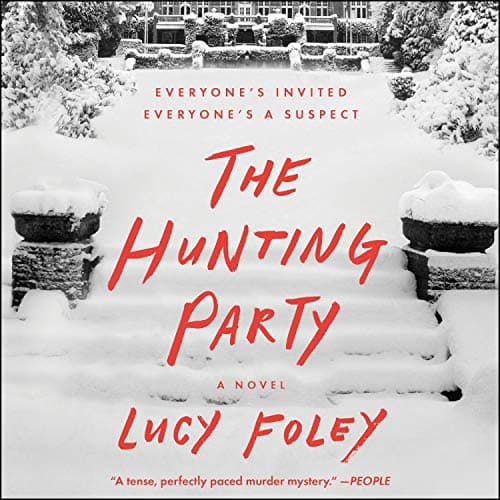

Most people seem to rave about The Hunting Party's narration while quietly admitting the story itself is just okay. After listening through the whole ten hours during a particularly dreary stretch of January commutes, I think that reputation is both fair and slightly unfair — because the narration doesn't just compensate for the story's weaknesses, it actively transforms the listening experience in ways the print version can't touch.
Here's the setup: a group of Oxford friends, now in their thirties and carrying a decade of accumulated resentments, rent an isolated estate in the Scottish Highlands for New Year's. Someone ends up dead. Everyone's a suspect. If that sounds familiar, it should — Lucy Foley essentially built her career on this template, and The Hunting Party is where it started. The locked-room mystery in a gorgeous, hostile setting. The rotating perspectives. The slow reveal of who's actually terrible beneath their polished surface. She'd later refine this formula in The Guest List and One by One, but there's something rawer about this debut thriller that I appreciated.
Foley's earlier work The Invitation is worth a look too if you want to trace how her instincts for atmospheric dread developed before she hit on the closed-circle formula.The five narrators — Gary Furlong, Elle Newlands, Morag Sims, Imogen Church, and Moira Quirk — split thirteen characters between them, and the casting choices are genuinely smart. Imogen Church brings a theatrical intensity to her characters that makes certain scenes land harder than they probably read on the page. Moira Quirk matches that energy beat for beat. Elle Newlands, who's Scottish herself and carries classical vocal training, grounds the Highland setting with an authenticity that a single narrator couldn't have achieved — when she describes the estate and the surrounding landscape, you can practically feel the frozen peat under your boots. Furlong handles the male perspectives with enough range that you never confuse one character for another, even when they're having conversations across chapters.
And that's where the real advantage of this audiobook lives. On paper, you're tracking a dozen-plus characters through alternating timelines, and I can see how that gets confusing in print. In audio, each narrator becomes your anchor. When a new chapter starts and you hear a particular voice, your brain immediately knows whose head you're in, what their grudges are, what they're hiding. The multi-narrator format doesn't just enhance this story — it solves a structural problem the book has.
Now, the honest part. The first four to five hours are slow. Not atmospheric-slow in a way that builds dread, but treading-water-slow in a way that occasionally tested my patience. Foley spends a lot of time establishing dynamics between these characters — who slept with whom at Oxford, who's jealous of whose career, who's drinking too much. It's all necessary groundwork, but there were mornings on my commute where I found my mind wandering during yet another champagne-fueled reminiscence. The characters are, by design, mostly unlikeable rich people being catty to each other, and that's a lot more fun in the second half when the stakes are actually high.
When the blizzard hits and the body drops, the book wakes up. The final stretch is genuinely tense, with the narrators leaning into the paranoia and suspicion in ways that had me sitting in my parked car finishing chapters. The Emma and Miranda performances deserve special attention here — these two characters carry most of the book's emotional toxicity, and their narrators deliver with a dramatic precision that turns what could've been stock thriller archetypes into people you viscerally react to. I genuinely despised some of these characters by the midpoint, which is exactly the point. You're supposed to be mentally shuffling your suspect list every chapter, and the vocal performances make that shuffle feel urgent rather than academic.
I'll admit I guessed the culprit about two-thirds through. Several listeners have flagged the predictability, and they're not wrong — if you read a lot of psychological thrillers, you'll likely see the shape of it coming. But knowing who doesn't quite spoil why, and Foley handles the motivation reveal well enough that the landing still has weight.
Where does this sit in Foley's catalog? It's not as tight as The Guest List, which benefits from a more focused cast and tighter setting. But it's more ambitious in scope, and the Scottish Highlands setting has a brooding menace that the Irish island of The Guest List can't quite match in audio — Newlands' voice alone adds a layer of place that reads differently than it sounds.
For the Agatha Christie comparison that Alex Michaelides makes in his blurb — it's apt, but with a caveat. Christie's puzzles are mechanical marvels where the clues click into place. Foley's mysteries are more about emotional revelation, about the ugliness people hide behind friendship. If you come in expecting a puzzle box, you might be disappointed. If you come in wanting to watch a friend group implode in spectacular fashion while snow piles up outside, you'll have a good time.
Here's my bottom line: this is a focused-listening audiobook, not a background one. The rotating POVs demand your attention, and if you zone out during housework you'll lose track of who resents whom and why it matters. For commutes or dedicated listening sessions, though, it works well — the chapter breaks are natural stopping points and the narrator switches keep you alert. If you love icy closed-circle mysteries and can tolerate a slow first half where the cast is mostly drinking and sniping at each other, spend a credit on this. The narration team earns it. Skip it if you want high body-count momentum, early surprises, or a mystery that genuinely stumps you — borrow it from the library instead and save your money for something with sharper teeth.