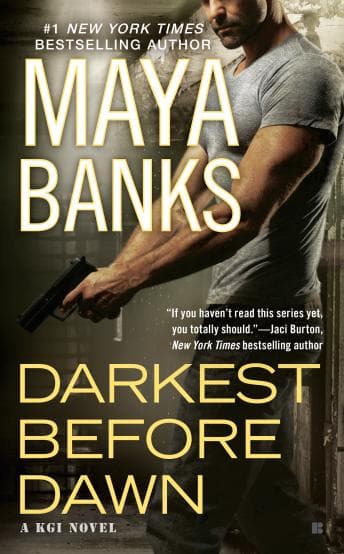

Look, I need to talk about Hancock. Because I've been stewing over this man for fourteen and a half hours and I have feelings, and not the kind Maya Banks intended.
I started this one while making chana masala on a Sunday evening — the kind of elaborate, multi-step cooking project where you need something absorbing in your ears to justify standing over a stove for two hours. And for the first third, Darkest Before Dawn delivered. The setup is genuinely interesting from a psychological standpoint: Honor, an American aid worker, survives a bombing that kills everyone around her, then spends days on the run through hostile territory before being captured by Hancock's team. The survival sequence is tense, well-paced, and Honor's resourcefulness under extreme duress is the kind of character work I actually respect. She's sarcastic even when terrified. She problem-solves. She doesn't just wait to be rescued. That same quality — a woman actively working the problem rather than enduring it — is what made me stick with Remember When, even when the plot tested my patience.
And then the book does something that made me set down my spatula.
The Captor-Protector Problem (Or: My Therapist Would Have So Many Thoughts)
Hancock is supposed to be the morally gray hero — the man who's spent years deep undercover, doing terrible things for a greater cause, who now faces the ultimate ethical dilemma when he's ordered to hand Honor over to a brutal terrorist. The protagonist exhibits classic avoidant attachment patterns: emotional shutdown, rigid compartmentalization, the inability to reconcile duty with genuine human connection. On paper, this is a fascinating case study in moral injury.
In practice? Psychologically, this doesn't track. Not fully. Hancock oscillates between cold tactical operator and tortured lover with a speed that gave me whiplash. One chapter he's calculating the acceptable cost of sacrificing Honor. The next, he's having internal monologues about her being his "sun" and the "only light in his darkness." There's no bridge between those two states. No gradual erosion of his defenses. The research actually shows that people with Hancock's level of emotional suppression don't suddenly crack open like an egg — they leak. Slowly. Messily. Banks understands that the concept is compelling but rushes the execution, especially in the middle section where the book loses its structural spine and wanders between action setpieces and repetitive internal anguish.
Honor, to her credit, stays more consistent. Her sarcasm is a genuine coping mechanism, not a quirk — I found myself asking: why does she keep making jokes when she's clearly dissociating from trauma? And the answer is because that's exactly what someone in her position would do. Fight, freeze, or crack wise. She chose option three. I appreciated that.
Tad Branson and the Fourteen-Hour Commitment
Here's where I have to be honest: Tad Branson is... fine. He reads the book. He doesn't do anything offensive. But he also doesn't do anything memorable. With a cast this large — the entire Kelly family, multiple military operatives, a literal terrorist villain — you need vocal differentiation, and I kept losing track of who was speaking during the group scenes. The emotional peaks, where listeners apparently laughed and cried and cheered, landed flatter for me in audio than I suspect they would on the page. Branson reads Hancock's turmoil with a steady, measured tone that works for the stoic-soldier persona but undercuts the moments where Hancock is supposed to be breaking. I wanted cracks in the voice. I got controlled narration.
At 14 hours 27 minutes, this is a significant time investment, and the saggy middle — where the book goes, as one listener put it, "WAY off in a different direction" — really tests your patience in audio format. You can't skim. You just have to ride it out.
Who This Is Actually For (And Who Should Run)
If you've been following the KGI series and you're invested in the Kelly family dynamics, the payoff moments with the ensemble cast will probably land for you. Banks clearly loves these characters and their fierce loyalty to each other, and that warmth is real even when the plotting wobbles.
But I need to flag this clearly: there is violence, abuse, and sexual assault content in this book. If those are triggers, please take that seriously. The book doesn't always handle these elements with the care they demand.
If you're coming in fresh to the series — don't start here. This is book ten. You'll be drowning in backstory references and won't understand why everyone treats the Kelly compound like a military-grade Thanksgiving dinner.
And if you're someone like me who needs character psychology to hold up under scrutiny? You'll love Honor. You'll be frustrated by Hancock. You'll finish the book feeling like it was seventy percent of something really good.
The Case File, Closed
My chana masala turned out great, by the way. The book turned out... uneven. Maya Banks can write emotional intensity like few others — the highs in this story genuinely hit. But the lows aren't narrative lows, they're structural ones. A middle that loses focus, a hero whose psychological transformation happens off-screen, and a narration that stays too even-keeled for material this volatile. I wanted to love it. I settled for being fascinated by the parts that worked and mildly annoyed by the parts that didn't.
(My mother would say I'm too picky. My mother would also read this entire book in one sitting and love it. We contain multitudes.)