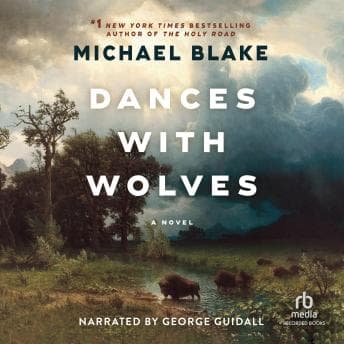

I'm going to start with a complaint, because that's what twenty years of teaching English earns you - the right to complain about books you mostly enjoyed. Here it is: Michael Blake does not know how to end a story. I say this with genuine affection for the man and what he built with Dances with Wolves, but the final stretch of this novel drifts off like a student's essay at 2 AM when they've run out of thesis and start writing about their feelings. The love story between Dunbar and Stands With A Fist goes from earned to sentimental so fast I actually checked my phone to see if I'd accidentally skipped ahead. And the closing pages - what should land as elegy lands as ellipsis. The story doesn't conclude. It just... stops breathing.
I was listening on a Saturday morning walk along the lakefront with Denise, and when the last chapter wound down she looked at me and said, "You're making your Gatsby face." She means the face I make when I love something but wish its author had trusted me more. That's Dances with Wolves in a sentence.
The Quiet Before the Comanche
But let's talk about what Blake gets right, because he gets a lot right, and it starts with silence. The first two hours of this audiobook are almost unbearably lonely - and I mean that as praise. Dunbar arrives at Fort Sedgwick, which is less a military post than a hole in the prairie with delusions of grandeur, and Blake just... leaves him there. With a horse. With a journal. With the kind of existential solitude that would make Thoreau nervous.
This is where George Guidall earns every cent. His voice carries a kind of weathered patience that matches Dunbar's slow unraveling perfectly - not dramatic, not showy, just a man reading his own thoughts into the wind and waiting for something to answer. Guidall doesn't try to turn Dunbar into a hero in these early sections. He lets him be confused, bored, a little unhinged. There's a passage where Dunbar is writing in his journal about the wolf he calls Two Socks, and Guidall reads it with this quiet wonder that made me stop walking and just stand there on the path like an idiot, blocking joggers.
The prose deserves to be savored here. Blake writes Dunbar's isolation in these short, declarative sentences - almost Hemingway-esque in their refusal to explain what they mean. This reminds me of what Hemingway said about writing: leave out the things you know, and the reader will feel them. Blake clearly took that to heart. The prairie becomes a character. The sky becomes a character. Two Socks, that wolf who circles the fort like a recurring dream, becomes the most emotionally honest relationship in the entire book.
What Blake Sees - And What He Doesn't
Now. The Comanche. This is where I have to put on my teacher hat, and it's a hat I wear reluctantly because nobody likes the guy at the party analyzing representation in a Western novel from 1988. But it matters. Blake clearly wrote this book with genuine respect and affection for the Comanche people, and compared to most Western fiction of its era, the portrayal is leagues ahead. Kicking Bird is drawn with real intelligence and dignity. Wind In His Hair is genuinely funny in spots - his competitive streak with Dunbar reads like something my sophomores would recognize.
But there's a flatness to some of the Comanche characters that I can't ignore. They function - sometimes - as mirrors for Dunbar's transformation rather than as fully independent people with their own interior lives. Blake is writing a conversion narrative, and the convert is always the protagonist. The Comanche exist partly so Dunbar can become someone better. It's well-intentioned, but it's a limitation, and a modern listener should know it's there.
Guidall handles the Comanche dialogue with a kind of formal gravity that I think was the right call. He doesn't attempt accents or vocal tricks - he shifts register, dropping into something slower and more deliberate, which at least suggests a different worldview being filtered through translation. It's not perfect, but it's respectful, and in a single-narrator audiobook that's about the best you can ask for.
Guidall Knows When to Shut Up
The highest compliment I can pay a narrator is this: he knows that the pause is punctuation. Guidall lets silences do work in this audiobook. After the buffalo hunt - which is the genuine setpiece of the novel, visceral and enormous and written with a kineticism Blake doesn't always achieve - Guidall takes a breath before Dunbar's reflection that you can feel in your chest. He doesn't rush to the emotion. He lets you arrive at it.
At nine hours, the pacing is right for what Blake is doing. This isn't a plot-driven book. It's a mood piece dressed up as a Western. If you come in expecting the Costner film's sweep and action, you'll be disappointed. The book is interior where the movie is exterior. Smaller. Quieter. Better in some ways, weaker in others.
The Annotation in the Margin
My students would hate this. I love it. Not unconditionally - that ending still frustrates me, and the romance never quite catches fire the way the friendship between Dunbar and Kicking Bird does. But there's something in Blake's spare, almost stubborn prose style that stays with you. It's the kind of book that's about one thing on the surface - a soldier goes native - and about something else entirely underneath: what happens when a man stops performing his life and starts living it. The Tattooist of Auschwitz does something similar - uses a historical surface story to ask the same quiet, devastating question about what it means to remain human when every institution around you has failed.
If you loved The Last of the Mohicans or Willa Cather's prairie novels, this is their spiritual successor from an unexpected direction. Worth pausing the faculty meeting for - just don't expect it to stick the landing.
Who should listen: Anyone who wants a Western that's really a meditation. Fans of the film who want to understand what Costner saw in the source material. People who like their audiobooks slow and contemplative.
Who should skip: If you need tight plotting and a satisfying resolution, this will make you crazy. If representation matters deeply to you, read some supplementary context alongside it.