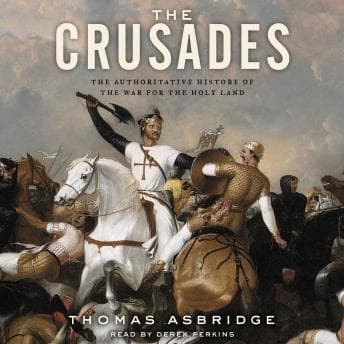

Let me cut to the chase: I finished this one during a three-day surveillance consulting gig in Dallas, sitting in my truck for hours with nothing but Ranger, bad coffee, and Derek Perkins walking me through two centuries of medieval warfare. Worth every minute of the 25-hour commitment.
Asbridge does something rare here—he treats both sides of this conflict with the same analytical rigor. As someone who's spent time in the Middle East, I've heard plenty of one-sided takes on Christian-Muslim relations. This isn't that. He gives you the political calculations, the tactical decisions, the human motivations on both sides of the line. When he breaks down the Muslim victory at Hattin—how Saladin maneuvered the Crusader army into waterless terrain and let the July sun do half his work for him—you can feel the strategic brilliance. That kind of tactical thinking, using terrain and timing instead of just brute force, is what makes Art of War still relevant after 2,500 years. I've studied that battle in professional contexts. Asbridge gets it right.
Logistics Win Wars, Not Just Swords
Here's what separates this from your average history audiobook: Asbridge understands that wars are won and lost on logistics, terrain, and timing. Not just swords clashing dramatically. The siege of Acre gets the treatment it deserves—months of grinding attrition, disease killing more men than combat, the psychological warfare between Richard the Lionheart and Saladin. He clearly did his homework on the military side, but never loses sight of the political chess game happening in Damascus, Jerusalem, and Rome simultaneously.
The Third Crusade section is where this thing really hits its stride. Richard and Saladin circling each other like two heavyweights who respect each other's capabilities—that's the kind of adversarial relationship I understand. Neither man was a saint. Both were brilliant. Asbridge doesn't pick favorites, and that's exactly how this story should be told. I appreciated the same kind of unflinching analysis in Caste—different subject entirely, but that same commitment to examining uncomfortable truths without taking the easy route.
Perkins Earns His Keep Over 25 Hours
Twenty-five hours is a serious commitment. Perkins makes it work. His pronunciation of Arabic and Latin terms has this precision that tells you he actually prepared for this job. No stumbling over "Outremer" or butchering Saladin's full name. The man maintains energy through scholarly details that could easily become dry—succession disputes, papal politics, Byzantine scheming—and somehow keeps you invested.
I listened at my usual 1.25x and never felt rushed. Perkins has the kind of voice that carries authority without becoming monotonous. No dramatic character voices here (this isn't that kind of book), but when he's describing the massacre at Jerusalem or the final fall of Acre, there's weight in his delivery. You feel the stakes.
Where It Lost Me (Briefly)
Look, 25 hours means you're going to hit some slow patches. The Byzantine political maneuvering in the early sections—who's backstabbing whom in Constantinople—gets dense. I rewound a few times because my attention drifted during the fourth or fifth succession crisis. That's not a failure of the book. It's just the nature of covering 200 years of complex history. You need those sections to understand why the Crusader states were always fighting on multiple fronts.
Also—and this is minor—I wanted more on the Templars and Hospitallers as military organizations. Asbridge covers them, but a guy who spent his career thinking about unit cohesion and institutional culture wanted deeper analysis of how these military orders actually functioned in the field. Maybe that's a different book.
Who Should Deploy With This One
If you're serious about medieval history, military history, or understanding the roots of Western-Islamic relations, this is essential listening. It's not background material—you need to pay attention. But the payoff is a genuinely balanced, thoroughly researched account that treats everyone involved as human beings making calculated decisions under pressure.
Skip this if you want simple heroes and villains. Skip it if you're looking for something light for the gym. This demands your focus.
For everyone else? Mission accomplished. Ranger approved this one—though he fell asleep during the Byzantine sections. Can't blame him.
Mission Debrief
Twenty-five hours of medieval warfare, political intrigue, and religious conflict, delivered by a narrator who respects both the material and your intelligence. Asbridge gives you the full picture without the propaganda, and Perkins makes the journey worthwhile. Worth your time if you're ready to commit.






![Steve Jobs [unabridged audiobook] audiobook cover](/_next/image?url=https%3A%2F%2Fcovers.audiobooks.com%2Fimages%2Fcovers%2Ffull%2F9788499923406.jpg&w=1920&q=75)