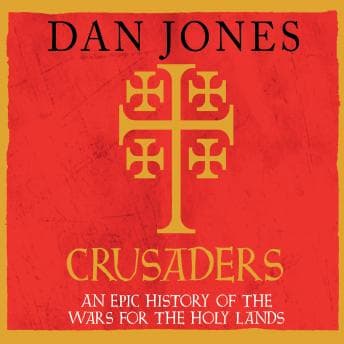

Sixteen hours of Crusades history while driving I-35 between Austin and Dallas for client meetings. That's two round trips with Dan Jones in my ear, and honestly, I didn't want the commute to end. Which tells you something, because I-35 traffic is its own kind of purgatory.
Let me cut to the chase: this is one of the best popular history audiobooks I've listened to in years. Jones covers two hundred years of religious warfare - from Pope Urban II's 1095 call to arms through the fall of Acre in 1291 - and he does it without dumbing things down or getting lost in academic weeds. That's a harder balance to strike than most people realize.
Two Centuries of Holy War Without Losing the Thread
Here's what impressed me most. Jones structures this thing around people, not just events. You get the big-picture strategic picture - the political chess between Fatimid Egypt, the Seljuk Turks, Byzantine Constantinople, and the various European kingdoms - but it's always anchored to specific humans making specific decisions. The result is that a period of history most people only know as "knights went to Jerusalem" opens up into something far more complex. Christians fighting Christians. Muslims fighting Muslims. Alliances that would make a modern geopolitical analyst's head spin.
The author clearly did their homework. Jones doesn't shy away from the brutality on all sides, and he gives Islamic, Jewish, and Christian perspectives without turning it into a modern political lecture. That restraint is worth noting because plenty of writers can't resist editorializing about the Crusades through a contemporary lens. Jones trusts you to draw your own conclusions from the evidence, which I respect.
I've seen this scenario play out in real life - not the medieval sieges, obviously, but the fundamental dynamics. Coalitions that fracture over religion, ego, and logistics. Supply lines that determine outcomes more than battlefield courage. Leaders who mistake God's favor for strategic planning. Reading about the disaster of the Second Crusade, I kept thinking about planning failures I'd witnessed firsthand. Different century, same human stupidity. That same reckoning with leadership, logistics, and the gap between ambition and reality shows up in Lewis and Clark too - different terrain, different century, but men making consequential decisions with incomplete information and paying the price.
Jones Behind the Mic - Better Than You'd Expect
So here's the thing about authors narrating their own work: it's usually a coin flip. Sometimes you get passion without polish. Jones lands solidly on the good side. His British accent is pleasant without being stuffy, and his pacing is genuinely excellent for dense material. He knows when to slow down on a critical name or date and when to push through connective tissue.
Is he a professional voice actor? No. You won't get distinct character voices for Saladin versus Richard the Lionheart. This is straight historical narration, and Jones delivers it like a very good lecturer who happens to be sitting across from you at a pub. His enthusiasm for the material comes through - you can hear it when he hits a particularly wild historical detail, this slight uptick in energy. Occasionally he over-emphasizes a word and it pulls you out for a second, but that's a minor complaint over sixteen hours.
I listened at my usual 1.25x and it worked perfectly. His natural pace is measured enough that the speed bump keeps things moving without losing clarity on the Arabic and Latin terms. And there are a LOT of names and places to track. At normal speed, I think some sections might drag for listeners who aren't already history nerds.
Where It Gets Heavy
Fair warning - this isn't sanitized history. The sack of Jerusalem in 1099, the massacres, the political assassinations. Jones doesn't sensationalize it, but he doesn't look away either. Some of the descriptions of siege warfare and its aftermath hit harder in audio than they would on the page. Linda walked into the garage while I was unloading gear and Jones was describing a particular atrocity, and she just gave me that look. You know the one.
The back half of the book - covering the later Crusades and the slow crumbling of the crusader states - is where Jones really finds his stride. The political complexity ratchets up, and his ability to keep you oriented through shifting alliances and simultaneous conflicts across the Mediterranean is genuinely impressive. I never felt lost, which in a book covering this much ground is saying something.
Mission Debrief
Worth your time? Here's the debrief. If you're interested in the Crusades but don't want to wade through academic texts, this is your entry point. If you already know the basics, Jones still offers enough fresh perspective and narrative skill to justify the sixteen-hour commitment. It's serious history delivered with energy and clarity.
Who should skip it: anyone looking for a quick overview. This is comprehensive. Sixteen hours demands dedicated attention - this isn't background listening while you're doing PT. You need to be locked in.
Ranger slept through most of it, but he perked up during the battle descriptions. Mission accomplished.







![Steve Jobs [unabridged audiobook] audiobook cover](/_next/image?url=https%3A%2F%2Fcovers.audiobooks.com%2Fimages%2Fcovers%2Ffull%2F9788499923406.jpg&w=1920&q=75)