
Quick Verdict: Worth your commute, but manage your expectations about who's actually talking.
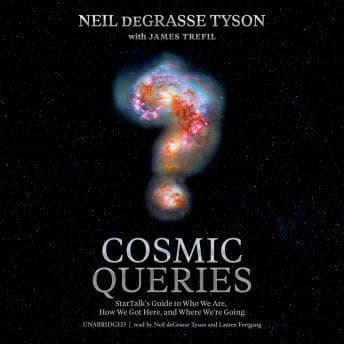
Okay, so here's the thing. I grabbed this thinking I'd get 6 hours of Neil deGrasse Tyson's voice explaining the cosmos to me on the Caltrain. That man's voice is like a warm blanket made of science. Instead, I got Lauren Fortgang narrating about 95% of it, with Tyson popping in occasionally like a celebrity cameo in a Marvel movie. Was I annoyed? Initially, yes. Did I get over it? Also yes.
The Narrator Situation (Let's Just Address It)
Look, the marketing on this is a bit misleading. If you're expecting Tyson to be your constant companion through the mysteries of the universe, you're gonna be disappointed. Fortgang does the heavy lifting here, and honestly? She's good at her job. Clear voice, easy to follow even when I was half-asleep at 6:15 AM surrounded by other dead-eyed commuters. Her pacing is solid—not too fast that you miss the science, not so slow that you zone out.
But—and this is a real but—her tone is what I'd call "science museum tour guide bright." Some reviewers called it chirpy, which... yeah, fair. For a book tackling existential questions like "Are we alone?" and "How did life begin?", the vocal energy sometimes felt like it belonged more in a children's planetarium show. It's not bad, just a mismatch. When Tyson does jump in with his deep, rich voice, you feel the difference immediately. It's like going from fluorescent office lighting to a fireplace.
The Science Actually Holds Up
This is where the book earns its keep. Tyson and Trefil (who doesn't get enough credit here, honestly) do something surprisingly rare in pop science books: they explain astrophysics without making you feel stupid, but also without dumbing it down to uselessness.
The structure follows the big questions format—origin of life, our place in the universe, the whole "are we cosmically significant or just mold on a rock" existential crisis package. It's basically StarTalk but organized into a coherent narrative instead of podcast tangents. Astrophysics for People in a Hurry has that same Tyson approach—quick, digestible, no fluff. If you've listened to the podcast, you'll recognize the vibe: accessible, occasionally funny, grounded in actual data rather than speculation.
The ROI on this audiobook is solid for the 6-hour runtime. I finished it in exactly 3 commutes, and I came away with a better understanding of current theories on everything from dark matter to exoplanets. The humor keeps it from feeling like a textbook, which—as someone who debugs distributed systems all day—I deeply appreciate. I don't need more dry technical content in my life.
Perfect For: Train, Gym. Skip For: Deep Work
You'll love it if: You're a StarTalk fan, you want accessible science that doesn't insult your intelligence, or you need something engaging enough to follow at 1.5x speed while standing on a packed train. The production quality is clean—no weird background noise, no awkward editing cuts. I listened without headphones a few times (when I forgot them, don't judge me) and could still follow everything.
Consider skipping if: You absolutely need Tyson's voice for the full experience, or you're looking for something with more narrative depth. This is informational, not emotional. It won't make you cry about the beauty of the cosmos. It'll just make you smarter about it.
I bumped it up to 1.5x after the first hour because Fortgang's clear enunciation handles speed well. Business books get 1.75x from me, but science content needs a bit more room to breathe.
Would I Queue It Up Again?
Probably not cover to cover, but I might revisit specific sections. The chapters on exoplanets and the search for extraterrestrial life were my favorites—genuinely interesting updates on where the science currently stands. Short History of Nearly Everything goes deeper on those origin questions if you want more than the documentary-level treatment. The early universe stuff is solid but covers ground that anyone who's watched a few documentaries will already know.
Is it a must-listen? For science enthusiasts who want to fill commute time productively, yeah, pretty much. Just go in knowing what you're getting: a well-organized science primer with a competent narrator who isn't Neil deGrasse Tyson. Once I adjusted my expectations, I genuinely enjoyed it. And hey, at least it couldn't have been a blog post—there's actually 6 hours of real content here.





![Steve Jobs [unabridged audiobook] audiobook cover](/_next/image?url=https%3A%2F%2Fcovers.audiobooks.com%2Fimages%2Fcovers%2Ffull%2F9788499923406.jpg&w=1920&q=75)