
"Fairy dust. It's real, and it's a big deal." Somewhere around the thirty-minute mark, Johanna Parker delivered that line with such deadpan Southern sincerity that I actually laughed out loud while chopping onions for a dal that was already getting too much of my attention. Which is the thing about Sookie Stackhouse — she says absurd things in the most matter-of-fact way, and if you've spent any time in the series, it just works.
But let me be upfront about something before we go any further.
The Title Is Doing Too Much
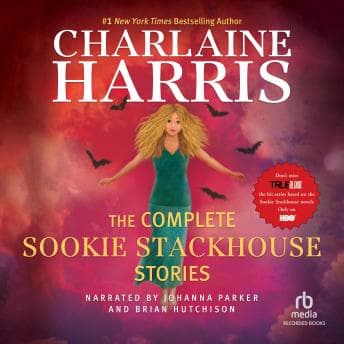
"The Complete Sookie Stackhouse Stories" is a genuinely misleading name. This is not thirteen novels. This is not the full saga. This is a short story collection — ten pieces, most of them previously published in various anthologies, clocking in at about eleven hours. If you come in expecting the whole Bon Temps epic from Dead Until Dark through Dead Ever After, you will be disappointed, and honestly? You'd have a right to be. The word "complete" is doing heavy lifting here that it hasn't earned.
What you actually get is a series of interstitial stories — little narrative bridges that fill gaps between the novels. "Fairy Dust" explores the fae world's politics in miniature. "Dracula Night" is basically a comedic bottle episode where Fangtasia hosts a party. "Small Town Wedding" gives us Sookie navigating the deeply human awkwardness of small-town social obligations while also being, you know, a telepath dating supernatural beings. These are companion pieces, not main courses.
And psychologically, that distinction matters. The protagonist exhibits classic patterns of someone constantly code-switching between worlds — reading minds at a wedding reception, negotiating vampire politics at a bar — but in short story form, you only get snapshots of that exhausting duality. You don't get the slow accumulation of emotional cost that makes Sookie interesting across thirteen books. You get vignettes. Some land. Some feel like deleted scenes.
Johanna Parker Knows This Woman
Here's what saves this collection from being a footnote: Johanna Parker's narration. Her light Southern accent isn't a performance choice — it's structural. It grounds every supernatural absurdity in the particular reality of small-town Louisiana. When Sookie processes something horrifying, Parker doesn't go dramatic. She goes quiet, practical, a little tired. That's exactly right. That's how someone who's been through what Sookie's been through would actually sound. My therapist would have thoughts about this character's coping mechanisms, but Parker instinctively gets the dissociation-as-normalcy thing.
Brian Hutchison handles a few of the stories, and he's competent — the man has theater training and an Earphones Award, so he's not fumbling anything. But the contrast is noticeable. Parker is Sookie in a way that Hutchison can't replicate, because he's narrating about her rather than inhabiting her. It's the difference between a case study written by the subject versus one written by an observer. Both valid. One's just closer to the nerve. The observer-vs-subject dynamic in supernatural fiction is something I kept turning over while reading Thief: A Novel of the Black Dagger Brotherhood too — Ward's narrators are deep inside their own damage in a way that makes outside analysis feel almost beside the point.
I found myself asking: why does Sookie really keep getting pulled back into supernatural chaos? The research actually shows that people with heightened empathic abilities (and telepathy is empathy turned up to eleven, metaphorically) often struggle with boundary-setting. Harris understands this. Even in these short stories, Sookie's pattern is clear — she helps because she literally can't stop hearing other people's pain. "Gift Wrap" and "Playing Possum" both play with this, putting her in situations where saying no would require a kind of emotional deafness she's incapable of. That's not heroism. That's a trauma response. And Harris, to her credit, doesn't pretend otherwise.
The Gap Between Novels Problem
The structural issue with a collection like this is that each story assumes you know the full context. "In the Blue Hereafter" hits differently if you've read the last few novels. "Two Blondes" requires understanding the Pam dynamic. If you're new to the series, this will feel like walking into a party where everyone already has inside jokes. Not hostile, just... you'll be catching up the whole time.
For series veterans, though, there's a particular pleasure in these small-scale stories. You get Sookie without apocalyptic stakes. You get her buying groceries, attending weddings, dealing with the mundane friction of living in a world that's gone publicly supernatural. It's a fascinating case study in how a character functions when the plot pressure drops — and the answer is, Sookie's still interesting. She's still reading the room (literally), still making sharp observations, still being fundamentally decent in a way that doesn't feel naive. Harris understands human nature, even when her humans aren't entirely human.
Who Gets the Most Out of This
If you've listened to the full series and want the equivalent of catching up with an old friend over coffee — not a dramatic reunion, just a comfortable hour — this delivers. If you're coming in fresh or expecting the novels, hard pass. And if you loved the True Blood adaptation but never read the books, be warned: Sookie on the page (and in Parker's voice) is sharper, funnier, and considerably less melodramatic than the HBO version.
At eleven hours, it's a reasonable commitment. I finished it across three evenings of cooking increasingly ambitious South Indian dishes to avoid my manuscript revisions. The stories are easy to pick up and put down, which is either a feature or a bug depending on what you want from your listening.
My Prescription
This is comfort food for Sookie completists, not a gateway drug. Parker's narration elevates material that could easily feel like bonus features on a DVD. The stories themselves range from genuinely engaging ("Dracula Night" is funnier than it has any right to be) to pleasant but forgettable. Worth your time if you're already invested. Not worth a credit if you're not.