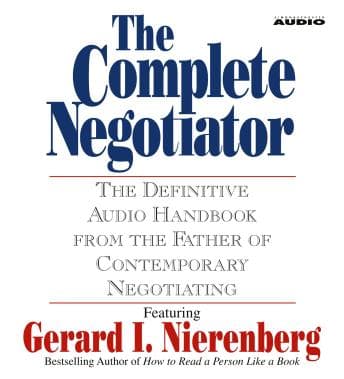

So I was half-awake at my desk at 11 PM, waiting for a deploy canary to either go green or ruin my night, and I figured — 2 hours 34 minutes, I can knock this out before the rollout finishes. That's basically the only reason I gave The Complete Negotiator a shot. Short audiobook, legendary author in the negotiation space, seemed like easy ROI.
I was wrong about the "easy" part.
The Mandatory Corporate Training Energy Is Real
Look, Gerard Nierenberg literally invented modern negotiation theory. The man founded The Negotiation Institute, wrote 22 books, and trained Fortune 500 execs before most of us were born. His frameworks — the 14 key strategies, the "everybody wins" philosophy, reframing demands as problems to solve — these ideas were genuinely revolutionary when they came out. And the core content here is solid. The concept of creating a "climate of agreement" before you even start negotiating? I've used a version of that in every sprint planning meeting where I need to convince my team to take on tech debt work. Transforming demands into collaborative problem-solving? That's basically incident response philosophy applied to business deals.
But here's the thing. Nierenberg narrates this himself, and the delivery feels exactly — and I mean exactly — like those annual compliance training modules your company forces you through. You know the ones. "Click NEXT to continue." There's this flat, authoritative-but-detached tone that makes you feel like you're being lectured at rather than taught. The man clearly knows his stuff, and there's a certain credibility that comes from hearing the actual inventor of these concepts explain them. But authoritative ≠ engaging. I caught myself zoning out multiple times during what should have been interesting strategy breakdowns, which is wild for something under 3 hours.
When the Framework Outgrew Its Format
Here's what I kept coming back to: this audiobook is structured like a handbook, but it doesn't play like one in audio. The 14 negotiation strategies are listed and explained, but without the visual anchoring you'd get in a physical book — no diagrams, no reference cards, no way to quickly flip back to "wait, was that strategy 7 or 9?" In a distributed system, you'd call this a serialization problem. The content was designed for one format and force-converted to another without adapting the interface.
The "lowest common denominator" criticism I've seen from other listeners? Yeah, I get it. Nierenberg's approach here is extremely broad — he's trying to make negotiation accessible to literally anyone in any business context. Noble goal. But it means the strategies stay pretty surface-level. If you've read Getting to Yes, Never Split the Difference, or honestly even listened to a few negotiation podcast episodes, you're going to find yourself ahead of the material pretty quickly. It's the startup book problem: solid concept that could've been a blog post. Or in this case, a really good blog post, because the core ideas are legitimately important — they just don't need 2.5 hours of this particular delivery to land. Seth Godin wrestles with the same tension in Practice: Shipping Creative Work — the gap between a genuinely important idea and whether the format you chose actually serves it.
The one thing that genuinely stuck with me: Nierenberg's insistence that lasting victories require the other side to gain something too. In 2024, that sounds obvious. But remembering this was written by the guy who basically started that conversation? There's historical weight there, even if the presentation hasn't aged well.
Who Should Bother (And Who Shouldn't)
If you're completely new to negotiation — like, you've never read a single book on it and you need a primer before a job offer conversation — there's value here. The frameworks are foundational for a reason. And at 2.5 hours, the time commitment is minimal.
But if you've consumed literally any modern negotiation content? Skip this version. Read the book if you want the historical perspective. The audio format actively works against the material, and the narration will have you reaching for the skip button.
Perfect for: absolutely nothing at 6 AM on Caltrain, because you WILL fall asleep and miss your stop. Maybe okay for a short drive where you can stay focused.
The Debug Log
I wanted to like this more than I did. There's something cool about hearing a foundational thinker explain their own work. But the cheesy delivery, the format mismatch, and the surface-level treatment of strategies that deserve deeper exploration — it all adds up to a pretty low ROI on your listening time. Kevin actually negotiated a better deal on our internet bill last month using stuff he picked up from Chris Voss, and that's kind of the whole problem with this audiobook in a nutshell: the students have surpassed the textbook.
The ROI on this audiobook is... about what you'd expect from a 2-hour corporate training module. You'll retain maybe two useful concepts and forget the rest by your next standup.