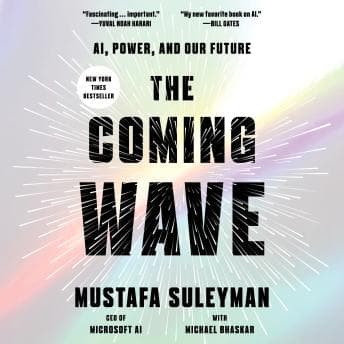

What happens when the person warning you about the flood is also the one who built the dam?
I was chopping onions for a chana masala at 10 PM on a Tuesday — the kind of elaborate cooking-for-one situation my mother would find deeply concerning — when Mustafa Suleyman started explaining how synthetic biology could, in theory, let a competent graduate student engineer a pandemic pathogen within the next decade. The onions weren't the only reason my eyes were watering.
The Fox Guarding the Henhouse Writes a Memoir
Here's what makes The Coming Wave a fascinating case study in cognitive dissonance: Suleyman co-founded DeepMind, one of the most consequential AI labs on the planet. He helped build the wave. And now he's writing a book telling us we need to contain it. The research actually shows that people who issue warnings about dangers they've personally contributed to tend to be either the most credible sources or the most conflicted ones. Suleyman is both.
He frames his central argument around what he calls "the containment problem" — the idea that powerful technologies, once created, have historically been impossible to put back in the box. He draws parallels between AI and previous technological waves (the printing press, industrialization, nuclear fission), but where most tech-bro futurists stop at vague hand-waving about "disruption," Suleyman gets specific about the threat to nation-states themselves. The argument isn't just that AI will change jobs or generate deepfakes. It's that the asymmetry between the power these tools grant individuals and the capacity of governments to respond could fundamentally break the social contract.
Psychologically, this tracks. The pattern he's describing — where institutional authority erodes because technology distributes power faster than governance can adapt — is basically anomie theory updated for the age of large language models. Durkheim would've had a field day.
Where the Insider Perspective Helps (And Where It Doesn't)
The strongest sections are where Suleyman draws on his actual experience inside DeepMind and the broader AI ecosystem. He's not theorizing from the outside. When he talks about the internal pressures to ship products, the competitive dynamics between labs, the way safety considerations get weighed against commercial imperatives — you're getting a window into the psychology of the people making decisions that will affect billions of lives. I found myself asking: why does someone who clearly understands the risks keep building? He doesn't fully answer that question, which is either honest or evasive. Maybe both.
But the book's weakness is also its author's position. Suleyman proposes a framework for containment that involves collaboration between tech companies, governments, and civil society. It's reasonable. It's also the kind of proposal that conveniently doesn't require the people who built these systems to, say, stop building them. The protagonist exhibits classic approach-avoidance conflict — genuinely alarmed by what he's created, but unable to walk away from the thing that gives his life meaning and his bank account zeros. The psychology of insiders who profit from systems they publicly critique gets a similarly uncomfortable autopsy in WOKE, INC. — different industry, same essential tension between personal gain and institutional criticism.
At nearly twelve hours, the book is thorough. Sometimes too thorough. The middle third — where he catalogs various emerging technologies from quantum computing to robotics to gene editing — starts to feel like a very well-researched TED talk that's gone long. My therapist would have thoughts about my inability to just skip ahead, but I'm a completionist. I listened to every minute on my morning jogs through Cambridge, and there were stretches along the Charles River where I was running on autopilot, brain fully occupied by his scenarios about autonomous weapons.
The Voice in Your Ear Belongs to the Man Who Built the Thing
Suleyman narrates the audiobook himself, and this matters. His English accent has a calm, measured quality — the kind of voice that makes apocalyptic scenarios sound like reasonable dinner conversation. There's something slightly unsettling about that, actually. He's describing civilizational risks with the same tone you'd use to explain a restaurant menu. But it works, because the material is alarming enough on its own. A dramatic narrator would've tipped this into panic-inducing territory.
The author-narrated format adds an intimacy that a professional narrator couldn't replicate. When he talks about the moral weight of building AI systems, you hear it differently knowing this is the person who actually did it. It's confession as audiobook.
Compared to something like Yuval Noah Harari's 21 Lessons for the 21st Century — which covers adjacent territory from a historian's vantage point — Suleyman's book is less philosophical and more operational. Harari asks "what does this mean for humanity?" Suleyman asks "okay but who's going to regulate the bioprinter?" If you've read Harari and wanted more specifics, this fills that gap.
Who Should Clear Twelve Hours for This
If you care about AI policy, technology governance, or just want to understand why the people building these systems seem simultaneously excited and terrified — yes, listen to this. If you want a deeply self-aware reckoning from someone who helped create the problem? You'll get about 70% of one, which is more than most tech founders offer. If you're looking for concrete personal advice on how to navigate AI in your daily life, this isn't that book. It operates at the civilizational scale.
My Diagnostic Impression
Suleyman has written the most honest book a person in his position could probably write without torpedoing his career. That's both a compliment and a limitation. The containment problem he describes is real, his analysis is sharp, and listening to the architect explain the structural vulnerabilities of his own building is genuinely compelling — even when you suspect he's left a few blueprints out of the presentation.









![Steve Jobs [unabridged audiobook] audiobook cover](/_next/image?url=https%3A%2F%2Fcovers.audiobooks.com%2Fimages%2Fcovers%2Ffull%2F9788499923406.jpg&w=1920&q=75)