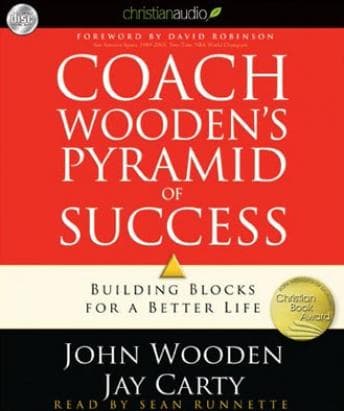

Everyone told me this was basically the self-help Bible for coaches and leaders. And technically, yeah, that's accurate - in more ways than one. What nobody warned me about was how much of this is literally biblical.
I picked this up on a Thursday after a particularly soul-crushing week of debugging a race condition that had been silently corrupting data for... let's not talk about it. Kevin suggested I listen to something "not about systems" for once. So I grabbed Coach Wooden's Pyramid of Success because I'd seen it referenced in like four different leadership books and figured it was time to go to the source. Finished it in two commutes plus a long grocery run. At 4.5 hours, this is a quick listen even at 1x.
The Pyramid Is a Framework - and I'm a Sucker for Frameworks
Here's the thing: the core structure is genuinely good engineering. Wooden breaks success into 32 building blocks arranged in a pyramid - industriousness and enthusiasm at the base, competitive greatness at the apex, with things like loyalty, cooperation, skill, and poise layered in between. Each block gets its own short chapter with a definition, Wooden's personal reflection, and then Jay Carty's companion piece.
If you've ever built a dependency graph, that's basically what this is. You can't have "competitive greatness" without first establishing "condition" and "skill," which themselves depend on "friendship" and "self-control" at the base. I actually respect the architecture here. Wooden wasn't just listing virtues - he was showing how they compound. The industriousness chapter specifically defines it not as "working hard" but as consistently doing what needs to be done without shortcuts, and the way he ties that to his father's farming stories from early 1900s Indiana hit different than the usual hustle-culture nonsense. The gratitude angle in Grateful Life takes a similarly grounded approach to virtue-building, though it leans on neuroscience instead of farming stories from Indiana.
The God Variable You Can't Ignore
Okay, so here's the part that'll be a dealbreaker for some of you. Each of the 32 readings includes Wooden's personal take followed by Carty's companion reflection, and Carty's sections lean HARD into Christian scripture. We're talking specific Bible verses, prayers at the end of each chapter, and explicit framing of the pyramid as a path to glorifying God.
I'm not religious. I went in expecting maybe a light spiritual seasoning. What I got was more like... the entire spice rack. Carty's sections sometimes feel like they're from a completely different book than Wooden's. Wooden tells a story about how he defined success for himself as a young teacher in 1934 because he was frustrated with how parents only cared about grades. That's fascinating. Then Carty pivots to a devotional that connects it to a specific passage from Proverbs. The tonal whiplash is real.
For Christian listeners, I imagine this works beautifully - it's the whole package. For the rest of us, you're essentially getting a 60/40 split: 60% timeless character-building wisdom from one of the greatest coaches who ever lived, 40% devotional material that you'll either connect with or mentally fast-forward through.
Sean Runnette at 1.5x Is Sean Runnette at Normal Speed
Runnette is an Earphones Award winner for a reason - the man is clean and professional. But his delivery here is slooow. That warm, folksy pacing that fits the grandfatherly wisdom vibe of Wooden's voice? At 1x, it had me zoning out on the morning train. Bumped it to 1.5x and suddenly it felt like a natural conversational pace. If you're used to listening at speed like I am, start at 1.25x minimum. At his default tempo, you'll be asleep before you hit Menlo Park.
The narration itself is solid - clear enunciation, no weird audio artifacts, consistent tone. But it's also pretty one-note. There's no real dynamic range between Wooden's anecdotes about Kareem Abdul-Jabbar's time at UCLA and Carty's devotional sections. Everything gets the same measured, reverent treatment. I found myself wishing for a little more punch during the basketball stories.
Who Should Queue This Up
Perfect for: Christian listeners who want faith-based personal development, basketball history nerds, anyone building a personal values framework. The pyramid structure itself is genuinely useful - I've seen engineering managers reference it in leadership docs.
Skip for: Anyone allergic to religious content (you'll spend half the book frustrated), people looking for tactical playbooks with action items, or listeners who need narrative momentum to stay engaged. This is 32 short devotional-style readings, not a story.
The ROI Calculation
TL;DR: The pyramid framework is worth knowing, and hearing it from Wooden himself (through Runnette) beats reading a Wikipedia summary. But at full credit price for 4.5 hours, with roughly 40% of the content being devotional material that won't land for secular listeners? The math doesn't quite work unless you're the target audience. I got maybe 2.5 hours of genuinely useful content out of it, which is fine for a commute background listen but not credit-worthy for me.
Could've been a blog post? No - the framework is legitimately deeper than a summary captures. But could've been a tighter audiobook without the co-author devotional padding? Absolutely.
Kevin asked me what I thought and I said: "Good framework, wrong delivery mechanism for me." He said that's how I describe most meetings at work too. He's not wrong.