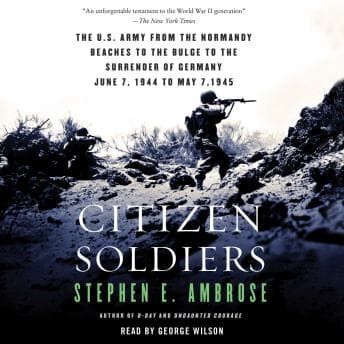

Ranger was asleep on the back seat somewhere outside San Antonio when I finally had to pause the audio and just... sit with it for a minute. Ambrose had just finished describing GIs in the Hürtgen Forest — men fighting in mud and snow so thick they couldn't see the guy next to them, casualties from trench foot outnumbering enemy fire some days. I've been cold and miserable in places I won't name. That passage hit somewhere specific.
Let me cut to the chase: this book is the real deal. Not perfect. But real.
The Part Where Ambrose Earns His Keep
What separates Citizen Soldiers from the usual WWII coffee-table history is the sourcing. Ambrose didn't reconstruct this from maps and after-action reports alone — he went and talked to the men. Hundreds of them. You get a sergeant from the 2nd Infantry describing exactly what it felt like to clear a hedgerow in Normandy, where every sunken field boundary was a pre-sighted German kill zone. You get a lieutenant colonel explaining the command paralysis that let the Germans regroup after the breakout at Saint-Lô. These aren't reconstructed composites. These are specific people, specific moments, specific failures and acts of extraordinary nerve.
I've seen this scenario play out in real life — not WWII obviously, but the dynamic Ambrose keeps returning to: the gap between what higher command thinks is happening and what the sergeant on the ground actually knows. He nails that tension without editorializing it to death. The author clearly did their homework, and then some.
The structure follows the campaign chronologically, June 7, 1944 through May 7, 1945 — D-Day plus one through V-E Day. Eleven months of grinding, brutal, often poorly-coordinated warfare across France, Belgium, Luxembourg, and into Germany itself. Ambrose doesn't shy away from the ugly parts: friendly fire incidents, the occasional breakdown in discipline, the sheer institutional chaos of moving a million-man army across a continent. If you've only read the sanitized version of WWII, this will recalibrate your expectations. The closest thing I've read to that same kind of institutional honesty about power, failure, and the gap between theory and reality is the Federalist Papers — different era, different war entirely, but the same unflinching look at what it actually takes to hold a republic together under pressure.
The Narrator Situation — Here's My Problem
George K. Wilson's delivery is clean and authoritative. He handles the battle descriptions well — good pacing, clear diction, doesn't rush the casualty figures or the quiet moments between engagements. For 21 hours and 46 minutes, that matters. You need someone who can sustain the weight of material like this without making it feel like a lecture.
But — and this is where it lost me, repeatedly — the mouth sounds. Lip smacking. Dry mouth clicks. Audible swallowing between sentences. At 1.25x it's actually slightly less noticeable because the gaps compress, but it's still there. On a long stretch of highway with good speakers, it's the kind of thing that pulls you out of a particularly intense passage about the Battle of the Bulge and reminds you that you're listening to a recording made in a booth somewhere. That's a problem. Not a dealbreaker, but a legitimate flaw in an otherwise solid performance. Wilson has the chops. The production team should've caught this in post.
No character voice differentiation either — but honestly, given that this is narrative history rather than dramatized fiction, I'm not docking him hard for that. You're not supposed to be doing voices for Eisenhower and Patton. The material doesn't call for it.
Who This Is For — And Who Should Probably Skip It
If you've already read Band of Brothers and D-Day and you want the campaign-level view that connects all those individual stories, this is exactly what you need. It fills in the operational context that the unit-level histories leave out. WWII enthusiasts, military history readers, anyone who's tried to understand why the Allies took so long to get from Normandy to Berlin — this is your book.
If you want fast-paced narrative with dramatic scene-setting and novelistic tension, look elsewhere. Ambrose is a historian first. Some sections — particularly the logistics chapters covering the supply crisis in late 1944 — are dense and will test your patience. My wife Linda would've bailed around hour six. That's not a criticism, that's just accurate intelligence about the terrain.
Mission accomplished, Ambrose. Ranger slept through most of it, but he was present for the Hürtgen Forest section, and I choose to believe that means something.







![Steve Jobs [unabridged audiobook] audiobook cover](/_next/image?url=https%3A%2F%2Fcovers.audiobooks.com%2Fimages%2Fcovers%2Ffull%2F9788499923406.jpg&w=1920&q=75)