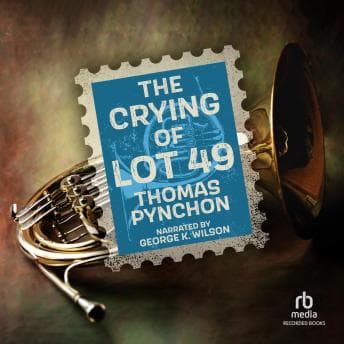

"One summer afternoon..." and already Pynchon is making a California housewife feel like the last sane person in a country built on codes, bad jokes, and mail routes. I started this audiobook while wiping down the kitchen after dinner - figured a short Pynchon might keep me company. Reader, I lasted maybe eight minutes before I had to stop, sit down, and actually listen. This is not a dishes book. This is a pencil-in-hand, stare-out-the-window, mutter-huh book.
What makes The Crying of Lot 49 such a strange little marvel is that Oedipa Maas is never allowed the dignity of a normal errand. She begins by trying to settle the estate of her dead ex, Pierce Inverarity, a real-estate mogul with the kind of name that sounds like Pynchon is already laughing at you. Then the world starts slipping sideways. Underground postal systems. Muted post horns. Jacobean revenge drama. Men named Max Fallopian and Gengis Cohen - names my students would assume I made up on a quiz to see if they were paying attention. They weren't. Oedipa is, mostly. Or she's trying to be.
And that's the trick of the book. It's not really asking, "Is there a conspiracy?" That's the bait. The real question is what happens to a mind - especially an intelligent, bored, underused mind - when it starts noticing patterns everywhere. This reminds me of what Hemingway said about the dignity of omission, except Pynchon takes the opposite road: overload the page, flood the signal, then make you decide what matters. The novel is short, but it does not feel small. It feels compressed, carbonated, a can shaken for 150 pages.
George K Wilson understands that tone better than a lot of narrators would. He doesn't play Pynchon like broad farce, which would've been fatal. He reads with this dry, slightly arch restraint - what one listener aptly called a "subtly lifted eyebrow." Exactly right. He lets the absurdity land without underlining it in red marker. So when Oedipa moves through Southern California collecting scraps of possible evidence, the comedy stays tethered to unease. You hear a woman trying to think clearly in a world that keeps turning into a pun.
The raised-eyebrow approach especially works with the names and the throwaway bits of lunacy. Max Fallopian sounds funny because Wilson trusts the name to do its own work. Gengis Cohen gets the same treatment. No cartoon mugging. No "look at me, I'm doing a weird book" performance. And for Pynchon, restraint is a kind of respect. The prose deserves to be savored. Not because it's pretty - Pynchon is too mischievous for simple prettiness - but because every sentence seems to have a second trapdoor under it.
The recording, though, is not spotless. You can hear the production seams. The chapter markers are apparently wrong, and yes, that matters more in a book like this than it would in some breezy thriller, because when you're trying to relocate a passage about Tristero or circle back to a clue, bad markers are maddening. Also - and I hate typing this because it sounds like parody - there are audible stomach grumbles between some sentences. Actual bodily rumblings. Worth pausing the faculty meeting for, though maybe not in the way we mean that as praise. Once I noticed it, I kept waiting for the next one like a tiny percussive accompaniment to paranoia.
So the audiobook becomes a slightly odd double experience: brilliant authorial control, pretty smart narration, and then these distracting little technical hiccups that remind you a human body was in the booth. Part of me almost admires that. Mostly, I wish somebody had edited more carefully.
Who should pick this up? If you've bounced off Gravity's Rainbow and want a smaller, sharper entry into Pynchon, this is probably the door. Six hours and change is manageable, though "manageable" here means intellectually, not casually. If you loved Kafka's bureaucratic dread but wished it had more California smog and postal symbolism, here you go. If you like books where the joke and the threat are the same thing, even better.
Who should skip? Anyone looking for clean plot delivery, emotional hand-holding, or good background company while folding laundry. My students would hate this. I love it. But I also had to rewind multiple times because one passing reference can become the whole book's hidden architecture twenty minutes later. The narrator helps, yet he can't make Pynchon less Pynchon, and honestly he shouldn't.
What stayed with me wasn't a single reveal - Pynchon is too slippery for that - but the feeling of Oedipa walking deeper into a system that may be secret history, may be elaborate nonsense, and may be the same thing. This is why we still read the classics, or the books circling classic status from a weirder orbit. They teach you how uncertainty sounds.
Just maybe borrow this version before you buy it. The novel is excellent. Though if you want something that goes down easier while you're still deciding how adventurous you feel, I reviewed Precious Gifts: A Novel a while back — lighter fare, nowhere near Pynchon's orbit, but I remember thinking it was a decent palate cleanser between more demanding reads. The audiobook is good, sometimes very good, and a little sloppier than the book deserves.