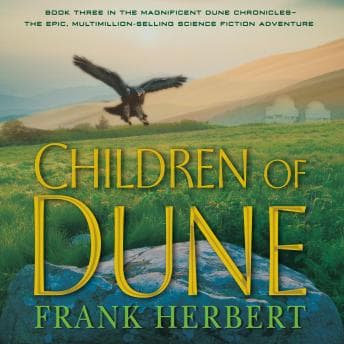

Okay, so here's the thing about Children of Dune: it's the audiobook equivalent of that one distributed system at work that's been running for years, does something critical, and nobody fully understands how it works anymore. You respect it. You're a little scared of it. And honestly? It took me like 5 commutes to really get into the groove.
I finished the first two Dune books last year (shoutout to Kevin for finally convincing me to stop being a fake nerd and actually read the source material), and this third one is where Herbert goes full galaxy-brain. If you haven't started the series yet, Dune: Book One in the Dune Chronicles is where you need to begin—trust me, jumping in here would be like trying to debug production without access to the logs. We're talking political intrigue wrapped in religious philosophy wrapped in ecological commentary wrapped in... more political intrigue. It's a lot. At 6AM on the Caltrain, surrounded by my fellow zombies, there were definitely moments where I zoned out and had to rewind. This is NOT a half-asleep listen. I'm warning you now.
The Narration Situation
This version has Scott Brick and Simon Vance splitting duties, and honestly? It's a mixed bag. Scott Brick is—and I will die on this hill—one of the best sci-fi narrators working today. He brought that same energy to Jurassic Park: A Novel, making Crichton's technical explanations feel like edge-of-your-seat thriller material instead of a biology lecture. The man gives Herbert's dense prose actual momentum. When he's narrating, the philosophical monologues about prescience and the Golden Path don't feel like homework. They feel like revelations. There's this scene where Leto II is contemplating his transformation (trying not to spoil, but if you know, you know) and Brick's delivery gave me actual chills. On a packed train. At 7:30AM. That's skill.
Simon Vance is... look, he's technically very good. The man has won approximately a billion Audie Awards for a reason. But his sections felt different to me. More detached? Some listeners online absolutely hate his British accent in the Dune universe and call it jarring—I didn't find it that distracting, but I get it. The Fremen are supposed to be these hardened desert warriors and then suddenly they sound like they're ordering tea at a London café. It's a choice. His character differentiation also isn't as sharp as Brick's, so during dialogue-heavy scenes I occasionally lost track of who was speaking. Not ideal when you're trying to follow Herbert's already-complex plotting.
16 Hours That Don't Drag (Mostly)
The pacing is where this audiobook really earns its keep. 16+ hours is a COMMITMENT, but the narrative passages genuinely don't drag. Herbert's prose is dense—we're talking paragraphs of internal monologue about the nature of power and humanity's relationship with its environment—but both narrators keep things moving. I never felt like I was stuck in quicksand (or... spice sand? Is that a thing?). The suspense builds properly, especially in the back half when everything starts converging.
One technical note: there are apparently some brief audio skips from the original tape digitization. I noticed maybe two or three in the latter half? They're like 1-2 seconds max. Mildly annoying but not deal-breaking. Just FYI if you're the type who gets pulled out of the story by production hiccups.
Who This Is (and Isn't) For
Listen if: You've done the first two books and want to continue the saga. You enjoy philosophical sci-fi that actually makes you think (this isn't popcorn entertainment, and that's the point). You're a commuter who wants something meaty enough to justify the 1.5x speed investment. Or you just appreciate world-building that treats you like an intelligent adult.
Skip if: You haven't read/listened to Dune and Dune Messiah—you will be completely lost. You need action-forward plotting (this is cerebral sci-fi, heavy on political maneuvering and light on space battles). Or if Simon Vance's style specifically bothers you (some people are very vocal about this), maybe sample first.
The Payoff Math
The ROI on this audiobook is high IF you're already invested in the series. It's the payoff for all that setup in the first two books. Leto and Ghanima are fascinating characters—these kids who carry the memories of all their ancestors and have to navigate being basically living gods while also being, you know, nine years old. Herbert does something really interesting with the tension between their ancient wisdom and their actual youth.
I finished this across maybe 10 commutes at 1.5x (dropped to 1.25x for the really dense philosophical bits—sue me). Would I recommend it? Yeah, but with caveats. This is graduate-level Dune. The science actually holds up in terms of the ecological themes, and Herbert was way ahead of his time thinking about how terraforming might backfire. But it requires your attention in a way that the first book didn't always demand.
Perfect for: Long commutes, flights, road trips where you're not driving. Skip for: gym sessions, anything where you need to split focus.
Queuing Up the Next 19 Hours
Now if you'll excuse me, I have God Emperor of Dune queued up and approximately 19 hours of sandworm content calling my name.