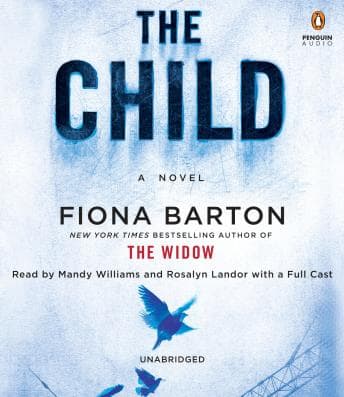

I made dal makhani last Tuesday — the kind that takes three hours and requires you to actually pay attention — and I still finished the whole audiobook before the lentils were done. That's either a comment on my cooking pace or Barton's pacing. Probably both.
The consensus on The Child seems to be: solid but not spectacular, a step up from The Widow, competent psychological suspense. And look, the consensus isn't wrong. But I think it undersells what Barton is actually doing here, which is less "whodunit" and more "how does a person become someone who does this." That's my territory. That's why I kept stirring the pot with one hand and turning up the volume with the other.
Three Women, One Buried Secret, Zero Simple Explanations
The premise is almost deceptively tidy: a skeleton found at a demolition site, a decades-old hospital baby abduction, journalist Kate Waters connecting the dots house by house. But what Barton is really building — and I mean this structurally — is a study in how trauma fragments identity across time. The three women at the center of this aren't just plot vehicles. They're case studies in how the same event produces completely different psychological architectures depending on where you were standing when it happened. What Alice Forgot does something adjacent with this — one woman, one fractured timeline, but the same core question of how identity survives when memory becomes unreliable.
I found myself asking: why does Angela — the woman I kept circling back to — maintain such a specific, almost curated version of her past? The research actually shows that false memory construction and selective narrative are how the mind protects itself from unbearable cognitive dissonance. Barton doesn't name that, but she writes it. The author understands human nature in the way that former journalists often do: not through theory, but through having sat across from people and watched them lie to themselves in real time. Her background as a crime reporter is all over this book's bones.
The protagonist exhibits classic compartmentalization — and what makes this character compelling is that Barton never tips her hand about whether the compartmentalization is pathological or survival. That ambiguity is doing a lot of work.
Five Voices, One Casting Problem
Five narrators for a book this intimate is an ambitious choice. Mostly it works. Mandy Williams carries the emotional weight of her sections with this particular quality of restrained grief — she doesn't perform the sadness, she just... holds it. That's harder than it sounds. Rosalyn Landor and Jean Gilpin bring a kind of worn-in credibility to their characters, the sense that these are women who have been living with something heavy for a long time.
And then there's the Katharine Lee McEwan situation. She's not a weak narrator — her pacing is actually quite good, her line readings are intelligent. But she's voicing Angela, who is sixty years old, and she sounds like she is emphatically not sixty years old. This is not a minor quibble. Angela's age is load-bearing. The specific texture of how a woman in her sixties has metabolized decades of grief and guilt is central to what makes her psychologically interesting. When the voice doesn't match, there's a constant low-grade friction — like reading subtitles that are slightly off from the dialogue. You adjust, but you're always adjusting.
Steve West handles the male perspective efficiently without distinction. He's fine. He's there.
The production itself is clean — no audio seams between narrators, transitions handled well — which matters more than people acknowledge in multi-narrator productions. Nothing pulled me out of the story on a technical level.
My Therapist Would Have Thoughts About Every Single Character Here
Here's where I land: The Child is not a perfect mystery. The pacing does sag in the middle third — there's a stretch around the neighborhood investigation sequences where Barton is laying pipe and you can feel it. The mystery mechanics are solid but not surprising to anyone who's spent time with this genre.
But the psychological architecture is genuinely interesting, and that's not nothing. This is a book about how women carry other people's secrets inside their own identities until the two become indistinguishable. That's a fascinating case study in what narrative psychology calls "narrative foreclosure" — when a person's story gets stuck at a particular moment and can't move forward. Barton doesn't resolve this neatly, which I appreciated more than I expected to.
If you need your mystery to move fast and hit hard, this isn't it. If you want to spend eleven hours with three women whose damage is specific and legible and sad in the way real damage is — with one casting caveat — this earns your time.