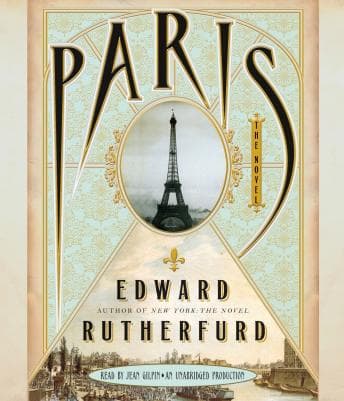

What happens when you give your heart to a city you've never actually walked through?
I've been to Paris exactly once, for three days in my twenties, and I spent most of it hungover and eating croissants on a bench near the Seine. But listening to this audiobook during a marathon week of logo redesigns and brand identity work, I felt like I'd lived there for centuries. Literally centuries. That's what 38 hours with Edward Rutherfurd does to you.
When a City Becomes Your Longest Relationship
Look, I knew what I was signing up for. Rutherfurd doesn't do quick flings—he does epic, generational love affairs. And Paris is exactly that. We're talking from the construction of Notre Dame (which hit different after 2019, let me tell you) all the way to the 1968 student revolts. Multiple families. Dozens of characters. Centuries of history threaded through births, deaths, affairs, and revolutions.
Here's the thing some listeners complained about: the non-linear timeline. And yeah, I get it. When you're bouncing from the 1890s to the 1600s to the Belle Époque and back again, keeping track of which Blanchard or Gascon you're following can feel like mental gymnastics. I actually started a little notes page on my phone—which family, which era, who's related to whom. But honestly? Once I surrendered to the rhythm of it, the jumping around started to feel intentional. Like Paris itself isn't linear. Cities layer their history on top of itself, and that's exactly how this book moves.
Jean Gilpin is Doing the Lord's Work
Thirty-eight hours. THIRTY-EIGHT HOURS. And Jean Gilpin carries every single one of them with this steady, warm authority that never once made me want to speed up or tune out. Her French pronunciations feel natural without being showy—she's not performing "I speak French, look at me," she's just... speaking the names correctly, the way you would if you loved them.
The character voices are distinct enough that even when I'd been away from the book for a day (Frida knocked my headphones off my desk and I lost momentum), I could usually figure out who was speaking within a few sentences. That's not nothing when you've got aristocrats and artists and revolutionaries and Nazi collaborators all sharing page space.
This is Not a Beach Read (And That's the Point)
I'm going to be honest with you: this audiobook requires your actual brain. It's not background listening while you scroll Instagram. It's not workout fuel. It's the kind of book you sit with during focused work sessions, or maybe on a long road trip where you're not also trying to navigate.
The payoff, though. MY HEART. There's a section during the Paris Commune that made me stop designing mid-stroke because I was crying too hard to see my screen. And the World War I chapters—Rutherfurd doesn't romanticize war, he shows you the specific, personal devastation of it through characters you've spent dozens of hours with by that point. When someone dies in this book, you feel it in your chest.
Abuela would have loved this one. She always said the best stories are the ones that make you feel like you've lived another life by the end. This book gave me about fifteen other lives, all tangled up in cobblestone streets and revolution and art and love affairs that span generations.
Skip This If You Want Fast—Stay If You Want to Feel Everything
If you want something fast and punchy, walk away. If you're looking for a single protagonist with a clear arc, this isn't it. If you can't commit to 38 hours, I understand—that's a relationship, not a date.
But if you want to fall in love with a city through the people who built it and burned it and rebuilt it again? If you want to feel the weight of history as something personal and lived rather than textbook-distant? If you have the patience for a slow burn that pays off in emotional devastation? This is your book.
My Heart Lives on the Left Bank Now
I finished this at 2 AM on a Tuesday, Diego purring on my chest and Frida judging me from the foot of the bed. I immediately wanted to book a flight to Paris. Not to see the tourist spots—to just walk the streets and think about all the people who walked them before me. That's what a good historical novel does. It makes the past feel like something you inherited. Homegoing did that same thing to me—made centuries of family history feel like my own memory.
Four crying sessions. One notes page. Thirty-eight hours I don't regret for a second.