
I was driving my daughter home from swim practice last Tuesday when Michael Boatman's voice first filled the car. Within ten minutes, she'd stopped scrolling her phone. By the time we pulled into the driveway, neither of us moved to get out. We just sat there in the dark garage, listening.
That's the kind of audiobook The Cay is.
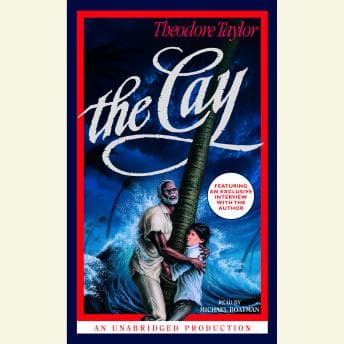
Theodore Taylor's 1969 survival story follows Phillip, a young white boy living on the Dutch island of Curaçao during World War II. When a German torpedo sinks the ship carrying him and his mother toward safety, Phillip wakes up blind, stranded on a raft with an elderly Black West Indian named Timothy and a cat named Stew. What unfolds over the next three hours is one of the most quietly devastating examinations of prejudice, dependency, and genuine human connection you'll find in children's literature.
But here's the thing about audiobooks: a great story can still fall flat with the wrong narrator. Michael Boatman doesn't just avoid that trap—he transforms the material into something that feels almost uncomfortably intimate.
Boatman's Timothy Will Wreck You
Boatman is a two-time Audie Award winner, and you understand why within the first few chapters. His Timothy is extraordinary. The lilting calypso intonation isn't performed like a dialect exercise; it breathes with the rhythm of someone who has lived in those words their whole life. When Timothy says "outrageous good" or patiently teaches the blind, frightened Phillip how to survive on their tiny cay, there's a warmth in Boatman's delivery that makes your chest tight.
The vocal contrast between characters works beautifully. Phillip starts out parroting his mother's casual racism, his voice carrying that particular brittleness of a child who thinks he understands the world. As the story progresses and his dependence on Timothy forces him to see—truly see—the man helping him survive, Boatman modulates the performance with remarkable subtlety. You hear Phillip's transformation before the text even spells it out.
Three Hours, Zero Wasted Minutes
At just under three hours, The Cay moves briskly, but Boatman never rushes the emotional beats. The quiet moments land with appropriate weight. When tragedy strikes late in the story, the narration doesn't oversell it. The restraint makes it hit harder.
The production itself is clean—no audio artifacts, no jarring edits, nothing to pull you out of the experience. As a bonus, this audiobook includes an interview with Theodore Taylor that provides fascinating context about how the story came together. It's the kind of extra that reminds you why audiobooks can offer something print simply can't.
A 1969 Book Tackling Race—What to Know
Some context for modern listeners: The Cay was written in 1969, and it tackles racial prejudice through the lens of a white protagonist learning to overcome his inherited biases. Some contemporary readers have questioned whether this approach centers the wrong perspective. That's a fair conversation to have. But Taylor's intent—and Boatman's interpretation—clearly aims to illuminate the ugliness of racism by showing how it crumbles under the weight of actual human relationship. The New York Times review from the book's release noted that the ethical purpose "permeates the whole book" without becoming a sermon. That still holds true.
For families, be aware that the story includes a ship torpedoing, the reality of Phillip's blindness, and the casual racism of 1940s attitudes (which the narrative explicitly challenges). These aren't gratuitous elements—they're central to what makes the book meaningful. But younger or sensitive listeners might benefit from a parent nearby for discussion.
Who This Is For (And Who Should Skip It)
If you loved Hatchet or Island of the Blue Dolphins, The Cay belongs on your list. I've found that same combination of survival stakes and deeper meaning in Automatic Millionaire, though it tackles financial dependency rather than physical. It's survival adventure filtered through something deeper—a story about what it means to truly depend on another person and what happens when prejudice meets reality. Commuters will find the length perfect for a week of drives. Parents looking for audiobooks to share with kids ages 10 and up will find rich material for conversation here.
Who might want to skip it? If you're looking for constant action or prefer stories that move at a relentless clip, The Cay's character-driven approach might feel slow. It's a quiet book, even when dramatic things happen.
Good Sad
My daughter and I finished it two days later, parked in the school pickup line. She was quiet for a long moment after the final chapter ended.
"That was really sad," she said finally. "But good sad."
Yeah. That about covers it.
Michael Boatman's narration earned an AudioFile Earphones Award, and it deserved every bit of that recognition. This is one of those audiobooks where the narrator elevates already strong source material into something that stays with you. The collision of worlds—Phillip's inherited prejudice meeting Timothy's patient dignity—comes alive through Boatman's voice in a way that reading alone might not achieve.
Sixty years after its publication, The Cay remains "one of the best survival stories since Robinson Crusoe," as The Washington Star once claimed. In audio form, with Boatman at the helm, it might be even better.